Before You Listen
Before You Listen
- Prerequisites: spinal cord injury (SCI) motor levels for C1-T1 (deltoid/biceps at C5, wrist extension at C6, triceps at C7, finger flexion at C8), pressure-injury risk over the ischial tuberosities and sacrum, and autonomic dysreflexia in T6-and-above SCI.
- Runtime: 1 hour 21 minutes.
- Topic in one line: the manual wheelchair weight ladder from depot to ultra-lightweight, the high-yield tilt-versus-recline distinction (tilt preserves hip angle and minimizes shear; recline opens hip angle and creates shear), the three power drive configurations matched to environment, the SCI-level control interface table from sip-and-puff at C1-C3 through a joystick at C6 (often with a modified handle) and a standard joystick below, the cushion hierarchy (foam < gel < honeycomb < air flotation, air as the conventional SCI answer), the propulsion biomechanics with axle position as the single most important parameter, and the diagnosis-driven prescription patterns including the posteriorly repositioned axle for bilateral lower extremity amputees.
Vignette. A 38-year-old man sustained a complete C6 American Spinal Injury Association (ASIA) A SCI 9 months ago. He has full deltoid, biceps, and wrist extension bilaterally but no active finger flexion. He is independent with sliding-board transfers. By end of day his shoulders ache and he cannot push up the modest hill from the parking lot to his apartment. He has had two superficial sacral pressure areas in 6 months on his current sling-seat depot wheelchair with a 2-inch foam cushion. His current chair weighs 42 pounds and the rear axle sits well behind his shoulder.
What single chair-design change is most likely to reduce his shoulder pain, what cushion category is the gold standard for his diagnosis and why, what push-rim modification matches his neurological level, and which power seating function addresses his sacral pressure history, and how is any future episode of autonomic dysreflexia managed?
(Answer at the end of this chapter)
Section 1: Manual Wheelchair Classification and Frame Design
Bottom line: manual wheelchairs are graded by weight from the 40-50 pound depot chair through the 30-35 pound lightweight to the under-30-pound ultra-lightweight; the depot wheelchair is for short-term institutional transport only; the rigid-frame ultra-lightweight is the gold standard for active full-time users because of its adjustability and the energy efficiency of a fixed frame.
The standard depot wheelchair weighs 40 to 50 pounds, is built of chrome-plated steel with a cross-brace folding frame, and has a sling seat, sling back, fixed axle position, and non-adjustable components. It is designed for short-term institutional transport, not daily mobility. Both the Paralyzed Veterans of America (PVA) Clinical Practice Guidelines and the Rehabilitation Engineering and Assistive Technology Society of North America (RESNA) consider prescription of a depot wheelchair for a full-time user to be suboptimal practice.
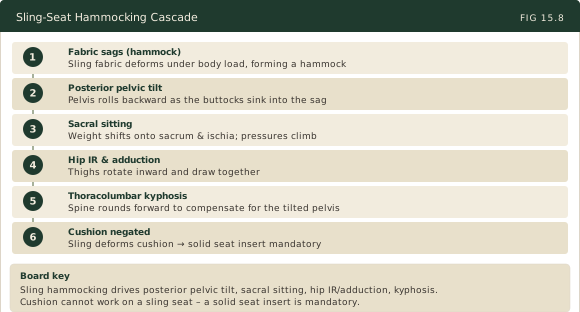
The biomechanical price of the sling seat is steep. As fabric sags under load, it creates a hammocking effect that drives the user into posterior pelvic tilt, sacral sitting, hip internal rotation and adduction, and thoracolumbar kyphosis. Sacral and ischial pressures climb. The clinical rule that follows is one of the cleanest in seating: a wheelchair cushion placed on a sling seat cannot function because the sling deforms under load and negates the cushion’s pressure-redistribution properties. Any patient receiving a specialized cushion needs a solid seat insert.
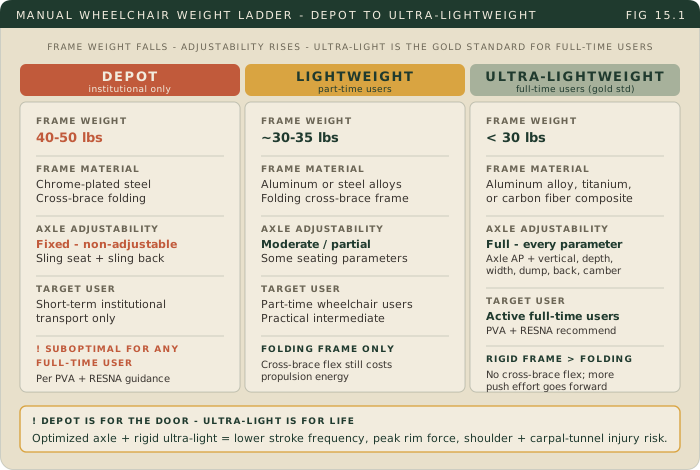
The lightweight wheelchair (about 30 to 35 pounds, aluminum or steel alloys with moderate adjustability) is a practical intermediate option for part-time wheelchair users. The ultra-lightweight wheelchair (under 30 pounds, aluminum alloy, titanium, or carbon fiber composite) is the gold standard for full-time users. Its defining feature is extensive adjustability across every seating and axle parameter: rear axle position (anteroposterior and vertical), seat depth, width, height, and angle (the dump or squeeze, usually set at about 5 degrees of posterior seat slope; more slope presses the pelvis back into the backrest for stability, and too much of it closes the hip angle, rolls the pelvis posteriorly and reproduces the sacral-pressure-and-shear cascade of a sling seat), back height and angle, footrest length and angle, and camber angle. Ultra-lightweight chairs come in rigid (fixed-frame) and folding configurations. The rigid frame is more energy-efficient because it eliminates the energy lost to frame flex at the cross-brace hinge, transferring more push effort into forward motion. For active full-time users, a rigid-frame ultra-lightweight is preferred. Clinical evidence shows ultra-lightweight chairs with optimized axle position reduce stroke frequency, decrease peak push-rim forces, and improve mechanical efficiency, with long-term reduction in shoulder impingement, rotator cuff injury, and carpal tunnel syndrome risk.
Sport wheelchairs share the rigid-frame architecture and add aggressive features for athletic competition. Increased wheel camber (15 to 20 degrees across the court sports — basketball, rugby, and tennis) tilts the tops of the wheels inward, widening the wheelbase at the floor for lateral stability, lowering the center of gravity, and positioning the push rims at a more ergonomic angle that reduces valgus stress on the wrists. Within that range, about 18 degrees performs best in trained athletes, while 24 degrees costs both speed and oxygen economy. The trade-off is wider overall chair width. Racing chairs carry camber up to about 15 degrees, chosen for straight-line tracking and stroke access to the push rim, while court-sport chairs run steeper, around 18 degrees, for maneuverability. Racing wheelchairs use a three-wheel configuration with extreme forward lean and compensator steering (chin- or head-activated) so both hands stay free for propulsion.
High Yield; Manual wheelchair classification
- Depot: 40-50 lbs, chrome steel, sling seat, fixed axle, NON-adjustable. Institutional only. Suboptimal for any full-time user.
- Lightweight: ~30-35 lbs, aluminum, moderate adjustability. Part-time users.
- Ultra-lightweight: <30 lbs, aluminum/titanium/carbon fiber, FULL adjustability. Gold standard for full-time users; PVA + RESNA recommend.
- Rigid frame > folding frame for energy efficiency (no cross-brace flex).
- Sling seat = hammocking = posterior pelvic tilt, sacral sitting, hip IR/adduction, kyphosis. Cushion on sling seat cannot work, solid seat insert is mandatory.
- Sport chairs: rigid frame, 15-20 degrees of camber for the court sports (about 18 degrees performs best); racing chairs run up to about 15 degrees for straight-line tracking. Racing = three-wheel with compensator steering.
Mnemonic; Depot is for the door, ultra-light is for life
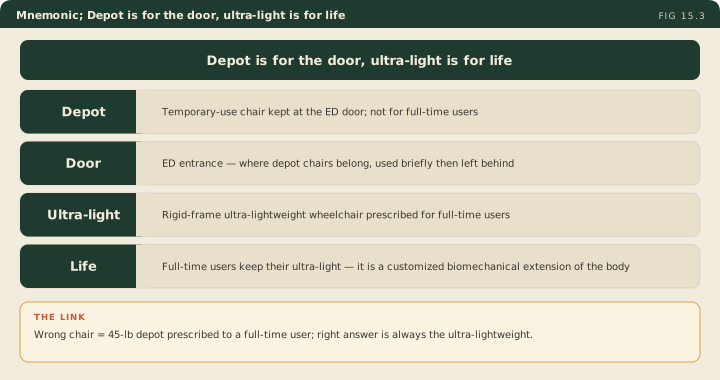
The depot chair belongs at the door of the ED for a temporary trip. The ultra-light belongs to the user for life. If the stem describes a full-time user being prescribed a 45-pound depot chair, the answer is “wrong chair”, the prescription should be a rigid-frame ultra-lightweight.