Before You Listen
Before You Listen
- Prerequisites: the Trendelenburg mechanism and hip abductor biomechanics, the spinal cord injury (SCI) motor levels through C8-T1 (especially wrist extension at C6 and finger flexion at C7-T1), the radial nerve and brachial plexus anatomy at the level of the axilla, and total hip arthroplasty (THA) posterior-approach precautions (no hip flexion beyond 90 degrees, no adduction past midline, no internal rotation).
- Runtime: 50 minutes.
- Topic in one line: the contralateral cane principle that drops hip joint reaction force by ~40-60%, the three crutch types matched to clinical niche (axillary for temporary use, forearm/Lofstrand for long-term, platform for inability to bear weight through wrists), the walker stability-versus-speed ladder, the five standard gait patterns from four-point through swing-through, the weight-bearing status definitions and matched devices, the post-THA adaptive-equipment package, and the SCI orthosis-by-level summary anchored by the C6 tenodesis splint.
Vignette. A 72-year-old woman with severe right hip osteoarthritis presents 6 weeks after an uncomplicated right posterior total hip arthroplasty (THA). She lives alone and was independent in all activities of daily living (ADLs) before surgery. Her surgeon has cleared her for weight-bearing as tolerated (WBAT). She demonstrates a Trendelenburg gait on the right and reports difficulty putting on socks and shoes and pain at the right hip with deep squatting to the toilet. She also reports a near-fall when she tried to use her late husband’s cane in her right hand “to take the weight off the bad hip.”
In which hand should the cane be held and what is the approximate reduction in hip joint reaction force, what three pieces of adaptive equipment most directly address her THA precautions, and what is the appropriate weight-bearing status terminology and the assistive device that matches it?
(Answer at the end of this chapter)
Section 1: Canes — Biomechanics, Types, and Fitting
Bottom line: canes and single crutches are held in the hand OPPOSITE the affected lower extremity; this contralateral placement reduces hip abductor force demand by ~50% and drops the affected hip joint reaction force by ~40-60%; the standard single-point cane offloads ~20-25% of body weight; quad canes (small-base and large-base) trade gait speed for lateral stability; proper fitting puts the handle at the level of the greater trochanter or ulnar styloid with 20-30 degrees of elbow flexion.
Ambulatory assistive devices serve three primary functions: widening the patient’s base of support, reducing weight bearing through a painful or healing lower extremity, and compensating for a neurological balance deficit. The stability hierarchy from least to most supportive runs single-point cane, quad cane, forearm crutch, axillary crutch, hemi-walker, rolling walker, standard pickup walker. Stability and functional independence do not correlate linearly, because the most stable devices also impose the slowest gait speeds and the greatest upper extremity metabolic demands. Maximum stability is never the default prescription. Overprescribing a standard walker to a patient with mild unilateral knee osteoarthritis destroys their reciprocal gait pattern, forces a start-and-stop step-to sequence, and exhausts the upper extremities without medical benefit. The clinician matches the mechanical assistance to the exact clinical deficit, nothing more.
Canes and single crutches are held in the hand OPPOSITE the affected lower extremity. During single-limb stance on the affected side, the hip abductors (primarily gluteus medius) generate force to counteract the body-weight moment acting medial to the hip joint center, producing a total joint reaction force of approximately 2.5 to 3 times body weight during normal gait. A cane in the contralateral hand extends a long external lever arm laterally from the body’s center of gravity; the downward force on the cane generates a powerful countermoment that reduces abductor force demand by approximately 50% and total hip joint reaction force by approximately 40 to 60%. An ipsilateral cane is less effective because the lever arm to the affected hip is shorter. The cane advances simultaneously with the affected leg so that the device and the painful limb strike the ground at the same millisecond and share the vertical load.
The standard single-point cane is the most commonly prescribed ambulatory assistive device. It reduces weight bearing by approximately 20 to 25% of body weight, is held in the contralateral hand, and advances with the affected leg. Indications include mild balance impairment, mild-to-moderate hip or knee osteoarthritis, and antalgic gait. The quad cane has a four-legged base with greater lateral stability and freestanding capability but the same vertical offload as a single-point cane. The small-base quad cane (SBQC) has closely spaced legs for moderate lateral stability and fits onto standard stair treads, a meaningful in-home advantage. The large-base quad cane (LBQC) has widely spaced legs for the maximum cane lateral stability available from a one-handed device but interferes with foot placement, slows gait, and cannot safely sit on a stair step. The flared side of the quad cane base must face AWAY from the patient’s body; if the flared legs face inward, the advancing foot will clip the metal legs and produce a fall. Quad canes are commonly prescribed after stroke when the patient needs more lateral support than a single-point cane provides but does not require a walker. The offset cane has a handle bent forward in a swan-neck shape; the user’s downward grip force aligns directly over the cane tip on the floor, eliminating the slight bending moment of a traditional crook-handle cane and producing clean straight-line load transfer through the shaft.
Proper cane fitting follows a fixed geometry. The patient stands erect with shoes on. The cane tip is placed approximately 6 inches lateral and 6 inches anterior to the small toe. The handle height should allow 20 to 30 degrees of elbow flexion, which corresponds anatomically to the greater trochanter of the femur or the ulnar styloid process at the wrist when the patient’s arm hangs naturally at the side. A cane that is too long forces the patient to hike the shoulder into a shrug with every step, producing trapezius spasm, rotator cuff impingement, and chronic cervical pain over a thousand steps a day. A cane that is too short forces excessive trunk flexion, strains the lumbar erector spinae, and compresses the anterior intervertebral discs. A poorly fitted cane is a mechanism of injury rather than an assistive device.
High Yield — Canes
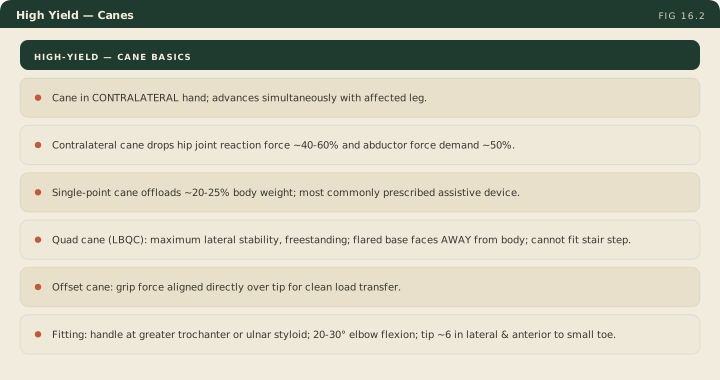
- Cane in the CONTRALATERAL hand; advances simultaneously with the affected leg.
- Hip joint reaction force drops by ~40-60% with contralateral cane; abductor force demand drops by ~50%.
- Single-point cane = ~20-25% body weight offload; the most commonly prescribed assistive device.
- Quad cane (LBQC) = maximum cane lateral stability; freestanding; flared base faces AWAY from body; slows gait, cannot fit a stair step.
- Offset cane = grip force aligned directly over the tip for clean load transfer.
- Fitting: handle at the greater trochanter or ulnar styloid; 20-30 degrees of elbow flexion; tip ~6 inches lateral and ~6 inches anterior to the small toe.
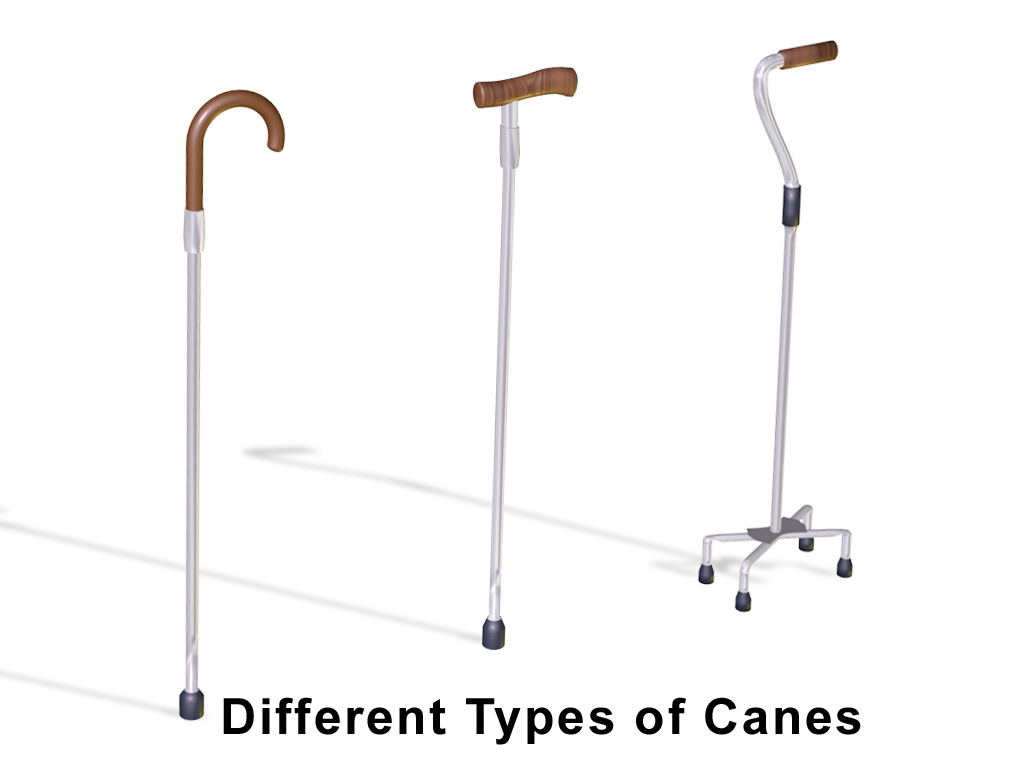
Source: BruceBlaus, “Home Care Cane Types”, CC BY-SA 4.0. https://commons.wikimedia.org/wiki/File:Home_Care_Cane_Types.png
I always picture it like a crane with a massive counterweight. The hip joint is the pivot point or the fulcrum of the crane. If you put the counterweight, which is the cane, far out on the opposite side, it balances the load effortlessly.
— PO-16 podcast, ~4:59