Before You Listen
Episode Setup
- Topic in one line: the adaptive driving triad (hand controls for bilateral lower extremity impairment, left-foot accelerator for right lower extremity impairment, spinner knob for one-handed steering); the Certified Driver Rehabilitation Specialist (CDRS) as the appropriate evaluator for return-to-driving; the environmental control unit (ECU) access ladder that scales with SCI level (sip-and-puff and eye gaze for C1-C3, head tracking and voice for C4, direct manual access for C5 and below); the four Medicare durable medical equipment (DME) coverage criteria; and the integrated post-THA equipment package answering the vignette.
- Prerequisites: Part 1 of this episode (canes, crutches, walkers, gait patterns, weight-bearing status, environmental modifications, ADL equipment, and the SCI orthosis hierarchy through C8-T1), the SCI motor levels with particular attention to C1-C3 (no extremity movement), C4 (diaphragm-intact, head/neck control), C5 (deltoid and biceps), and C6 (wrist extension and tenodesis grasp), and Total Hip Arthroplasty (THA) posterior-approach precautions (no hip flexion beyond 90 degrees, no adduction past midline, no internal rotation).
- Runtime: 22 minutes.
Vignette. A 72-year-old woman with severe right hip osteoarthritis presents 6 weeks after an uncomplicated right posterior total hip arthroplasty (THA). She lives alone and was independent in all activities of daily living (ADLs) before surgery. Her surgeon has cleared her for weight-bearing as tolerated (WBAT). She demonstrates a Trendelenburg gait on the right and reports difficulty putting on socks and shoes and pain at the right hip with deep squatting to the toilet. She also reports a near-fall when she tried to use her late husband’s cane in her right hand “to take the weight off the bad hip.”
In which hand should the cane be held and what is the approximate reduction in hip joint reaction force, what three pieces of adaptive equipment most directly address her THA precautions, what is the appropriate weight-bearing status terminology and the assistive device that matches it, and which professional should evaluate her before she returns to driving?
(Answer at the end of this chapter)
Section 1: Adaptive Driving Equipment — The Mechanical Triad
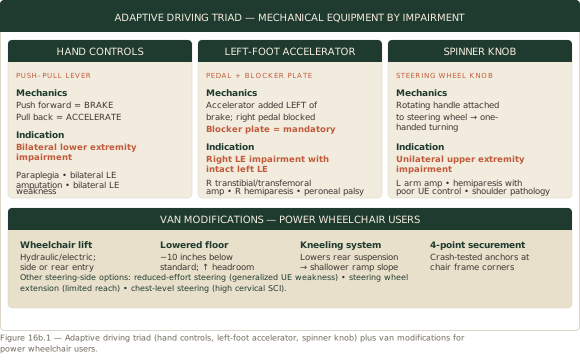
Bottom line: three pieces of adaptive driving equipment cover the vast majority of disability driving prescriptions; hand controls for bilateral lower extremity impairment (paraplegia, bilateral lower extremity amputation, bilateral lower extremity weakness); a left-foot accelerator with a blocker plate over the disabled right pedal for right lower extremity impairment with intact left lower extremity function; a spinner knob (steering knob) on the steering wheel for one-handed steering when one upper extremity is impaired. Van modifications scale up for power wheelchair users and include lifts, lowered floors, kneeling systems, and four-point securement.
Driving is one of the most important functional outcomes for adults with new physical disability, and adaptive driving equipment matches the specific pattern of impairment. Hand controls are the foundational device for bilateral lower extremity impairment. They operate the accelerator and brake through hand-operated levers mounted on or near the steering column rather than through foot pedals. The most common system is the push-pull configuration: pushing the lever forward activates the brake, and pulling it back activates the accelerator. The system is indicated whenever both lower extremities are insufficient to operate the standard pedals reliably and safely, including paraplegia, bilateral lower extremity amputation, and bilateral lower extremity weakness from conditions such as advanced peripheral neuropathy, muscular dystrophy, or post-polio syndrome. Bilateral lower extremity impairment is the prototypical hand-control indication on the boards.
The left-foot accelerator addresses the asymmetric case: a patient whose right lower extremity cannot reliably operate the accelerator but whose left lower extremity is intact. A supplemental accelerator pedal is installed on the left side of the brake, and the original right-side accelerator is blocked or removed with a metal plate so that the patient cannot accidentally depress both pedals simultaneously. The classic board scenario is a right transtibial or transfemoral amputation, a right hemiparesis after stroke (when the leg is the limiting factor), or right lower extremity weakness from a peripheral nerve injury such as common peroneal palsy. The blocker plate is the safety feature most worth remembering, because driving with both accelerators active is dangerous.
The spinner knob, also called the steering knob, is a rotating handle attached to the steering wheel that allows the patient to turn the wheel one-handed by gripping the knob and rotating it. The indication is unilateral upper extremity impairment with intact contralateral upper extremity function, classically a left arm amputation, a hemiparesis with poor affected-side upper extremity control, or severe shoulder pathology that prevents full two-handed steering. Other steering-side modifications that may appear on the boards are reduced-effort steering for upper extremity weakness, a steering wheel extension for limited reach, and chest-level steering for high cervical SCI patients whose shoulders cannot lift hands to the standard wheel position.
For patients who drive from a wheelchair, van modifications transform a standard vehicle into a wheelchair-accessible platform. Side-entry or rear-entry wheelchair lifts (hydraulic or electric) raise the patient and chair into the cabin. Lowered floors (roughly 10 inches below the standard floor) raise the headroom and allow the patient to remain seated in the wheelchair behind the steering wheel. Kneeling systems lower the rear suspension to reduce the slope of the entry ramp. Four-point wheelchair securement systems tie down the wheelchair frame at four corners with crash-tested anchors, preventing the chair from sliding or tipping during sudden stops or collisions. The combined van conversion is expensive, often more than the vehicle itself, but is the only way for many high-level SCI patients to drive independently.
Adaptive driving equipment is not a do-it-yourself prescription. The physiatrist identifies the candidate and refers, but the comprehensive evaluation and equipment selection happen elsewhere, with the Certified Driver Rehabilitation Specialist as discussed in Section 2. The board takeaway from this section is the mechanical triad: bilateral lower extremity impairment gets hand controls, right lower extremity impairment gets a left-foot accelerator with a right-pedal blocker, unilateral upper extremity impairment gets a spinner knob.
 ::: {.callout-important}
## High Yield — Adaptive driving equipment
::: {.callout-important}
## High Yield — Adaptive driving equipment
- Hand controls (push-pull) = bilateral LE impairment (paraplegia, bilateral LE amputation, bilateral LE weakness); push forward = brake, pull back = accelerator.
- Left-foot accelerator = right LE impairment with intact left LE; blocker plate over the right-side accelerator is mandatory for safety.
- Spinner knob (steering knob) = unilateral UE impairment requiring one-handed steering.
- Reduced-effort steering = generalized UE weakness; chest-level steering = high cervical SCI.
- Van mods: wheelchair lift (side/rear entry), lowered floor (~10 in), kneeling system, four-point securement. :::
The original right side accelerator gets blocked or physically removed with a solid metal plate. You do not just ask the patient to avoid stepping on it. You physically block it.
— PO-16 podcast, ~6:09
Well, when you place a cane in the opposite hand and push down into the floor, that cane creates an upward force. And because the cane is extending laterally from your center of gravity, it sits at the extreme end of a very long lever arm. So it is essentially functioning like a seesaw.
— PO-16 podcast, ~1:32