Before You Listen
Episode Setup
- Topic in one line: The consolidated complications playbook for prosthetics, orthotics, and mobility equipment — residual-limb skin complications (contact dermatitis, folliculitis, hyperhidrosis, choke syndrome from proximal restriction with distal void, verrucous hyperplasia treated with total contact and compression not excision), phantom limb pain and phantom sensation (epidemiology, short residual limb as a risk factor, why congenital amputees do NOT typically develop phantom pain, a stepped treatment approach built from the VA/DoD recommendations), symptomatic residual-limb neuroma (Tinel sign, ultrasound-guided diagnostic block, secondary TMR/RPNI), bone complications (heterotopic ossification in combat vs civilian, distal bony spurs, the adult-vs-pediatric terminal bony overgrowth distinction and joint disarticulation prevention in pediatrics), contractures (hip flexion in transfemoral, knee flexion in transtibial, plantar-flexion equinus after Chopart from loss of dorsiflexor insertions), falls in prosthesis users (~50% annual incidence, MPK reduces falls 60-80%), adjacent-limb overuse (contralateral knee OA 41-63% in TF, low back pain, wheelchair shoulder), cardiovascular mortality (5-year mortality 60-65% pooled, lower in contemporary US data), mental health (depression 20-35%, PTSD 23-65% in trauma amputees), and venous thromboembolism (9-13% rate, LMWH prophylaxis). It also covers device-specific and iatrogenic complications: osseointegration infection, powered-prosthesis failure modes, orthotic and halo-vest complications, wheelchair pressure injury, and adverse-event reporting.
- Prerequisites: the surgical principles framework from PO-03 (myodesis vs myoplasty, TMR/RPNI primary technique, post-op residual-limb management); transtibial pressure-tolerant vs pressure-sensitive areas from PO-04 (with peroneal nerve at the fibular head as the classic complication); transfemoral adductor myodesis from PO-05; the advanced-technology overview from PO-10 (MPK, OPRA/POP, TMR); pediatric terminal bony overgrowth from PO-12; K-level and energy-expenditure framework from PO-14; wheelchair propulsion biomechanics from PO-15; and crutch palsy from PO-16.
- Runtime: 56 minutes.
- Series position: This is the final episode of the PO series, closing the 17-episode arc.
Vignette. A 58-year-old man is 8 months out from a right transtibial amputation for dysvascular complications of type 2 diabetes (HbA1c 8.4%, ABI 0.42 pre-amputation). He has been wearing a patellar-tendon-bearing (PTB) socket with a silicone gel liner and one cotton sock layer for 4 months. He presents to your clinic with a 3-week history of a deep, dull aching pain at the very distal end of his residual limb that is worst at the end of the day, accompanied by visible distal swelling that he describes as “puffy and discolored.” On examination the distal residual limb shows pitting edema with a peau-d’orange skin texture and several small papillomatous lesions over the most distal 2 cm. Proximally his socket leaves a clear ring impression around the patellar tendon and tibial tuberosity. He has also had two falls in the past month, both occurring when his foot felt “loose” during community ambulation. He asks why his foot keeps slipping inside the socket.
Identify the residual-limb complication producing the distal pitting edema and papillomatous lesions, explain the underlying socket mechanism responsible, describe the canonical first-line treatment principle, classify his socket-fit symptom (foot loose in the socket during ambulation), discuss his annual fall risk and how a microprocessor-controlled component would affect it if he were a transfemoral patient, and identify one cardiovascular risk-stratification step that should occur given his amputation etiology.
(Answer at the end of this chapter)
Section 1: Residual-Limb Skin Complications
Bottom line: the socket-skin interface produces a predictable set of complications. Verrucous hyperplasia (warty papillomatous distal-limb skin from loss of total contact plus distal venous obstruction) and choke syndrome (acute distal congestion when the proximal socket constricts and the distal end has no contact) share a common pathophysiology and are treated by restoring total contact plus compression, never excision. Contact dermatitis (most often allergic to liner adhesive or detergent), folliculitis (Staph from sweat and occlusion, worse with shaved skin under suspension sleeves), hyperhidrosis (excessive sweat causing pistoning, slippage, and skin maceration; treated stepwise with topical aluminum chloride first, intradermal botulinum toxin second, and systemic glycopyrrolate reserved for refractory cases), and intertrigo (deep-flexure friction-and-moisture inflammation) round out the differential.
The socket-skin interface is the most clinically active complication zone in prosthetics. The mechanical environment is unforgiving: cyclic compression, shear, sweat occlusion, and venous-return interference operate continuously, and the residual-limb skin must tolerate forces that no other patch of skin in the body experiences daily. Two distinct mechanisms produce most of the complications you will see in clinic.
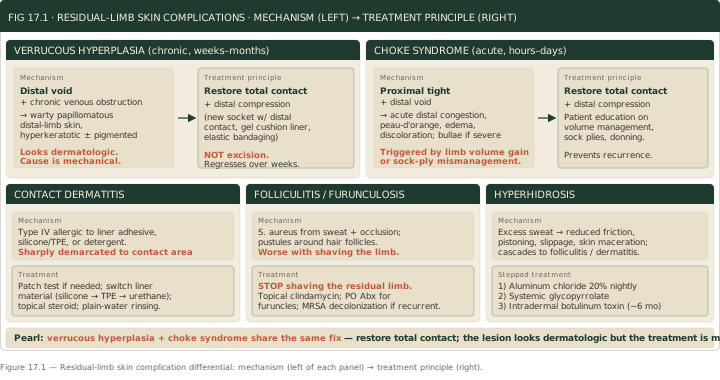
Verrucous hyperplasia is wart-like papillomatous thickening of the distal residual-limb skin, often hyperkeratotic and sometimes pigmented, that develops over weeks to months in patients whose socket fit allows a distal void (the socket does not make full contact with the most distal end of the limb). The mechanism is chronic distal venous obstruction: the proximal socket creates a tourniquet effect while the distal end has no compressive contact to assist venous return, and chronic distal congestion drives papillomatous epidermal proliferation. Treatment is not excision. Treatment is restoring total contact, meaning a new socket with full distal contact, often combined with elastic bandaging or a gel-filled distal-cushion liner. With proper total contact, the lesions typically regress over weeks to months. This is one of the most board-tested concepts in P&O complications: the lesion looks dermatologic but the treatment is mechanical.
Choke syndrome shares the same pathophysiology in acute form. When a previously well-fitting socket becomes proximally restrictive (often from residual-limb volume gain, sock-ply mismanagement, or new edema) while the distal end loses contact, the resulting pattern is proximal tight plus distal void, which produces venous obstruction with acute distal congestion, peau-d’orange skin, edema, and discoloration. Severe cases progress to bullae and ulceration. Treatment is the same principle as for verrucous hyperplasia: restore total contact and add distal compression. Patient education on volume management (sock plies, donning technique) prevents recurrence.
Contact dermatitis in residual limbs is most often allergic (delayed type IV hypersensitivity) to a component of the liner system, including the adhesive, the silicone or thermoplastic elastomer (TPE) itself, or residual detergent. Irritant contact dermatitis from sweat-trapping is also common. The lesion is sharply demarcated where the offending material contacted the skin, which is the most useful bedside discriminator from a diffuse infectious rash. Treatment requires identifying the allergen (patch testing if needed), switching liner material (silicone gel to TPE to urethane), topical corticosteroids during flares, and meticulous liner hygiene with thorough plain-water rinsing.
Folliculitis and furunculosis in the socket environment are most often Staphylococcus aureus, exacerbated by occlusion, sweat, and shaving of the residual-limb skin. Shaving under a suspension sleeve introduces micro-trauma at every hair follicle and predisposes to infection. The intervention is to stop shaving the residual limb (let hair grow), improve liner hygiene, and treat with topical clindamycin or oral antibiotics for furuncles. Methicillin-resistant S. aureus (MRSA) decolonization may be warranted in recurrent cases.
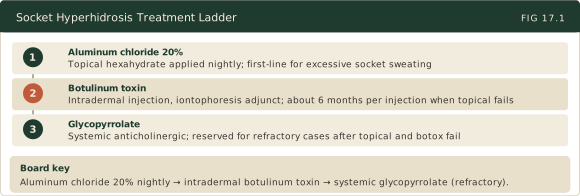
Hyperhidrosis is excessive sweating into the socket. Beyond the cosmetic and odor concerns, sweat reduces friction between skin and liner, producing pistoning, slippage, and skin maceration, and frequently triggering a cascade to folliculitis and contact dermatitis. The stepped treatment is topical aluminum chloride hexahydrate 20% nightly first, then intradermal botulinum toxin (with iontophoresis as an adjunct) for cases that fail topical therapy, effective for roughly 6 months per injection, and systemic glycopyrrolate reserved for refractory cases after topical and botulinum toxin have failed. Intertrigo and epidermoid (inclusion) cysts complete the differential for the boards: intertrigo is friction-and-moisture inflammation in deep socket-skin folds (treat with barrier creams, antifungals if Candida is present); inclusion cysts develop when repeated mechanical loading plugs sebaceous glands and follicles with keratin (excision for symptomatic cysts; ignore asymptomatic ones).
 ::: {.callout-important}
## High Yield — Residual-limb skin complications
::: {.callout-important}
## High Yield — Residual-limb skin complications
- Verrucous hyperplasia = warty papillomatous distal-limb skin from distal void plus chronic venous obstruction. Treatment = restore total contact plus compression, NOT excision.
- Choke syndrome = acute distal congestion from proximal tight plus distal void; peau-d’orange, edema, discoloration. Treatment = same principle (restore total contact).
- Contact dermatitis is usually allergic to liner adhesive/material; sharply demarcated to the contact area. Switch liner material plus topical steroid.
- Folliculitis = Staph aureus, worse with shaving; tell the patient to stop shaving the residual limb.
- Hyperhidrosis ladder: aluminum chloride 20% then intradermal botulinum toxin (iontophoresis as adjunct) then systemic glycopyrrolate.
- Intertrigo in deep folds; epidermoid cysts from repeated mechanical loading plugging sebaceous glands and follicles with keratin. :::
You get a new socket that actually touches the distal limb. You add a gel-filled distal cushion liner to provide that missing counter pressure. And you use elastic bandaging to assist venous return.
— PO-17 podcast, ~5:37