Before You Listen
Episode Setup
- Topic in one line: the velocity-dependent definition of spasticity (Lance 1980) that distinguishes it from rigidity, dystonia, and clonus; the Modified Ashworth Scale and the Tardieu Scale R1-R2 framework that separates dynamic neural spasticity from fixed contracture; the seven-step management ladder from removal of noxious stimuli through orthopedic surgery; the four oral antispasticity agents (baclofen, tizanidine, dantrolene, diazepam) and their American Academy of Neurology (AAN) evidence levels per the 2010 Delgado practice parameter; botulinum toxin type A (BoNT-A) SNAP-25 mechanism with the rule of threes; phenol nerve neurolysis for pure motor targets; intrathecal baclofen (ITB) trial physiology and the dual emergencies of withdrawal and overdose; and selective dorsal rhizotomy (SDR) candidate selection.
- Prerequisites: the upper motor neuron (UMN) syndrome with positive and negative phenomena, basic spinal reflex circuitry including the Ia inhibitory interneuron, and the corticospinal tract anatomy from BASIC and NEURO.
- Runtime: 39 minutes.
Vignette. A 38-year-old man with a C6 incomplete spinal cord injury (SCI) sustained four years ago is referred to your spasticity clinic. He uses a manual wheelchair and is independent with self-catheterization. He reports worsening hip adductor scissoring that interferes with perineal hygiene and intermittent painful nocturnal flexor spasms. He is currently taking oral baclofen 20 mg four times daily and oral tizanidine 4 mg three times daily. Six weeks ago his primary care provider added oral ciprofloxacin for a urinary tract infection; the next morning he was found unresponsive and hypotensive. On examination today he has Modified Ashworth Scale 3 at the bilateral hip adductors and 2 at the gastrocnemii, with a Tardieu R2-R1 difference of approximately 30 degrees at both ankles and 25 degrees at the adductors. There are no fixed contractures.
What was the mechanism of his hospitalization, what does the Tardieu R2-R1 gap tell you about the responsiveness of his spasticity to chemodenervation, what focal intervention is best matched to his pure-motor adductor target, and what generalized intervention sits at step six of the spasticity management ladder for an SCI patient with this functional profile?
(Answer at the end of this chapter)
Section 1: The Lance Definition, the UMN Syndrome, and Mimics
Bottom line: the Lance 1980 definition frames spasticity as a velocity-dependent increase in tonic stretch reflexes with exaggerated tendon jerks, one component of the upper motor neuron syndrome; velocity-dependence is the single most tested distinction on the boards because it separates spasticity from rigidity (velocity-independent, lead-pipe), from dystonia (sustained co-contraction with active twisting posture), and from clonus (rhythmic 5-7 Hz oscillation provoked by sustained stretch); positive UMN phenomena (spasticity, hyperreflexia, clonus, Babinski sign, flexor and extensor spasms) coexist with negative phenomena (weakness, fatigue, loss of dexterity) and treating the positive can unmask the negative.
The Lance 1980 definition is the keystone of every board question on tone. Spasticity is “a motor disorder characterized by a velocity-dependent increase in tonic stretch reflexes (muscle tone) with exaggerated tendon jerks, resulting from hyperexcitability of the stretch reflex as one component of the upper motor neuron syndrome.” Every word is testable, but the operative phrase is velocity-dependent. If passive limb resistance increases with the speed of stretch, the answer is spasticity. If resistance is constant regardless of speed, the answer is rigidity, and the lesion is in the basal ganglia, not in the corticospinal pathway.
The clasp-knife phenomenon is the bedside hallmark of spasticity in a strongly spastic limb: resistance builds during the initial portion of a fast passive stretch and then suddenly gives way, like a folding pocket knife. Lead-pipe rigidity (uniform, velocity-independent) is the parkinsonian counterpart, and superimposed tremor on lead-pipe rigidity produces cogwheel rigidity with its ratcheting feel.
Dystonia is a separate movement disorder defined by sustained or intermittent muscle contractions producing abnormal, often twisting, postures. Cervical dystonia (torticollis) is the prototype. Dystonia is not simply tightness; it is an active, involuntary patterned movement. Spastic dystonia describes coexistence in the same limb: an abnormal posture at rest (dystonic component) that worsens with rapid passive stretch (spastic component), commonly seen after stroke and traumatic brain injury (TBI). Clonus is a rhythmic, involuntary 5-7 Hz oscillation provoked by sustained stretch (classically by brisk ankle dorsiflexion), reflecting hyperexcitability of the spinal reflex arc. It is distinguished from tremor (rhythmic but spontaneous, no provoking stretch) and from myoclonus (sudden, shock-like, irregular). Co-contraction is abnormal simultaneous activation of agonist and antagonist during voluntary movement, analogous to driving with the parking brake on.
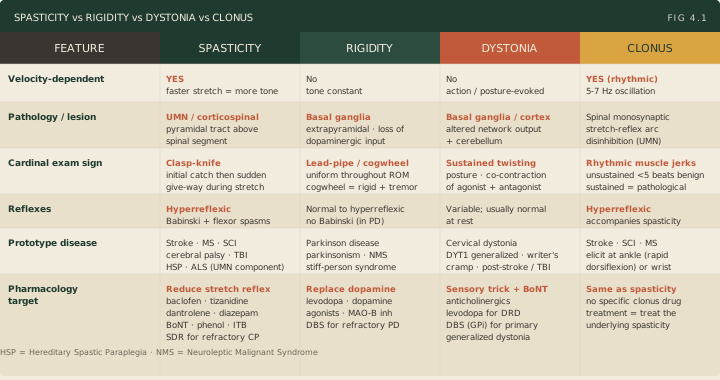
The upper motor neuron syndrome divides into positive phenomena (added abnormal behaviors representing release of lower circuits from higher control: spasticity, hyperreflexia, clonus, the Babinski extensor plantar response, flexor and extensor spasms, spastic dystonia, and co-contraction) and negative phenomena (lost normal functions: weakness or paresis, loss of dexterity, particularly fine finger control, often the earliest deficit, disuse atrophy, fatigue, and reduced endurance). The clinical implication is that aggressive treatment of positive signs can unmask negative signs. The classic teaching scenario is the post-stroke hemiparetic patient whose extensor quadriceps spasticity acts as a natural splint, locking the knee in extension and allowing standing transfers; aggressive antispasticity treatment can reveal the underlying weakness and destroy mobility. Always ask whether the patient is using their spasticity functionally before treating it.
The pathophysiologic mechanism is loss of descending inhibitory input to the spinal cord. Corticospinal and reticulospinal input normally maintains spinal inhibition through several circuits: presynaptic inhibition of Ia afferent terminals, reciprocal Ia inhibition of the antagonist motor pool through the Ia inhibitory interneuron, and the Ib (Golgi tendon organ) and Renshaw (recurrent) inhibitory pathways. The Ia inhibitory interneuron does not inhibit the homonymous monosynaptic stretch reflex; its job is to silence the antagonist while the agonist contracts. When stroke, SCI, TBI, or demyelinating disease removes this descending drive, these inhibitory circuits lose their normal gain, the stretch reflex is disinhibited, and the reflex arc becomes hyperexcitable, producing velocity-dependent hypertonia and the release phenomenon. Over time, intrinsic structural changes in chronically spastic muscle (collagen deposition, viscoelastic shifts) add a mechanical component that persists even after a successful nerve block. This is why pure neural intervention may not eliminate stiffness in long-standing spasticity.
High Yield — Lance, mimics, UMN syndrome
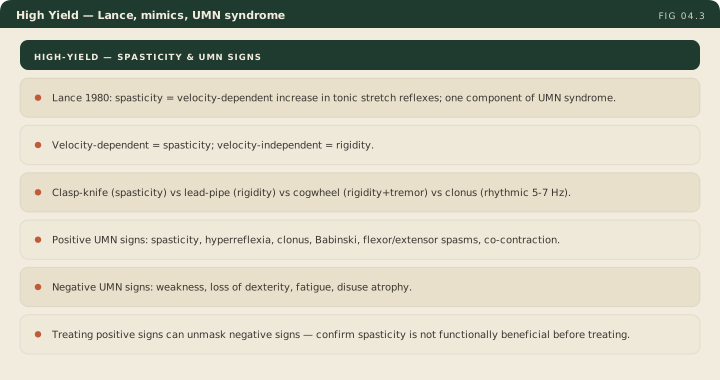
- Lance 1980: spasticity = velocity-dependent increase in tonic stretch reflexes; one component of UMN syndrome.
- Velocity-dependent = spasticity; velocity-independent = rigidity.
- Clasp-knife spasticity vs lead-pipe rigidity vs cogwheel (rigidity + tremor) vs dystonia (active twisting) vs clonus (rhythmic 5-7 Hz, requires stretch).
- Positive UMN signs: spasticity, hyperreflexia, clonus, Babinski, flexor/extensor spasms, co-contraction.
- Negative UMN signs: weakness, loss of dexterity, fatigue, disuse atrophy.
- Treating positive signs can unmask negative signs; verify spasticity is not functionally beneficial before treating.
- Mechanism: loss of descending drive to spinal inhibitory circuits (presynaptic Ia inhibition, reciprocal Ia inhibition of antagonists via the Ia inhibitory interneuron, Ib and Renshaw pathways) → disinhibited, hyperexcitable stretch reflex.
Mnemonic — “The seatbelt test”
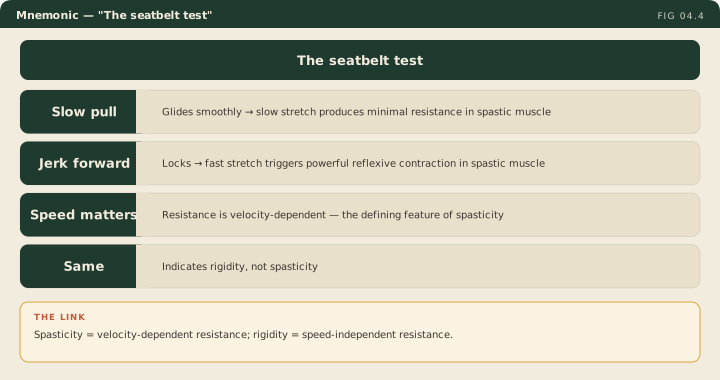
Pull a seatbelt slowly across your chest and it glides smoothly. Jerk forward suddenly and it locks. The locking mechanism is velocity-dependent, exactly like spastic muscle. A slow stretch produces minimal resistance; a fast stretch triggers a powerful reflexive contraction. If the resistance is the same regardless of speed, you are feeling rigidity, not spasticity.
So the golden rule here is absolute. Always ask if the spasticity is functional before you treat it. Never just treat a number on a tone scale.
— REHAB-04 podcast, ~12:30
When you superimpose a tremor on top of lead pipe rigidity, you get cogwheel rigidity. That gives you a very distinct, ratcheting sort of stop-and-go feel as you passively move the joint. It feels like a gear clicking through its teeth.
— REHAB-04 podcast, ~4:41