Before You Listen
Episode Setup
- Topic in one line: the three-nerve model of bladder control (sympathetic T11-L2 hypogastric for storage, parasympathetic S2-S4 pelvic for voiding, somatic S2-S4 pudendal for voluntary external sphincter); the three lesion patterns (suprapontine = uninhibited overactive, suprasacral = detrusor-sphincter dyssynergia with upper-tract risk, sacral / infrasacral = areflexic with overflow incontinence); the McGuire 40 cm H2O leak point pressure threshold; the bladder management ladder from timed voiding to clean intermittent catheterization (CIC) to anticholinergic, beta-3 agonist, alpha blocker, intradetrusor botulinum toxin (200 U), augmentation cystoplasty, and Mitrofanoff; the parallel bowel framework with upper motor neuron (UMN) reflex bowel and lower motor neuron (LMN) areflexic bowel; bowel program structure timed to the gastrocolic reflex; sacral neuromodulation (InterStim) for refractory overactive bladder and fecal incontinence; and the bladder-distension trigger for autonomic dysreflexia in spinal cord injury (SCI) at T6 and above.
- Prerequisites: spinal cord level anatomy, the conus medullaris versus cauda equina distinction, autonomic nervous system pharmacology (muscarinic M3, beta-3, alpha-1), and the SCI initial-management framework from the SCI series.
- Runtime: 43 minutes.
Vignette. A 28-year-old woman with a T8 American Spinal Injury Association Impairment Scale (AIS) A spinal cord injury (SCI) sustained 14 months ago is referred to your clinic for ongoing bladder and bowel management. She performs clean intermittent catheterization (CIC) every six hours, draining 600-700 mL each time. She reports new daily episodes of urinary leakage between catheterizations, increased lower-extremity spasticity over the past two weeks, and one episode last week of pounding headache, flushing, and a blood pressure of 178/110 mm Hg that resolved when her caregiver emptied her bladder. Recent urodynamics document a detrusor leak point pressure of 52 cm H2O with electromyographic evidence of detrusor-sphincter dyssynergia. Renal ultrasound shows mild bilateral hydronephrosis. She is currently on no bladder medication. Her bowel program is alternate-day digital stimulation 30 minutes after dinner using a polyethylene-glycol-based bisacodyl suppository, and her stool consistency is appropriate.
What is the immediate threat to her upper urinary tract, what episode last week represents and how should she be counseled to prevent it, what changes to her CIC protocol and pharmacology are indicated, and what step-up options exist if she fails to bring her detrusor leak point pressure below 40 cm H2O?
(Answer at the end of this chapter)
Section 1: Bladder Neuroanatomy and the Three-Nerve Model
Bottom line: micturition is governed by three nerves at three spinal levels with three distinct functions: the sympathetic hypogastric nerve from T11-L2 stores urine through beta-3 detrusor relaxation and alpha-1 internal-sphincter contraction (“sympathetics store”); the parasympathetic pelvic nerve from S2-S4 empties the bladder through M3 muscarinic detrusor contraction (“parasympathetics pee”); the somatic pudendal nerve from S2-S4 provides voluntary control of the external urethral sphincter through nicotinic acetylcholine receptors; the pontine micturition center (Barrington’s nucleus) coordinates synergistic voiding, and the medial frontal cortex provides voluntary inhibition.
The bladder is controlled by three nerves at three spinal levels, each serving a distinct function. The simplest organizing principle for the boards is to remember which nerve stores urine, which nerve empties urine, and which nerve provides voluntary control of the external sphincter.
The sympathetic hypogastric nerve arises from T11-L2 (the inferior mesenteric and superior hypogastric plexuses). Sympathetic activation accomplishes storage through two simultaneous receptor effects: beta-3 adrenergic receptors on the detrusor muscle relax the bladder wall, allowing accommodation of increasing volumes without rising pressure; alpha-1 adrenergic receptors at the bladder neck and internal urethral sphincter (smooth muscle, involuntary) cause contraction, keeping the outlet closed. The combined effect is a relaxed bladder body with a contracted outlet, which is exactly what storage requires. The mnemonic is “sympathetics store”.
The parasympathetic pelvic nerve (also called pelvic splanchnic nerves) arises from S2-S4. Parasympathetic activation causes detrusor contraction through muscarinic M3 receptors, generating the pressure to expel urine. The mnemonic is “parasympathetics pee”.
The somatic pudendal nerve also arises from S2-S4 but travels through a separate pathway. The pudendal nerve provides voluntary control of the external urethral sphincter (skeletal muscle) through nicotinic acetylcholine receptors at the neuromuscular junction. This is the nerve that allows conscious holding of urine and voluntary stream interruption. The internal sphincter is smooth muscle (autonomic); the external sphincter is skeletal muscle (somatic, voluntary).
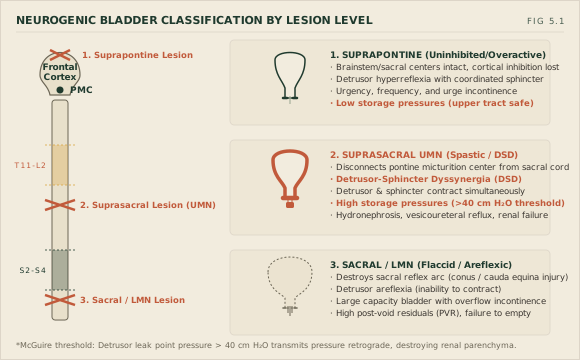
The coordinating center sits in the brainstem. The pontine micturition center, also known as Barrington’s nucleus, is the master switch for the voiding reflex. When the bladder fills to a critical volume, sensory afferents travel up the spinal cord to the pontine micturition center, which orchestrates a coordinated voiding response: simultaneous activation of parasympathetic outflow to contract the detrusor while inhibiting sympathetic and somatic outflow to relax both internal and external sphincters. This coordinated relaxation of the sphincters with simultaneous detrusor contraction is synergistic voiding.
Above the pons, the medial frontal cortex provides voluntary control by exerting tonic inhibition over the pontine micturition center, suppressing the voiding reflex until the individual is ready to urinate. Damage to the frontal cortex (TBI, stroke, dementia, normal pressure hydrocephalus) removes this inhibitory control, producing uninhibited (suprapontine) overactive bladder: urgency, frequency, and incontinence, but with coordinated sphincter behavior because the brainstem and below are intact.
The guarding reflex is a sacral spinal reflex that contributes to continence. When abdominal pressure rises (cough, sneeze, laugh), sensory afferents trigger pudendal-mediated reflex external sphincter contraction. Stress urinary incontinence (leakage with effort) reflects an inadequate guarding reflex from pelvic floor weakness, not a neurologic injury per se.
High Yield — Three-nerve model
- Sympathetic T11-L2 hypogastric = storage: beta-3 detrusor relaxation + alpha-1 internal sphincter contraction. Mnemonic: sympathetics store.
- Parasympathetic S2-S4 pelvic = voiding: M3 detrusor contraction. Mnemonic: parasympathetics pee.
- Somatic S2-S4 pudendal = voluntary external sphincter via nicotinic ACh.
- Pontine micturition center (Barrington’s nucleus) coordinates synergistic voiding.
- Medial frontal cortex provides voluntary inhibition; damage removes inhibition (suprapontine pattern).
- Guarding reflex = pelvic floor / pudendal contraction with abdominal pressure spikes.
They fire a rapid afferent signal into the sacral cord at S2 to S4, which immediately synapses on the anterior horn cells of the pudendal nerve, triggering an instantaneous forceful contraction of the external urethral sphincter. It guards the outlet before the pressure wave can force fluid through.
— REHAB-05 podcast, ~17:51
This is what provides the bladder with its high compliance, allowing it to stretch and accommodate increasing volumes of urine without any corresponding rise in intravesical pressure.
— REHAB-05 podcast, ~5:03