Before You Listen
Episode Setup
- Topic in one line: the four phases of swallowing (oral preparatory, oral propulsive, pharyngeal, esophageal) and their cranial nerve control (V/VII for mastication and lip seal, IX/X for pharyngeal sensation and motor, X for soft palate elevation via the pharyngeal plexus and for esophageal peristalsis, XII for tongue); silent aspiration in up to 40% of aspirators that defeats bedside swallow evaluation; the modified barium swallow study (videofluoroscopic swallow study, VFSS) as the gold standard for visualizing all four phases and aspiration timing; fiberoptic endoscopic evaluation of swallowing (FEES) for portable bedside assessment with the white-out limitation; the Penetration-Aspiration Scale (Rosenbek 1996) from 1 (normal) to 8 (silent aspiration); the International Dysphagia Diet Standardisation Initiative (IDDSI) framework with drinks 0-4 and foods 3-7; compensatory strategies (chin tuck, head turn, supraglottic / super-supraglottic swallow, Mendelsohn maneuver, effortful swallow); rehabilitative exercises (Shaker, Masako, Lee Silverman Voice Treatment / LSVT for Parkinson disease); cricopharyngeal achalasia and Zenker diverticulum; and the four-week NG-versus-PEG enteral feeding threshold with refeeding-syndrome hypophosphatemia.
- Prerequisites: cranial nerve neuroanatomy (V, VII, IX, X, XII), brainstem swallow center localization (medulla), and the basic gastroesophageal reflux / aspiration framework.
- Runtime: 1 hour 7 minutes.
Vignette. A 72-year-old man with right middle cerebral artery (MCA) ischemic stroke 14 days ago is in your acute inpatient rehabilitation unit. He has left hemiparesis (Modified Ashworth 1+ at the elbow flexors) and dense left facial droop. The bedside speech-language pathologist administered a 3-ounce water swallow test on hospital day 5 with no overt cough or wet voice quality, and he was advanced to a regular diet. Over the past 48 hours he has had two episodes of low-grade fever, oxygen desaturation to 88% on room air, and a new right lower lobe infiltrate on chest radiograph. He denies cough or odynophagia. Albumin is 2.9 g/dL; prealbumin is 14 mg/dL. The team is preparing to make him strict NPO and start enteral nutrition. He has no history of aspiration prior to this stroke.
What is the likely mechanism of his pneumonia, what diagnostic study should have been performed before advancing his diet and what is the alternative bedside instrumental option, what compensatory strategy has the strongest evidence for delayed swallow trigger, and how should the team decide between nasogastric and percutaneous endoscopic gastrostomy (PEG) tube feeding now?
(Answer at the end of this chapter)
Section 1: Four Phases of Swallowing and Cranial Nerve Control
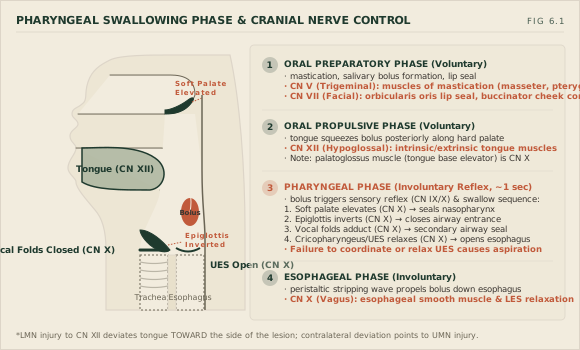
Bottom line: swallowing comprises four sequential phases (oral preparatory and oral propulsive are voluntary; pharyngeal and esophageal are involuntary), with cranial nerves V (mastication) and VII (lip seal, buccinator) governing the oral preparatory phase, XII (hypoglossal) propelling the bolus posteriorly, IX and X driving the pharyngeal phase including soft palate elevation, laryngeal elevation, vocal fold adduction, pharyngeal constriction, and upper esophageal sphincter relaxation, and X conducting esophageal peristalsis; the pharyngeal phase is reflexive and lasts approximately one second; cranial nerve XII lesions deviate the tongue toward the side of the lesion.
Swallowing divides into four sequential phases. The first two are voluntary and occur in the mouth; the last two are involuntary and occur in the pharynx and esophagus.
The oral preparatory phase is voluntary and includes placement of food in the mouth, mastication, and bolus formation with saliva. Cranial nerve V (trigeminal) powers the muscles of mastication: masseter, temporalis, medial pterygoid, and lateral pterygoid. Cranial nerve VII (facial) controls the orbicularis oris (lip seal) and the buccinator (keeps food between the teeth during chewing) along with the muscles of facial expression that prevent food spillage. Without adequate lip seal from VII, food and liquid spill anteriorly. Without adequate mastication from V, solids cannot be broken down into a manageable bolus. The palatoglossus (which raises the posterior tongue and depresses the soft palate) is the only tongue muscle innervated by cranial nerve X, not XII.
The oral propulsive phase (oral transport phase) is voluntary. Once the bolus is formed, the tongue propels it posteriorly toward the pharynx. Cranial nerve XII (hypoglossal) innervates all intrinsic and extrinsic tongue muscles (except the palatoglossus / X). The hypoglossal controls tongue elevation, retraction, and the wave-like squeezing motion that strips the bolus along the hard palate toward the oropharynx. Lower motor neuron lesion of XII deviates the tongue toward the side of the lesion (the working side overpowers the weak side). Upper motor neuron lesions of the corticobulbar tract typically produce contralateral tongue weakness with deviation away from the cortical side, but bedside testing is dominated by the LMN finding.
The pharyngeal phase is involuntary and reflexive. It begins when the bolus contacts the posterior tongue base and pharyngeal wall, triggering the swallow reflex. A rapid, coordinated sequence occurs within approximately one second. The soft palate elevates to close the nasopharynx, preventing nasal regurgitation (CN X). The larynx elevates and moves anteriorly, pulling the epiglottis over the airway entrance like a trapdoor. The true vocal folds adduct to seal the airway. Pharyngeal constrictor muscles contract sequentially from top to bottom, creating a stripping wave that drives the bolus toward the esophagus (CN IX and X). The upper esophageal sphincter (cricopharyngeus muscle) relaxes to allow the bolus to pass from pharynx to esophagus (CN X). Failure of cricopharyngeus relaxation produces bolus retention in the pharynx and aspiration risk.
The esophageal phase is entirely involuntary. The bolus is propelled through the esophagus by peristaltic contractions of esophageal smooth muscle (CN X), and the lower esophageal sphincter relaxes to allow entry into the stomach. This phase is largely outside the scope of swallowing rehabilitation, but esophageal dysphagia (strictures, tumors, achalasia, motility disorders) presents differently from oropharyngeal dysphagia and requires different evaluation (typically gastroenterology referral with esophageal manometry and endoscopy).
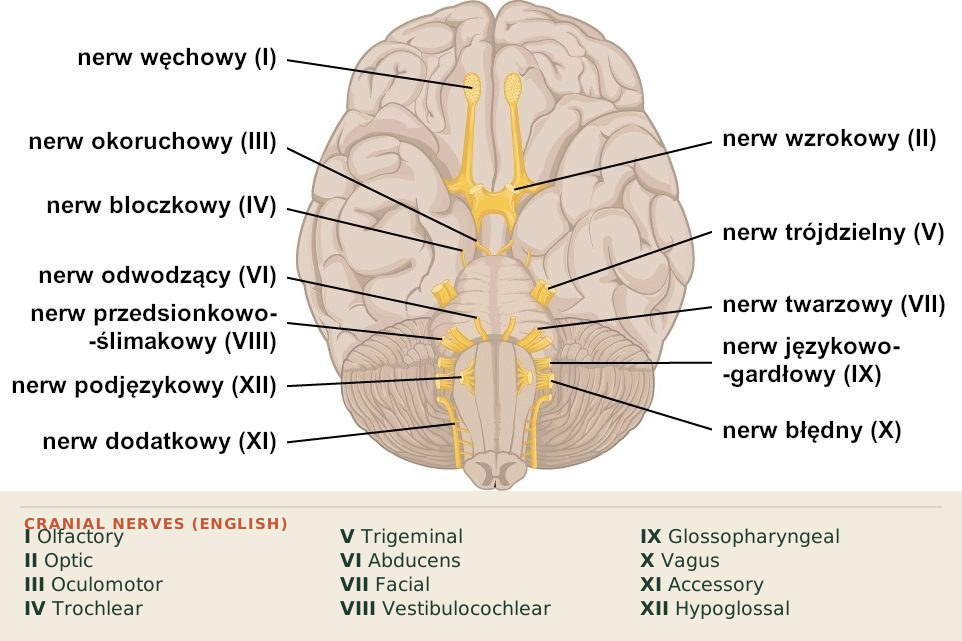
Source: OpenStax, Anatomy and Physiology, Wikimedia Commons, CC BY 4.0
High Yield — Phases and cranial nerves
- Oral preparatory (voluntary): CN V (mastication), CN VII (lip seal, buccinator).
- Oral propulsive (voluntary): CN XII (tongue, except palatoglossus = CN X). LMN lesion deviates tongue toward lesion.
- Pharyngeal (involuntary, ~1 second): CN IX and X (sensation, pharyngeal constriction, soft palate, laryngeal elevation, vocal fold adduction, UES relaxation).
- Esophageal (involuntary): CN X (peristalsis, LES relaxation).
- Cricopharyngeus = upper esophageal sphincter; failure of relaxation drives Zenker diverticulum.
The healthy right side is doing all the work, so it outmuscles the weak side, and physically bulldozes the tip of the tongue over into the empty space left by the paralyzed side.
— REHAB-06 podcast, ~6:04