Before You Listen
Episode Setup
- Topic in one line: the multisystem cascade that begins within hours of bed rest, anchored by the testable rate constants (1 to 1.5 percent muscle strength loss per day, 0.5 beat-per-minute resting heart-rate rise per day, approximately 0.9 percent maximal oxygen consumption (VO2max) decline per day, approximately 1 percent bone loss per week with weight-bearing sites hit hardest), the cardiovascular collapse to orthostasis, the pulmonary slide to atelectasis and pneumonia, the metabolic shift to hypercalcemia of immobilization and insulin resistance, the deep vein thrombosis (DVT) and pulmonary embolism (PE) risk explained by Virchow’s triad, the prophylaxis ladder from sequential compression devices (SCDs) through low molecular weight heparin (LMWH) to inferior vena cava (IVC) filter, the heparin-induced thrombocytopenia (HIT) 4T score and timing window, the contracture-versus-heterotopic-ossification distinction, and the psychosocial adjustment frameworks.
- Prerequisites: knowledge of upper-versus-lower-motor-neuron physiology, basic spinal cord injury (SCI) autonomic anatomy, and standard anticoagulant pharmacology (heparin, warfarin, direct oral anticoagulants).
- Runtime: 49 minutes.
Vignette. A 28-year-old man with a complete C6 American Spinal Injury Association Impairment Scale grade A (AIS A) tetraplegia is on day 12 of his acute hospital stay before transfer to your inpatient rehabilitation facility. Overnight his right calf is noted to be 3 cm larger in circumference than the left, his temperature is 38.0°C, and his baseline lower-extremity spasms have markedly increased. He has been receiving enoxaparin 30 mg subcutaneously every 12 hours and wearing sequential compression devices (SCDs). Platelet count is 92,000/μL, down from 220,000/μL on hospital day 5. D-dimer is markedly elevated; lower extremity duplex ultrasound shows non-compressible right popliteal vein. He has no history of bleeding diathesis.
What is the diagnosis driving the calf swelling, what is the alternative diagnosis explaining the platelet drop and what scoring tool quantifies its probability, what is the immediate change to his anticoagulation, what duration of therapy is appropriate, and what is the role of an inferior vena cava (IVC) filter in this scenario?
(Answer at the end of this chapter)
Section 1: Cardiovascular, Pulmonary, and Metabolic Effects of Bed Rest
Bottom line: bed rest produces predictable rate-constant changes the boards quantify directly, with resting heart rate rising approximately 0.5 beats per minute per day, maximal oxygen consumption (VO2max) declining approximately 0.9 percent per day, plasma volume contracting toward orthostatic intolerance through blunted baroreceptor reflexes and lower-extremity venous pooling, functional residual capacity dropping with cephalad diaphragmatic shift toward atelectasis and pneumonia, and metabolic derangements including insulin resistance, negative nitrogen balance, and hypercalcemia of immobilization (most dangerous in young males, spinal cord injury, and malignancy).
The cardiovascular system deteriorates predictably during bed rest, and the boards test the rate constants. Resting heart rate rises approximately 0.5 beats per minute per day of bed rest. After two weeks the resting rate is roughly 7 beats higher; after a month, 15 beats higher. The tachycardia compensates for falling stroke volume (down about 15 percent by two weeks as plasma volume contracts) and progressively impaired cardiac output reserve; the VO2max decline begins within 3 to 5 days. Maximal oxygen consumption (VO2max) declines approximately 0.9 percent per day, the single most-cited cardiovascular deconditioning number on the American Board of Physical Medicine and Rehabilitation (ABPMR) Part One examination. After three weeks of bed rest a patient may have lost nearly 20 percent of aerobic capacity, with direct consequences for fatigue tolerance, exercise prescription, and rehabilitation participation.
Orthostatic intolerance develops through three converging mechanisms: plasma volume contraction (the body discards intravascular volume it perceives as excess in recumbency), blunted baroreceptor reflex (vasoconstriction and tachycardia on standing become sluggish), and reduced lower-extremity venous tone (blood pools in the legs on assuming upright posture). The clinical phenotype is lightheadedness, visual dimming, nausea, and syncope on first mobilization. Management is graduated: head-of-bed elevation, sitting, then standing; compression stockings; abdominal binder; and pharmacologic agents including midodrine (alpha-1 agonist promoting peripheral vasoconstriction), fludrocortisone (mineralocorticoid expanding plasma volume through sodium and water retention), and droxidopa (norepinephrine prodrug raising blood pressure).
The pulmonary system is compromised by mechanical and clearance changes. Functional residual capacity (FRC) decreases in the supine position because abdominal contents push the diaphragm cephalad. The reduction in FRC closes small airways in dependent lung zones during normal tidal breathing, producing atelectasis (alveolar collapse) and a ventilation-perfusion mismatch. Mucociliary clearance is impaired because the escalator works less effectively against gravity, and the cough is weakened by reduced inspiratory volume and respiratory muscle deconditioning. Secretions pool in dependent segments and become a nidus for bacterial growth, producing the pneumonia that is one of the most common and serious complications of prolonged bed rest.
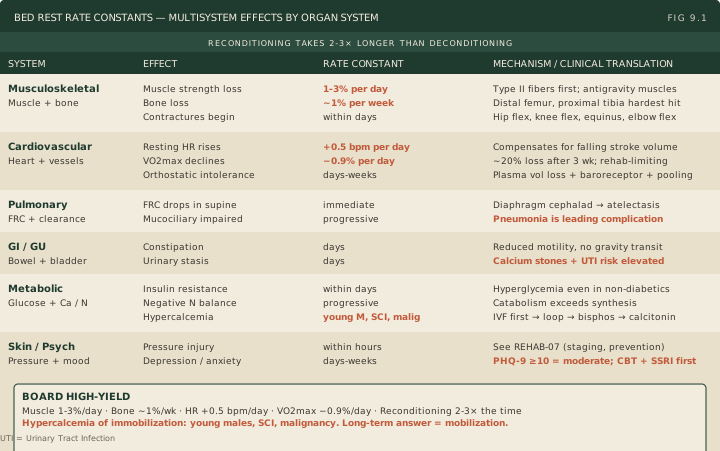
The metabolic consequences include insulin resistance within days (hyperglycemia even in non-diabetics), negative nitrogen balance (catabolism exceeds protein synthesis, about 2 g of nitrogen a day from days 5-6, peaking in the second week), and hypercalcemia of immobilization. Mechanical unloading of the skeleton allows osteoclastic resorption to outpace osteoblastic formation, producing net calcium efflux. In young males, spinal cord injury patients, and patients with malignancy, the kidneys cannot keep up and serum calcium climbs; after SCI it affects about 10 to 23 percent, typically 4 to 8 weeks after injury, and even asymptomatic hypercalcemia is treated because prolonged elevation causes nephrocalcinosis. The symptomatic picture is “stones, bones, groans, moans, and psychiatric overtones.” Treatment is aggressive IV fluid hydration, with loop diuretics added only after volume repletion and only when needed for volume overload or persistent hypercalcemia (hydration alone often suffices); thiazides are avoided because they raise serum calcium, bisphosphonates (pamidronate or zoledronic acid), and calcitonin as a rapid bridge. The definitive long-term therapy is mobilization and weight-bearing.
The genitourinary system suffers from urinary stasis combined with hypercalciuria from bone resorption, producing ideal conditions for calcium stone formation and elevated urinary tract infection (UTI) risk. The gastrointestinal system experiences constipation from reduced motility and absent gravity-driven colonic transit. Skin breakdown begins within hours; that material is covered fully in REHAB-07.
High Yield — Bed rest rate constants
- Muscle strength: loss about 1-1.5 percent per day (up to 3 in some cohorts); Type I antigravity fibers first in disuse (aging sarcopenia takes Type II first); antigravity muscles first.
- Bone: loss ~1 percent per week; distal femur, proximal tibia hit hardest.
- Resting heart rate: rise 0.5 bpm per day.
- VO2max: decline 0.9 percent per day.
- Orthostatic intolerance: plasma volume contraction + blunted baroreceptor reflex + venous pooling. Treat with graduated mobilization, compression, abdominal binder, midodrine, fludrocortisone, droxidopa.
- Hypercalcemia of immobilization: highest risk in young males, SCI, malignancy. Treat with IV fluids first (hydration alone often suffices); loop diuretic only after volume repletion and only if needed for volume overload or persistent hypercalcemia (thiazides avoided); bisphosphonate; calcitonin bridge; long-term answer is mobilization.
- Reconditioning takes 2-3× longer than deconditioning (the reverse asymmetry).
The system has literally forgotten how to respond to acute gravitational stress. The sensors in the carotid sinus and aortic arch are completely out of practice.
— REHAB-09 podcast, ~6:52