Before You Listen
- Prerequisites: brainstem respiratory control anatomy, the autonomic axis (sympathetic/parasympathetic), the suprachiasmatic nucleus and circadian entrainment, and the upper motor neuron versus lower motor neuron distinction relevant to spinal cord injury (SCI) sleep-disordered breathing.
- Runtime: 1 hour 4 minutes.
- Topic in one line: normal sleep architecture (non-rapid eye movement [NREM] stages N1-N3 and rapid eye movement [REM]); polysomnography (PSG) signatures (sleep spindles, K-complexes, slow waves, muscle atonia); obstructive sleep apnea (OSA) with apnea-hypopnea index (AHI) severity bands and continuous positive airway pressure (CPAP) treatment; central sleep apnea (CSA) including Cheyne-Stokes and the heart-failure adaptive servo-ventilation (ASV) contraindication; cognitive behavioral therapy for insomnia (CBT-I) as first-line; circadian rhythm disorders; narcolepsy and orexin/hypocretin deficiency; rapid eye movement sleep behavior disorder (RBD) as synucleinopathy prodrome; and population-specific sleep burden in spinal cord injury, traumatic brain injury (TBI), stroke, and multiple sclerosis (MS).
Vignette. A 58-year-old man with C5 motor-complete tetraplegia from a motor vehicle collision 18 months ago is admitted to inpatient rehabilitation for a pressure injury. He reports loud snoring, witnessed apneas, morning headaches, and unrefreshing sleep despite 9 hours in bed. Body mass index (BMI) is 34. Overnight pulse oximetry shows a desaturation index of 38 events per hour with a nadir of 78%. His night nurse notes thrashing movements during sleep that the patient does not recall.
What is the most likely sleep-disordered breathing diagnosis, what diagnostic study confirms it, what is the first-line treatment, what is the differential for the nocturnal movements, and which polysomnography finding would distinguish them?
(Answer at the end of this chapter)
Section 1 — Sleep Architecture: NREM, REM, and the Polysomnography Signatures
Bottom line: normal sleep cycles every 90 minutes through NREM stages N1, N2, N3, and REM, with the American Academy of Sleep Medicine (AASM) staging system replacing the older Rechtschaffen and Kales four-stage NREM nomenclature; N2 is defined by sleep spindles and K-complexes, N3 by delta waves and the highest arousal threshold (most restorative, growth hormone secretion), and REM by paradoxical electroencephalographic (EEG) desynchronization with skeletal muscle atonia.
Normal sleep is organized into a cyclical pattern of distinct stages with characteristic electroencephalographic (EEG), electrooculographic (EOG), and electromyographic (EMG) signatures. The American Academy of Sleep Medicine (AASM) updated the staging in 2007, replacing the older Rechtschaffen and Kales system (NREM stages 1-4 plus REM) with N1, N2, N3, and REM; old stages 3 and 4 were combined into N3.
N1 is the lightest stage of sleep and the gateway from wakefulness. It accounts for 2-5% of total sleep time. The EEG shows low-voltage mixed-frequency activity with disappearance of the posterior dominant alpha rhythm; theta waves at 4-7 Hz predominate. Slow rolling eye movements may be present. Muscle tone is reduced but not absent. Patients in N1 are easily aroused and may not perceive that they were asleep.
N2 is the predominant stage of sleep, accounting for 45-55% of total sleep time, and it is defined by two heavily tested EEG features. Sleep spindles are brief bursts of rhythmic activity at 12-14 Hz generated by the thalamic reticular nucleus, believed to play a role in memory consolidation and in gating sensory input to prevent arousal. K-complexes are large-amplitude biphasic waveforms that occur spontaneously or in response to external stimuli; they are thought to function as a cortical arousal-suppression mechanism. If a question asks which sleep stage is characterized by sleep spindles and K-complexes, the answer is N2.
Board note — electrodiagnostic nuance: Board exams and standard sleep-architecture questions classically define sleep spindles (hallmarks of N2 sleep) with a narrow frequency of 12 to 14 Hz. However, clinical neurophysiology and broader electroencephalography literature recognize a wider spectrum ranging from 10 to 16 Hz, divided into frontal slow spindles (10 to 13 Hz) and centroparietal fast spindles (13 to 16 Hz). For PM&R board preparation, prioritize the canonical 12 to 14 Hz range as the standard textbook benchmark.
N3 is deep sleep, also called slow-wave sleep or delta sleep. It is defined by predominance of high-amplitude low-frequency delta waves (less than 2 Hz) occupying at least 20% of the epoch. N3 is the most restorative stage, associated with growth hormone secretion, tissue repair, immune function, and energy conservation. Arousal threshold is highest during N3, meaning patients are most difficult to awaken from this stage. N3 is most abundant in the first third of the night and decreases across later cycles. Slow-wave sleep decreases significantly with aging, contributing to the perception of lighter, less refreshing sleep in older adults. Growth hormone secretion is most concentrated during N3, particularly in the first sleep cycle, with implications for inpatient rehabilitation: fragmented sleep may impair growth hormone secretion, tissue repair, wound healing, and muscle anabolism.
REM sleep combines cortical activation with peripheral muscle paralysis. The EEG shows low-voltage mixed-frequency activity resembling wakefulness, earning REM the name paradoxical sleep. Rapid conjugate eye movements in bursts are the defining EOG feature. Skeletal muscle tone is at its lowest, with functional atonia of all voluntary muscles except the diaphragm and extraocular muscles. Atonia is mediated by active inhibition of alpha motor neurons via brainstem (sublaterodorsal nucleus) projections and prevents dream enactment. When this fails, the result is REM sleep behavior disorder (RBD).
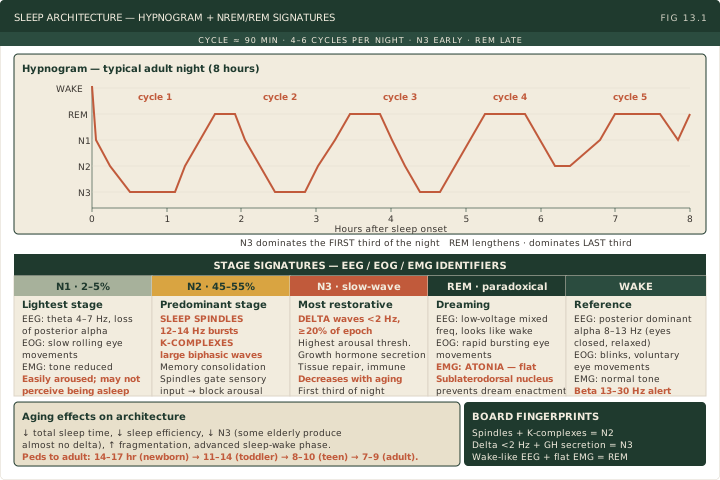
Normal sleep cycles through these stages in a predictable pattern. A complete cycle from N1 through N2, N3, and REM lasts approximately 90 minutes. A typical night contains four to six cycles. The composition shifts across the night: the first cycles are dominated by deep slow-wave sleep with brief REM, while later cycles contain less deep sleep and progressively longer REM periods. Most vivid dreams occur in the early morning hours before waking.
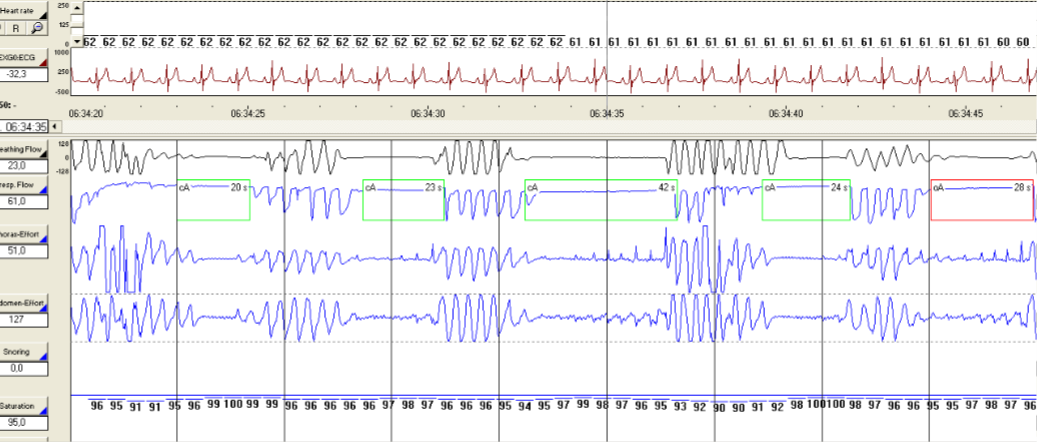
Source: Polysomnography multi-channel recording. Eumetaxas, Wikimedia Commons (CC BY-SA 3.0). https://commons.wikimedia.org/wiki/File:Polysomnography.png
With aging, sleep architecture changes in predictable ways: total sleep time decreases, sleep efficiency (percentage of time in bed actually spent asleep) decreases, N3 slow-wave sleep decreases substantially (some elderly produce almost no delta sleep), sleep fragmentation increases, and the circadian rhythm shifts earlier (advanced sleep-wake phase). Pediatric to adult sleep needs decline gradually: newborns sleep 14-17 hours, infants 12-15, toddlers 11-14, school-age children 9-12, adolescents 8-10, and adults 7-9.
High Yield: Sleep architecture
- Cycle length is approximately 90 minutes; 4-6 cycles per night.
- N1: 2-5%, theta, easily aroused.
- N2: 45-55%, sleep spindles (12-14 Hz) and K-complexes.
- N3: deep slow-wave (delta less than 2 Hz), highest arousal threshold, growth hormone secretion, decreases with age.
- REM: paradoxical EEG (resembles wake) plus muscle atonia, dreaming, increases through the night.
- Aging: less total sleep, less N3, more fragmentation, advanced phase.
So by interrupting a patient repeatedly during that critical early block of sleep the medical system is literally robbing the body of Its primary biological window for wound healing and immune function.
— REHAB-13 podcast, ~12:52