Before You Listen
- Prerequisites: rehabilitation team structure (REHAB-01, REHAB-08), an awareness of disability prevalence by diagnosis (spinal cord injury [SCI], traumatic brain injury [TBI], stroke, amputation), and a basic vocabulary for diagnostic depression screening and pharmacotherapy.
- Runtime: 32 minutes.
- Topic in one line: psychological adjustment to acquired disability including the limits of the Kubler-Ross framework; depression in rehabilitation populations with population-specific prevalence (20-45% after SCI, 25-50% after TBI, 30-40% after stroke); Patient Health Questionnaire-9 (PHQ-9) screening with the score-10 threshold and item-9 suicide screen; antidepressant selection (sertraline / citalopram preferred in stroke; bupropion for sexual side effects; paroxetine avoided in TBI / stroke); post-traumatic stress disorder (PTSD) and trauma-focused therapy; substance abuse screening and medication-assisted treatment; caregiver burden assessment with the Zarit Burden Interview and respite care; community reintegration with the Craig Handicap Assessment and Reporting Technique (CHART); vocational rehabilitation under the Americans with Disabilities Act (ADA) with the 15-employee threshold for reasonable accommodations; the return-to-work cliff at 6 months / 1 year / 2 years (50% / 25% / under 5%); and driving evaluation with a certified driver rehabilitation specialist.
Vignette. A 48-year-old man is 4 months post-stroke with right hemiparesis (improved to ambulation with a single-point cane), expressive aphasia (resolving), and a left middle cerebral artery infarct. He has been adherent to outpatient therapy. At today’s follow-up his wife mentions privately that he has stopped attending church, refuses social invitations, eats little, sleeps 14 hours a day, and tearfully said last week that “the family would be better off without me.” The patient himself denies depression and says he is “just tired.” Pre-injury, he worked as a senior software engineer at a 200-person company. He has not been back to work since the stroke.
What screening should be performed today, what does the wife’s report indicate must be addressed immediately, what first-line pharmacologic treatment is most appropriate for a stroke patient with depression on aspirin and amlodipine, what counseling framework guides discussion of return to work, and what statistic underscores the urgency of vocational planning?
(Answer at the end of this chapter)
Section 1 — Psychological Adjustment, the Kubler-Ross Framework, and the Boundary with Clinical Disorder
Bottom line: psychological adjustment to acquired disability is a process, not an event; the Kubler-Ross five-stage model (denial, anger, bargaining, depression, acceptance) is a useful framework for understanding common emotional responses but is not linear, not universal, and not prescriptive; the clinician’s task is to distinguish normal adjustment from clinical disorder, with the boundary defined by functional impairment, persistence beyond the expected adjustment period, and meeting diagnostic criteria for depression, anxiety, PTSD, or substance use disorder; risk factors for poor adjustment include pre-existing psychiatric history, substance abuse, limited social support, chronic pain, cognitive impairment, younger age at injury, and higher injury severity; the strongest single predictor of long-term adjustment is the strength of the patient’s social network.
Psychological adjustment to acquired disability is a process rather than an event. The patient’s emotional experience varies enormously by personality, social context, pre-injury identity, injury severity, and prognosis. The Kubler-Ross five stages (denial, anger, bargaining, depression, acceptance) were originally described for terminal illness and have been extended informally to disability. The model is useful as a vocabulary for common emotional responses but is not linear, not universal, and not prescriptive. Patients do not progress in a fixed order, many never experience all five stages, and some cycle back to earlier stages. The model is best used as a framework for understanding emotional responses, not as a sequential pathway the patient must traverse.
A common board scenario asks whether a particular response represents pathology or normal adjustment. The answer requires nuance. A newly injured SCI patient who expresses anger at the team during the first week is not necessarily pathologic; some anger is expected after a catastrophic injury. The same patient with the same anger at 6 months, interfering with therapy participation, family relationships, and self-care, has crossed into a pattern warranting formal psychological evaluation. The boundary is functional and temporal, not purely emotional. Two named diagnoses sit on either side of that boundary: Adjustment Disorder is a time-limited emotional response to an identifiable stressor that resolves as the person adapts, while Major Depressive Disorder is the full syndrome — persistent low mood, loss of interest, neurovegetative symptoms, and functional impairment lasting at least two weeks and meeting full diagnostic criteria.
The clinician’s task is to distinguish normal adjustment (a range of emotional responses including sadness, frustration, anger, and withdrawal occurring in the context of active engagement with rehabilitation) from clinical disorder (symptoms causing functional impairment, persisting beyond the expected adjustment period, and meeting diagnostic criteria for major depression, anxiety, PTSD, or substance use disorder). The team supports the patient through normal adjustment and treats the clinical disorders when they emerge.
Risk factors for poor psychological adjustment include pre-existing psychiatric history, substance abuse, limited social support, chronic pain, cognitive impairment, younger age at injury (which may correlate with less mature coping skills), and higher injury severity. The strongest single predictor of long-term adjustment is the strength of the patient’s social network — family, friends, religious or cultural community, and post-injury peer connections.
Effective coping mechanisms include active problem-solving, social support engagement, acceptance of the disability without surrender to it, and finding meaning or purpose in the new life situation. The construct of post-traumatic growth describes positive psychological changes that can emerge from the struggle with a traumatic injury — strengthened relationships, deepened spirituality, renewed appreciation for life, identification of new priorities. Post-traumatic growth does not negate the loss but coexists with it and correlates with better long-term outcomes.
Maladaptive coping includes avoidance, denial that persists beyond the acute phase, substance use as escape, and social isolation. The clinician supports adaptive coping by providing factual education about the disability, connecting the patient with peer mentors, encouraging engagement with family and friends, addressing pain and other modifiable barriers, and screening for and treating depression and PTSD.
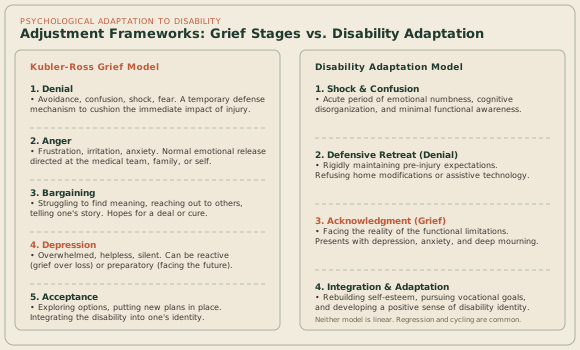
Board Trap — “The patient is in the anger stage and needs to move to acceptance”
Wrong frame. The Kubler-Ross stages are not a sequential pathway the patient must walk through, and there is no clinical goal of “moving the patient to acceptance.” The model is a vocabulary for common emotional responses, not a treatment algorithm. The clinician’s task is to assess functional impairment, screen for treatable clinical disorders (depression, anxiety, PTSD, substance use), and provide support for the patient’s individual adjustment trajectory — without imposing expectations about which stage they should be in.
High Yield: Kubler-Ross and the adjustment boundary
- Kubler-Ross 5 stages: denial, anger, bargaining, depression, acceptance. Not linear, not universal, not prescriptive.
- Boundary between normal adjustment and clinical disorder: functional impairment, persistence beyond expected period, meeting diagnostic criteria.
- Risk factors for poor adjustment: pre-existing psychiatric history, substance abuse, limited social support, chronic pain, cognitive impairment, younger age at injury, higher injury severity.
- Strongest predictor of long-term adjustment = strength of social network.
- Post-traumatic growth can coexist with loss; correlates with better long-term outcomes.
A patient with a strong, resilient support system and a severe physical deficit will consistently outperform a patient with a mild deficit who is entirely isolated.
— REHAB-15 podcast, ~7:23
And when you apply a framework meant for dying to someone who is, you know, actively trying to figure out how to live in a wheelchair, you create exactly backwards clinical instincts.
— REHAB-15 podcast, ~3:13