Before You Listen
- Prerequisites: basic central nervous system organization (gray matter neurons, white matter tracts, primary sensory and motor cortex); spinal meningeal anatomy in cross-section; awareness that the corticospinal tract carries voluntary motor signals from cortex to muscle; the difference between upper motor neuron (UMN) and lower motor neuron (LMN) signs.
- Runtime: 45 minutes.
- Topic in one line: the bony container (33 vertebrae, the four physiologic curves, the C1–C2 dens articulation, the posterior ligamentous complex) versus its neural contents (cord segments C1 through coccygeal, conus medullaris at L1–L2, cauda equina, denticulate ligaments), the Rule of 1, 2, 3 vertebral-cord level discrepancy that decouples the imaging level from the examination-defined neurological level, the three ascending sensory systems (dorsal column-medial lemniscus, lateral spinothalamic, spinocerebellar) and the descending corticospinal tract with their crossing points and somatotopic maps, the Rexed laminar organization of gray matter with Clarke’s nucleus at C8–L2, the intermediolateral cell column at T1–L2 (the principal sympathetic preganglionic column and the anatomic substrate for autonomic dysreflexia at or above T6), the sacral parasympathetic nucleus at S2–S4, the Onuf nucleus controlling continence, the anterior spinal artery and its segmental reinforcement by the variably placed artery of Adamkiewicz, the mid-thoracic watershed, and the valveless Batson plexus that explains hematogenous vertebral metastasis.
Vignette. A 68-year-old man with long-standing cervical spondylosis catches his toe on a rug, instinctively throws his head backward as he falls, and strikes the floor. Plain films show no fracture, no dislocation, and no canal disruption. On bedside examination he has profound weakness and impaired pinprick sensation in the hands, with much milder leg weakness; proprioception and vibration are preserved throughout.
Which incomplete cord syndrome did he sustain, which two ascending tracts account for his preserved versus impaired sensation, what imaging does he still need, and why is the corticospinal somatotopy not the explanation for the selective hand weakness?
Section 1: The Bony Container — Vertebral Column, Curves, and the C1–C2 Pivot
Bottom line: 33 vertebrae stack into a coiled spring with two primary kyphotic curves (thoracic, sacral) and two secondary lordotic curves (cervical, lumbar); only the upper 24 are mobile; the C1 atlas lacks a body and the C2 axis carries the dens, which generates 50% of total cervical rotation.
The vertebral column is a 33-vertebra axial skeleton organized into seven cervical, twelve thoracic, five lumbar, five sacral (fused into the sacrum), and four coccygeal segments. Only the upper 24 are mobile in the adult; the sacral five are wedged into the pelvis and the coccygeal four are variably fused. The structure is not a straight rod. It is a coiled spring with four physiologic curvatures: the thoracic and sacral curves are primary, present at birth and concave anteriorly (kyphotic), while the cervical and lumbar curves are secondary, lordotic, and develop in response to gravity. The cervical lordosis appears as the infant gains head control; the lumbar lordosis appears as the child begins to walk upright. Boards reward the primary-versus-secondary distinction directly.
A typical vertebra has two functional parts. The anterior vertebral body (centrum) is the weight-bearing core, made of cancellous bone wrapped in cortical bone. The posterior vertebral arch is built from two pedicles and two laminae, and together with the back of the body it encloses the vertebral foramen. Stack the foramina and you get the vertebral canal that houses the spinal cord, meninges, and segmental vessels. Seven processes project from the arch: one spinous process, two transverse processes, and four articular processes. The orientation of the articular processes (the facet joints) varies by region and dictates the dominant plane of motion at each level. Thoracic facets are coronal (favoring rotation), and lumbar facets are sagittal (favoring flexion-extension while limiting rotation).
Cervical vertebrae from C1 through C7 carry small bodies, bifid spinous processes from C2 through C6, and transverse foramina that transmit the vertebral arteries from C6 to C2, with the V3 segment looping separately through C1. Two vertebrae are exceptional. The atlas (C1) lacks both a body and a spinous process; it consists of anterior and posterior arches with two lateral masses, and it cradles the skull. The axis (C2) bears the dens (odontoid process) projecting upward from its body. The dens articulates with the anterior arch of the atlas at the median atlantoaxial joint, and that joint alone provides approximately 50% of total cervical rotation; the subaxial segments below C2 supply the remaining half. Flexion-extension is a separate motion at a separate joint: the atlanto-occipital joint above is the nodding joint, strongly extension-biased, and it contributes on the order of 15 to 20 percent of the total cervical flexion-extension arc rather than half. Keep the two apart: C1-C2 rotates, occiput-C1 nods. Thoracic vertebrae carry costal facets on the body and transverse process for rib articulation, with long downward-angled spinous processes. Lumbar vertebrae have the largest bodies of any segment, reflecting cumulative axial load.
High Yield — Bony container essentials
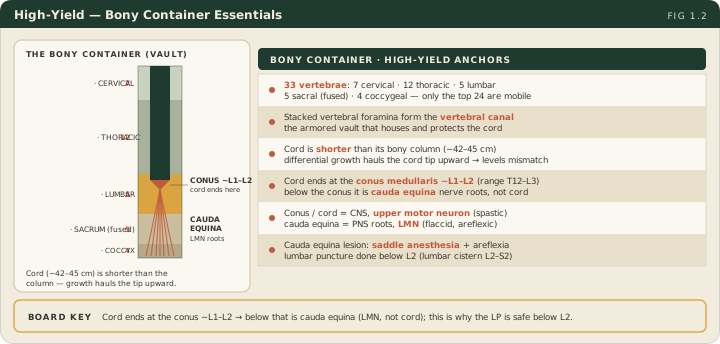
- 33 vertebrae: 7 cervical, 12 thoracic, 5 lumbar, 5 sacral (fused), 4 coccygeal. Only the upper 24 are mobile.
- Primary curves (kyphotic): thoracic and sacral, present at birth.
- Secondary curves (lordotic): cervical (head control) and lumbar (upright gait).
- C1 atlas has no body, no spinous process; it is a ring with lateral masses cradling the skull.
- C2 axis carries the dens; the median atlantoaxial joint provides approximately 50% of cervical rotation.
- Vertebral arteries traverse the transverse foramina from C6 to C2; the V3 segment loops separately through C1.
- Facet orientation: thoracic coronal (rotation), lumbar sagittal (flexion-extension).
The bones physically crash into each other if you try to twist too far. That structural block in the lumbar spine protects the massive nerve roots of the cauda equina from shearing forces.
— SCI-01 podcast, ~5:52