Before You Listen
- Prerequisites: working knowledge of spinal cord cross-sectional anatomy from Episode 1 (corticospinal tract, dorsal columns, lateral spinothalamic tract, tract crossing points); awareness from Episode 2 that vehicular crashes remain the leading cause of traumatic spinal cord injury (SCI) at 37.1% and that incomplete tetraplegia is the most common neurological category at 47.7%.
- Runtime: 51 minutes.
- Topic in one line: the International Standards for Neurological Classification of Spinal Cord Injury (ISNCSCI) worksheet endorsed by the American Spinal Injury Association (ASIA) and the International Spinal Cord Society (ISCoS); 28 key sensory points and 10 key muscle functions per side; the ASIA Impairment Scale (AIS) grades A through E and the algorithm that assigns them; sacral sparing as the only discriminator of complete versus incomplete; deep anal pressure (DAP) and voluntary anal contraction (VAC) testing; the zone of partial preservation (ZPP), recorded whenever the matching sacral function is absent; pin prick as a stronger prognostic signal than light touch; and the four classical incomplete syndromes (central cord, Brown-Sequard, anterior cord, posterior cord) plus the conus medullaris versus cauda equina distinction.
Vignette. A 72-year-old man with cervical spondylosis falls forward and strikes his forehead, hyperextending his neck. He is awake and cooperative. All ten upper-extremity key muscle functions (C5–T1 on each side) grade 1/5, and all ten lower-extremity key functions (L2–S1 on each side) grade 3/5. Light touch and pin prick are normal bilaterally at C2–C4, altered at C5, and variably impaired below. S4–S5 light touch and pin prick are intact; DAP and voluntary anal contraction are present. He reports burning dysesthesias in both hands.
Which incomplete spinal cord injury syndrome does this patient most likely have, what is the AIS grade, what is the predicted recovery sequence, and what single physical-exam finding immediately rules out an AIS A or B classification?
Section 1: Terminology, Definitions, and the Eight Steps
Bottom line: ISNCSCI is the ASIA/ISCoS standard, and the current version is the 2026 ninth edition; tetraplegia replaced quadriplegia in 1992 for etymological consistency and means cervical damage to neural elements inside the spinal canal, so a brachial plexus injury with paralyzed arms is not tetraplegia; the official worksheet lists six classification steps after the examination, and this chapter teaches the examination and classification together as eight.
The classification of spinal cord injury has evolved across more than five decades. The Frankel scale of 1969 was the first attempt at standardization but used five blunt categories that could not capture asymmetry or fine sensory distinctions. ASIA published the first International Standards for Neurological Classification of Spinal Cord Injury in 1982, and the worksheet has been revised in 1992, 1996, 2000, 2006, 2011, 2019, and most recently in 2026. The 2026 ninth edition is the current standard. The 2019 eighth edition is the last version with a published methods paper; it revised the zone of partial preservation rules and added a taxonomy for non-SCI conditions that affect examination scores, such as a concurrent peripheral injury or traumatic brain injury. A non-SCI condition is not the same thing as a nontraumatic spinal cord injury, and the two are easy to confuse. Work from the official ASIA resources and current worksheet; the 2019 standards paper still carries the detailed examination methods.
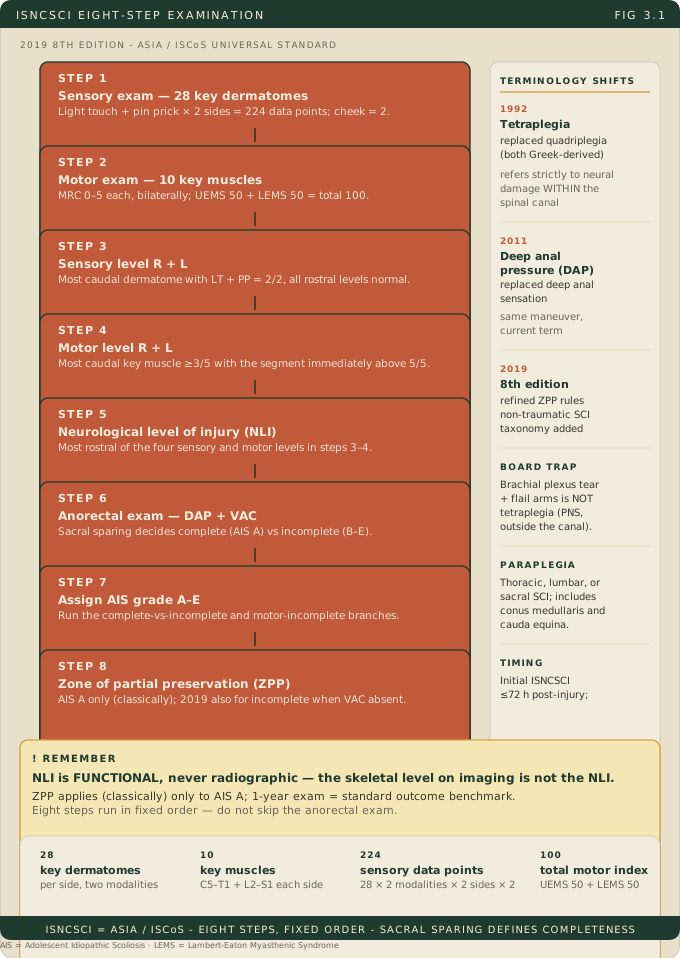
A 1992 terminology shift matters for the boards. The word tetraplegia officially replaced quadriplegia because quadri derives from Latin while plegia derives from Greek, and tetra (four, Greek) keeps the etymology consistent. Tetraplegia is the preferred ISNCSCI term. Tetraplegia means impairment or loss of motor and sensory function in the cervical segments due to damage to neural elements within the spinal canal, producing functional impairment of the arms, trunk, legs, and pelvic organs. Paraplegia means impairment or loss of motor and sensory function in thoracic, lumbar, or sacral segments and includes conus medullaris and cauda equina injuries. The within-the-canal rule decides a recurring classification question: a patient who tears the brachial plexus and has flail upper extremities plus a separate thoracic spinal cord injury is not tetraplegic, because brachial plexus damage is peripheral nervous system injury outside the spinal canal. That patient is paraplegic. In a second testable terminology change, the 2011 revision replaced deep anal sensation with deep anal pressure (DAP). If a stem still uses the older language, treat it as the same finding.
Several definitions must be memorized before walking through the worksheet. A dermatome is the area of skin innervated by sensory axons within a single segmental spinal nerve through the dorsal root. A myotome is the collection of muscle fibers innervated by motor axons within a single segmental spinal nerve through the ventral root. The neurological level of injury (NLI) is the most caudal segment with normal sensory and antigravity motor function on both sides, provided every segment above is also normal. The skeletal level is the level of greatest vertebral damage on imaging and is not synonymous with the NLI. A complete injury means absence of sensory and motor function in S4 through S5 (no sacral sparing). An incomplete injury means preservation of sensory or motor function below the NLI that includes S4 through S5 (sacral sparing present). The zone of partial preservation (ZPP) is the single most caudal segment below the corresponding sensory or motor level that retains any preserved function on that side, recorded whenever the matching sacral function is absent. Since 2019 the ZPP is recorded in incomplete injuries as well as in AIS A.
Use this eight-step teaching workflow, which merges the examination with the worksheet’s six classification steps. Examine the patient supine with appropriate spinal precautions; the anorectal examination may require side-lying. Step 1: test light touch and pin prick at 28 key points per side, which is 56 tests per modality and 112 tests across both modalities. Step 2: test 10 key muscle functions per side. Step 3: determine the right and left sensory levels. Step 4: determine the right and left motor levels. Step 5: take the most rostral of those four levels as the single NLI. Step 6: establish sacral sparing from S4–S5 light touch and pin prick, DAP, and VAC. Step 7: assign the AIS grade. Step 8: record each applicable sensory and motor ZPP, entering NA where the rule does not apply. Never omit the sacral examination: without it the classification cannot be completed.
High Yield — ISNCSCI foundations
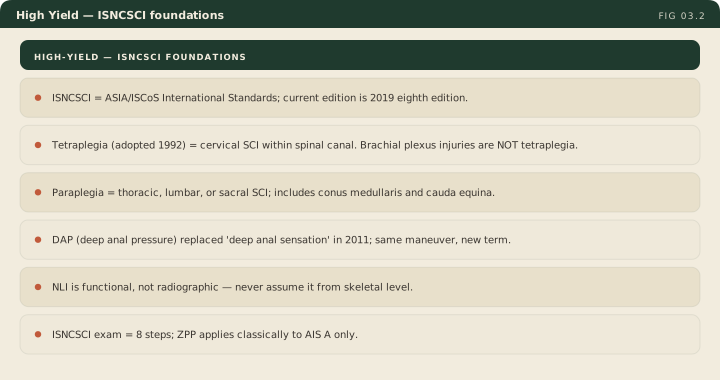
- ISNCSCI = ASIA/ISCoS International Standards; current edition is the 2026 ninth edition, and the 2019 eighth edition is the last one with a published methods paper.
- Tetraplegia (1992) replaced quadriplegia for etymological consistency; refers to cervical SCI within the spinal canal. Brachial plexus injuries are NOT tetraplegia even with paralyzed arms.
- Paraplegia = thoracic, lumbar, or sacral SCI; includes conus medullaris and cauda equina.
- DAP (deep anal pressure) replaced deep anal sensation in 2011; same maneuver, current term.
- NLI is functional, not radiographic. Never assume it from the skeletal level.
- The worksheet lists six classification steps after the examination; this chapter teaches eight. ZPP is recorded whenever the matching sacral function is absent, not in AIS A alone.