Before You Listen
- Prerequisites: ASIA Impairment Scale (AIS) classification and the meaning of complete (AIS A) versus incomplete (AIS B/C/D) injuries; the splanchnic sympathetic outflow from T5–T12 and the intermediolateral cell column; the resolution of spinal shock and the return of segmental reflexes; baseline autonomic findings in cervical spinal cord injury (SCI), including resting hypotension.
- Runtime: 52 minutes.
- Topic in one line: the T6 splanchnic threshold and the quarter of cardiac output behind it, the 20 mmHg systolic blood pressure (SBP) rule above a 90 to 110 mmHg SCI baseline, the sit-up-first sequence, the bladder-bowel-skin trigger order, medication at SBP 150 and above, nitroglycerin ointment and its alternatives, the phosphodiesterase-5 inhibitor (PDE5) nitrate interaction, the labor-versus-preeclampsia distinction in pregnant SCI patients, silent autonomic dysreflexia (AD), and the boosting prohibition under the International Paralympic Committee (IPC).
Vignette. A 26-year-old man with a complete C5 AIS A tetraplegia, 8 months post-injury, develops a sudden pounding bifrontal headache, profuse sweating across his face and neck, and goosebumps over his thighs while watching television. His baseline SBP is 92 mmHg. The bedside cuff reads 168/104 mmHg with a heart rate of 112 bpm. His indwelling Foley appears clamped against the bedrail. His wife mentions he took sildenafil approximately 6 hours earlier.
What is the diagnosis, the immediate non-pharmacologic intervention, the first organ system to investigate, and which first-line antihypertensive agent is absolutely contraindicated?
Section 1: Splanchnic Anatomy and the T6 Threshold
Bottom line: AD is a disease of neurological injuries at T6 or above, because that is where descending control of the splanchnic vascular bed is lost. The splanchnic bed receives about 25 percent of resting cardiac output, so reflex constriction there drives a systemic hypertensive crisis. T6 is a clinical risk threshold, not proof that every T5 through T12 fiber is severed, and a convincing episode at T7 or T8 is still AD.
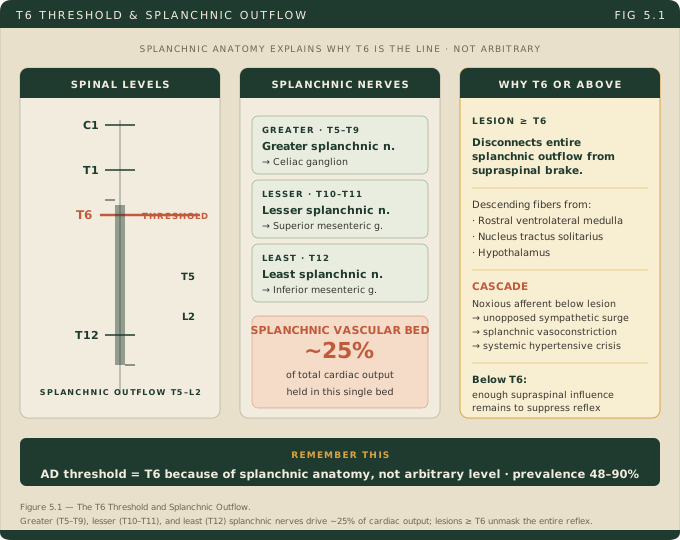
Sympathetic preganglionic neurons lie in the intermediolateral cell column (IML), conventionally T1 through L2. Descending fibers from the rostral ventrolateral medulla, the nucleus tractus solitarius and the hypothalamus run in the lateral funiculus and act as a tonic brake on spinal sympathetic output. In an intact nervous system a stretching bladder or a tight sock never produces a vascular response, because that supraspinal brake trims the local reflex in real time. SCI disrupts the brake while leaving the afferent input and the spinal reflex arc below the injury fully capable of driving sympathetic neurons. The IML span describes the broader sympathetic outflow; it is not interchangeable with the origins of the thoracic splanchnic nerves.
A trigger such as bladder distention activates afferent pathways below the injury and evokes a sympathetic response. With the brake impaired, the response is amplified into marked vasoconstriction, most importantly in the splanchnic territory and with contributions from the renal and lower-extremity beds. The blood-pressure rise is systemic. Carotid and aortic baroreceptors detect it and mount a compensatory response that slows the heart through the vagus and dilates vessels above the lesion, but that compensation cannot reach the constricted territory below the injury because the descending sympatholytic signal cannot cross it. The trigger keeps firing and the pressure stays up until the stimulus is removed or the pressure is treated. Sweating and piloerection are sympathetically mediated; do not attribute sweating to the vagus or describe the hypertension as confined below the lesion.
The greater splanchnic nerve conventionally arises from T5 through T9, the lesser from T10 through T11, and the least from T12; human dissections show substantial variation, and the lesser and least are absent in some. They feed interconnected abdominal prevertebral and renal plexuses, including celiac and aorticorenal connections, rather than three invariant one-to-one ganglion destinations. T6 or above is the answer to the “why T6” stem, because an injury there compromises control over the largest rapidly mobilizable vascular reservoir in the body. T6 is not physically above T5, and AD is reported with lower injuries, so a convincing trigger-linked hypertensive episode is not dismissed because the neurological level reads T7 or T8.
Severity tracks level and completeness. Asked which patient is at highest risk for severe AD, the answer is the one with the highest and most complete injury: a complete C5 AIS A injury produces more frequent and more severe episodes than an incomplete C5 AIS C injury, because incomplete lesions preserve some descending inhibitory fibers. AIS A means absent sacral sensory and motor sparing at S4 to S5; it does not establish anatomical transection or loss of every descending autonomic fiber. The often-quoted prevalence range 48 to 90 percent and the first-year estimate of more than 90 percent are population and ascertainment figures rather than an individual prediction. AD usually emerges over the weeks to months after injury, but it has been documented as early as 7 days after an acute transection with tendon reflexes still absent. Do not exclude AD during spinal shock.
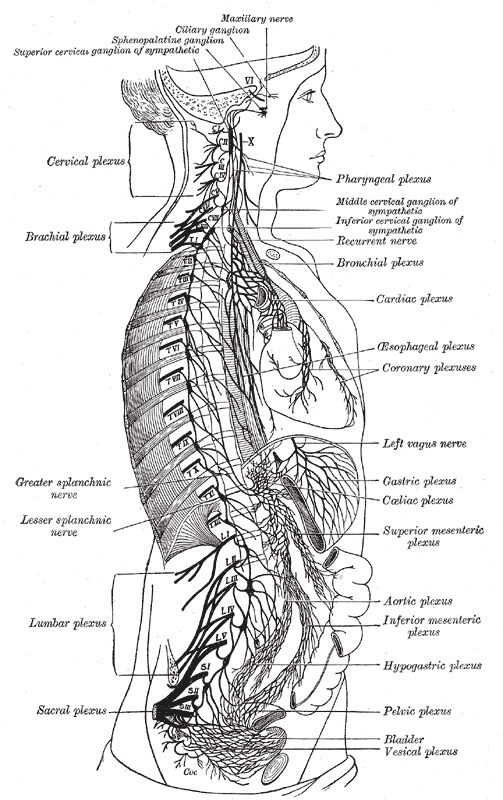
Source: Henry Vandyke Carter, Gray’s Anatomy of the Human Body (1918), Plate 838, via Wikimedia Commons, Public Domain. https://commons.wikimedia.org/wiki/File:Gray838.png
High Yield — Why T6
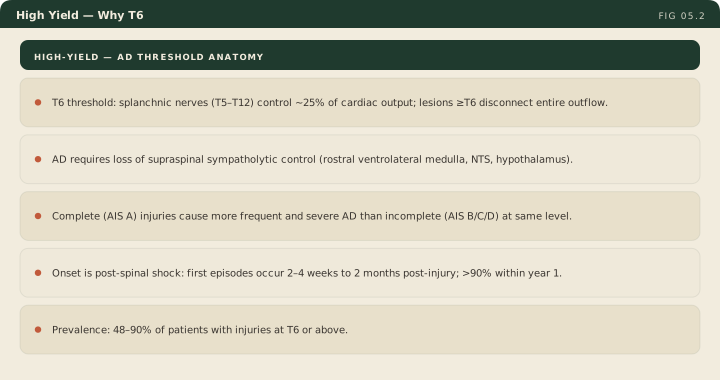
- T6 or above is the major neurological risk group. The greater (T5 to T9), lesser (T10 to T11) and least (T12) splanchnic nerves supply a bed that receives roughly 25 percent of resting cardiac output. That is a flow fraction, not a stored blood volume.
- AD needs the loss of supraspinal sympatholytic control. The reflex arc below the injury is intact; the brake from the rostral ventrolateral medulla, the nucleus tractus solitarius and the hypothalamus is gone.
- Completeness matters. Complete (AIS A) injuries produce more frequent and more severe episodes than incomplete injuries at the same level. AIS A denotes no sacral sparing; it does not prove every autonomic pathway is disconnected.
- Early AD is possible: documented as early as 7 days post-injury with tendon reflexes still absent. Neither absent reflexes nor the label spinal shock rules it out.
- Reported prevalence varies. The commonly cited 48–90% range is not a universal probability for every injury at T6 or above.
Board Trap — “Below T6 can’t be AD”
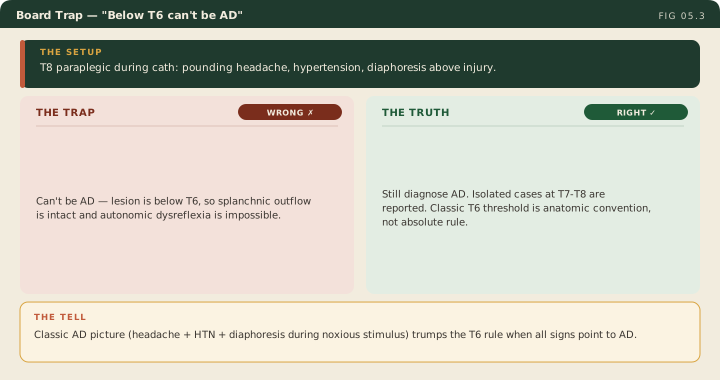
The board answer to “why T6” is the splanchnic bed, which takes about 25 percent of resting cardiac output and loses its supraspinal control at that level. “T6 by tradition” is not the answer. But the level is a risk threshold, not an exclusion rule: a stem describing hypertension with a pounding headache during catheterization in a T8 patient is still AD, and cases at T7 and T8 are reported.
An injury at T6 or above sits physically above the origin of the greater splanchnic nerve, which, remember, starts at T5. Because the injury sits above that origin, it disconnects that entire splanchnic outflow from supraspinal control all at once.
— SCI-05 podcast, ~9:22