Before You Listen
- Prerequisites: segmental innervation of the cervical and thoracic cord (SCI-01); the upper motor neuron (UMN) versus lower motor neuron (LMN) distinction; basic pulmonary physiology (forced vital capacity (FVC), tidal volume, the inspiratory and expiratory phases of cough); the autonomic nervous system framework from SCI-05; basic ventilator vocabulary (tidal volume, fraction of inspired oxygen, positive end-expiratory pressure).
- Runtime: 38 minutes.
- Topic in one line: the segmental respiratory muscle map (diaphragm at C3-C5, intercostals at T1-T11, abdominals at T6-T12, accessory muscles at cranial nerve XI and C2-C4), why pneumonia dominates SCI mortality, the paradoxical breathing pattern, the rise in FVC over the first months without neurologic recovery, the supine-versus-upright positional advantage, the fitted abdominal binder, peak cough flow (PCF) thresholds and the manually assisted (“quad”) cough, mechanical insufflation-exsufflation (MI-E) pressures, progressive ventilator-free breathing (PVFB) as the SCI weaning standard, diaphragm pacing candidacy, glossopharyngeal (frog) breathing, the Passy-Muir speaking valve, and sleep-disordered breathing in tetraplegia.
Vignette. A 32-year-old man sustained a C4 American Spinal Injury Association Impairment Scale (AIS) A complete spinal cord injury (SCI) in a diving accident 3 days ago. He is breathing spontaneously through a tracheostomy with mild support, but his forced vital capacity (FVC) is 42% of predicted, his respiratory rate is 24, and you can see his chest wall collapsing inward during inspiration while his abdomen protrudes. Suctioning produces moderate thick yellow secretions, and his peak cough flow (PCF) is 95 L/min. Oxygen saturation is 93% on a fraction of inspired oxygen of 0.4. He has not required full mechanical ventilator support but is visibly tiring. Phrenic nerve conduction studies were ordered.
Name the breathing pattern and explain why it occurs. What needs urgent assessment in a patient who is visibly tiring? Will his FVC improve or worsen over the coming weeks if no neurologic recovery occurs, and by what mechanisms? Which airway-clearance strategies should you start immediately, and what adjunct should be added in the wheelchair? What determines whether he is a candidate for diaphragm pacing?
Section 1: Respiratory Muscle Innervation by Spinal Level
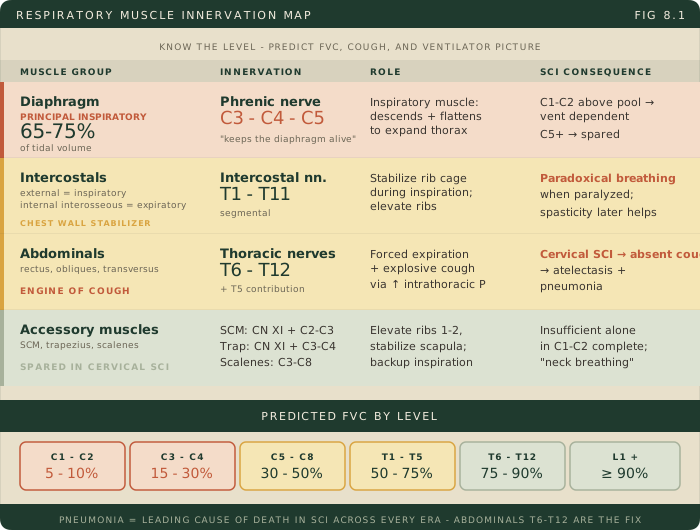
Bottom line: every respiratory consequence of SCI flows from one map (diaphragm C3-C5 via the phrenic nerve, generating 65-75 percent of tidal volume; intercostals T1-T11; abdominals T6-T12 driving forced expiration and cough; accessory muscles via cranial nerve XI plus the high cervical segments). Know the level and you can anticipate the FVC and the cough: roughly 5 to 10 percent of predicted at C1-C2, 15 to 30 percent at C3-C4, 30 to 50 percent at C5-C8, 50 to 75 percent at T1-T5, and 75 to 90 percent at T6-T12. Those bands are the expected picture, and the measured FVC is the one that counts. The pattern is extrinsic restriction: every lung volume falls except residual volume, which rises, and the FEV1/FVC ratio is preserved or raised.
Respiratory complications are the leading cause of morbidity and mortality in both the acute and chronic phases of spinal cord injury. In the Model Systems cohorts that defined this, pneumonia was the commonest single cause of death at every interval measured, from the first year after injury to decades later; the ranking shifts with era, population and length of follow-up, and not every respiratory death is a pneumonia. Respiratory complications accounted for approximately 42 percent of acute-phase deaths in one cohort, a category that includes pulmonary embolism as well as chest infection. The severity of respiratory impairment maps onto the level and completeness of injury, and that map is built from the segmental innervation of each respiratory muscle group. Learn the wiring and you can anticipate the FVC, the cough and the ventilator picture before you walk into the room, then measure them.
The diaphragm is the principal muscle of inspiration, generating approximately 65-75% of tidal volume during quiet breathing. It is innervated by the phrenic nerve, which arises from the C3, C4, and C5 nerve roots. The mnemonic that every medical student learns is “C3, C4, C5 keeps the diaphragm alive.” The phrenic nerve provides motor supply to the diaphragm and has sensory branches to the central diaphragm, pericardium, and peritoneal surfaces.
The clinical implications follow directly. Injuries at C1-C2 sit above every phrenic motor neuron, so descending drive is severed, the diaphragm is paralyzed, and the patient is ventilator-dependent. Injuries at C3-C4 produce partial diaphragm weakness because some but not all phrenic motor neurons are damaged, and most of these patients need at least temporary ventilatory support; a C4 label on the chart does not by itself establish intact phrenic function, so test it. Injuries at C5 and below spare the diaphragm, because the phrenic motor neurons have already sent their axons out, though the loss of intercostals and abdominals still impairs respiratory mechanics and cough.
The intercostal muscles are innervated segmentally by the intercostal nerves at T1-T11. The external intercostals are inspiratory; they elevate the ribs during inspiration to expand the thoracic cavity. The internal intercostals (interosseous portion) depress the ribs during forced expiration; the parasternal portion is paradoxically inspiratory. In cervical SCI, complete intercostal paralysis means the chest wall cannot stabilize during inspiration, which is the mechanism of paradoxical breathing.
The abdominal muscles are the primary muscles of forced expiration and cough, innervated at T6-T12 with some contribution from T5. Rectus abdominis (T7-T12), external oblique (T7-T12), internal oblique and transversus abdominis (T7-L1) generate the high intrathoracic pressures required for an effective cough. Their paralysis in cervical and high thoracic SCI is the primary reason for impaired secretion clearance and the resulting susceptibility to atelectasis and pneumonia.
The accessory muscles of respiration are largely spared in cervical SCI because their innervation comes from cranial nerve XI and the highest cervical segments. The sternocleidomastoid is supplied primarily by the spinal accessory nerve (cranial nerve XI) with contributions from C2-C3. The trapezius is supplied by cranial nerve XI plus C3-C4 and stabilizes the scapula. The scalenes (C3-C8) elevate ribs 1 and 2. In high cervical SCI at C1-C4 the sternocleidomastoid and trapezius become the principal available respiratory muscles, and accessory muscles alone cannot sustain ventilation in most complete C1-C2 injuries. One caution on the anatomy: cranial nerve XI has a spinal root arising from the upper cervical cord, so examine what actually works rather than assuming every accessory muscle survives the highest injuries.
The respiratory consequences by level cluster into bands. C1-C2 leaves only the sternocleidomastoid and trapezius available; FVC falls to 5-10 percent of predicted and the patient is ventilator-dependent. C3-C4 gives partial diaphragm function with FVC at 15-30 percent; most need acute ventilatory support and some later wean. C5-C8 preserves the diaphragm but loses intercostal and abdominal function; cough is severely impaired and FVC sits at roughly 30-50 percent. T1-T5 preserves the diaphragm and partial intercostal function, cough is moderately impaired, and FVC runs 50-75 percent. T6-T12 preserves the diaphragm and the intercostals above the lesion, with segmental intercostal loss at and below it, plus part of the abdominal wall; cough is mildly impaired and FVC runs 75-90 percent. Read the bands as the expected picture for a motor-complete injury, not a prediction for the individual: completeness, time since injury, posture, conditioning and coexisting lung disease all move the number, and the measured FVC is the one you act on.
Naming the pattern matters as much as the numbers. Cervical SCI produces an extrinsic restrictive defect: the lungs themselves are normal, but the bellows driving them is paralyzed. Every lung volume falls, vital capacity, total lung capacity, inspiratory capacity and expiratory reserve volume, and because FEV1 and FVC fall together the FEV1/FVC ratio is preserved or even raised, which is what separates this from an obstructive picture. Atelectasis, infection or coexisting lung disease can be layered on top, so a genuinely abnormal ratio means look for a second diagnosis rather than assuming the cord explains everything.
The one counterintuitive value is the exception that stems are built on: residual volume rises. Expiration below functional residual capacity is an active maneuver performed by the abdominal muscles, and in a cervical injury those are paralyzed, so the patient cannot squeeze the last air out and gas is trapped behind. Every volume falls except residual volume, which increases. If a question asks which lung volume goes up after a cervical SCI, that is the answer. L1 and below leaves the respiratory muscles intact, with no respiratory impairment from the SCI itself.
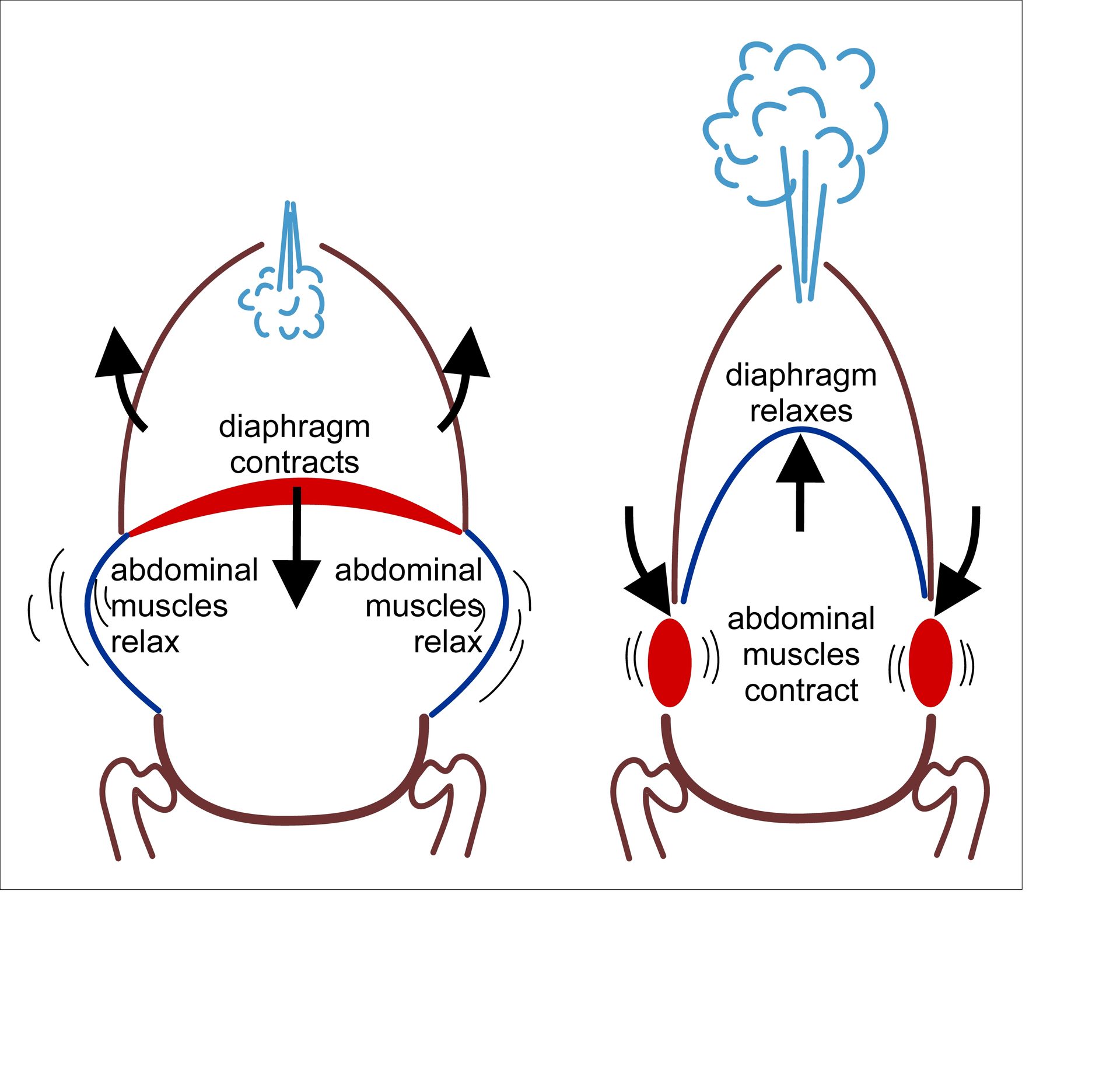
Source: Cruithne9, “Muscles involved in forceful breathing in and out”, via Wikimedia Commons, CC BY-SA 4.0. https://commons.wikimedia.org/wiki/File:Muscles_involved_in_forceful_breathing_in_and_out.jpg
High Yield — Innervation map and FVC by level
- Phrenic = C3, C4, C5, generates 65-75% of tidal volume; “C3, C4, C5 keeps the diaphragm alive.”
- Intercostals T1-T11, external = inspiratory, internal interosseous = expiratory; loss = paradoxical breathing.
- Abdominals T6-T12, the engine of forced expiration and cough; loss = the cardinal driver of atelectasis and pneumonia.
- Accessory muscles (SCM, trapezius) receive cranial nerve XI plus high cervical input and are largely preserved in cervical SCI, which is why C4-C5 patients look like they are “using everything in their neck” to breathe. Cranial nerve XI has a spinal root, so examine function in the highest injuries.
- Expected FVC by level: C1-C2 ≈ 5-10%, C3-C4 ≈ 15-30%, C5-C8 ≈ 30-50%, T1-T5 ≈ 50-75%, T6-T12 ≈ 75-90%. Measure the actual FVC; the bands set the expectation, not the answer for one patient.
- Pattern = extrinsic restrictive: all volumes fall (VC, TLC, IC, ERV) with a preserved or raised FEV1/FVC ratio; residual volume is the exception and RISES, because active expiration below FRC needs the paralyzed abdominals.