Before You Listen
This episode explains how SCI disrupts cardiovascular and temperature control. Three levels organize the topic: T1–T5 carries cardiac sympathetic outflow, so cervical injury causes bradycardia; T6 is the landmark for autonomic dysreflexia and orthostatic hypotension; T8 is the traditional landmark for loss of sweating and shivering below the lesion. The emergency priorities are recognizing a rise from baseline blood pressure, treating dangerous hypertension, and promptly addressing its trigger.
What you should already know coming in:
- The thoracolumbar sympathetic outflow (T1 to L2) and the intermediolateral cell column origin
- Baroreceptor anatomy: carotid sinus and aortic arch afferents to the medulla via cranial nerves IX and X
- The basics of Virchow’s triad (stasis, hypercoagulability, endothelial injury)
Runtime: 47 minutes.
Vignette. A 32-year-old man with a C6 ASIA Impairment Scale (AIS) A spinal cord injury (SCI), 5 weeks post-injury, is found in his hospital bed with a pounding headache, profuse facial sweating, and flushed skin above the clavicles. Below the level of injury his skin is pale and cool. Blood pressure is 218/124 mmHg; baseline is 96/60. Heart rate is 48 beats per minute. The indwelling urinary catheter is kinked under his thigh and the drainage bag is empty.
Name the syndrome and the spinal-cord level that defines its risk, identify the most likely trigger, describe immediate management and monitoring, name the topical first-line antihypertensive and where on the body to place it, and explain how to reduce catheter-related stimulation without delaying urgent bladder drainage.
Section 1: The Three Autonomic Levels (T1–T5, T6, T8)
Key point: cardiac sympathetic outflow arises in the upper thoracic cord, described as T1–T5 in the ISAFSCI standards. T6 is the injury-risk landmark for autonomic dysreflexia and orthostatic hypotension. T8 is the landmark for loss of sweating and shivering below the lesion, and thermoregulatory impairment is greatest with cervical and high thoracic injury.
The thoracolumbar sympathetic outflow originates in the intermediolateral gray matter from T1 to L2. Preganglionic axons leave through ventral roots and white rami, then synapse in paravertebral or prevertebral ganglia. Postganglionic fibers reach the heart, vessels, sweat glands, and pilomotor muscles. SCI can interrupt descending control while leaving spinal autonomic circuits below the lesion active; the degree of preserved control depends on the injury.
The heart receives sympathetic input from the upper thoracic cord (T1–T5 in ISAFSCI) through cervical and upper thoracic sympathetic ganglia, including the stellate ganglion. Postganglionic norepinephrine acts at beta-1 receptors to increase rate, conduction, and contractility. T1–T4 is the common textbook shorthand for the same outflow. Cervical SCI disconnects this input while sparing the vagus nerve outside the spinal canal, producing bradycardia and susceptibility to severe vagal slowing during suctioning or hypoxia. Neither a resting rate of 40–60 bpm nor cardiac arrest is inevitable.
T6 is an injury-risk landmark for AD, reflecting loss of descending control over a large splanchnic vascular reservoir. The ISAFSCI describes major splanchnic and lower-body vascular outflow across T6–L2, not T6 alone. Reduced vasoconstriction on standing causes OH; an excessive spinal sympathetic response to a trigger causes AD. Both are common after high SCI, and OH also occurs with lower injuries and other causes.
T8 is the third landmark: above it, the patient loses sweating, cutaneous vasoconstriction and shivering below the lesion, and core temperature drifts toward the ambient temperature. That state is poikilothermia. The mnemonic is temp-EIGHT-ture. Loss of sympathetic vasomotor and sudomotor control limits both heat conservation and heat loss, and shivering additionally requires intact somatic motor pathways and sufficient active muscle. T8 is the board landmark; thermoregulatory impairment is greatest with cervical and high thoracic injury, and residual sweating and vascular responses vary with the lesion.
A clean way to commit these to memory: T1–T5 = cardiac accelerator (bradycardia), T6 = vascular volatility (AD and orthostatic hypotension), T8 = thermal failure (poikilothermia). Then assess actual autonomic function as well as neurological level.
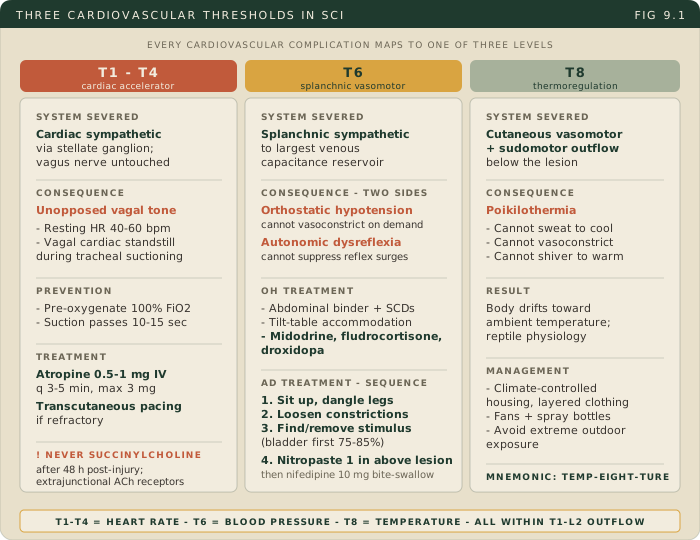
High Yield — Autonomic Anatomy and Risk
- T1–T5: Cardiac sympathetic outflow in ISAFSCI; cervical injury increases bradycardia and suction-related arrest risk.
- T6 and above: Major AD risk; OH is also common but is not restricted to this level.
- T8: Thermoregulation. Above T8 the patient cannot sweat, vasoconstrict or shiver below the lesion, giving poikilothermia. Mnemonic: temp-EIGHT-ture. Impairment is greatest with cervical and high thoracic injury. Sweating is autonomic and shivering is somatic.
- T1–L2: Thoracolumbar sympathetic preganglionic outflow.
I mean, you have a cinder block sitting on the brake pedal and the gas line is completely severed. You cannot accelerate to get out of trouble, you know, no matter what happens in the environment.
— SCI-09 podcast, ~4:29