Before You Listen
This episode dissects spasticity in spinal cord injury (SCI) along the entire stepwise management ladder, from removing noxious stimuli through intrathecal baclofen pump implantation. The clinical question that organizes the chapter is whether the patient’s tone is helping them or hurting them. Treating tone that the patient relies on for transfers and standing can convert an independent patient into a dependent lift transfer overnight. Memorize the Modified Ashworth Scale (MAS), the Tardieu R2 minus R1 arithmetic, the receptor targets and signature toxicities of every oral agent, the SNAP-25 cleavage of botulinum toxin type A, and the distinction between the rigid hot crisis of intrathecal baclofen withdrawal and the flaccid cold crisis of overdose, along with the features the two crises share.
What you should already know coming in:
- The upper motor neuron (UMN) syndrome and the positive vs negative phenomena distinction
- The basics of the muscle spindle, the type Ia afferent, and the alpha motor neuron stretch reflex arc
- The GABA-A vs GABA-B receptor distinction (ionotropic vs metabotropic)
Runtime: 54 minutes.
Vignette. A 38-year-old woman with a T10 American Spinal Injury Association Impairment Scale (AIS) A paraplegia, 18 months post-injury, has been on baclofen 60 mg/day for 9 months with excellent control of her lower-extremity flexor spasms. She presents to clinic with a 1-week history of violent flexor spasms that wake her at night, hip and knee jerks at the slightest sheet contact, and a Modified Ashworth Scale (MAS) increase from 1+ to 3 in the right hamstrings. Her medication adherence is unchanged. She reports no pain and has absent sensation on routine examination below the lesion. She mentions that her nurse adjusted her indwelling Foley catheter 3 days ago. Her temperature is 99.4 degrees Fahrenheit; her urine appears cloudy in the bag.
Name the pathophysiologic principle that makes a sudden increase in baseline spasticity a red flag, identify the most likely trigger, name the FIRST investigation to run before any pharmacologic escalation, and explain why increasing the baclofen dose to 80 mg/day at this visit would be a profound clinical error.
Section 1: The Lance Definition, the UMN Syndrome, and Beneficial vs Harmful Tone
Bottom line: spasticity is Lance’s velocity-dependent increase in tonic stretch reflexes from hyperexcitability of the stretch reflex, one component of the upper motor neuron (UMN) syndrome; positive UMN signs add abnormal behaviors (spasticity, clonus, Babinski), negative UMN signs subtract function (weakness, loss of dexterity); the central clinical decision is whether the patient’s tone is beneficial (transfers, standing, trunk control, muscle bulk, and possible skeletal loading and venous return benefits) or harmful (contracture, pain, sleep disruption, hygiene barriers).
The clinical assessment of spasticity is rooted in the Lance definition (1980): a motor disorder characterized by a velocity-dependent increase in tonic stretch reflexes (muscle tone) with exaggerated tendon jerks, resulting from hyperexcitability of the stretch reflex, as one component of the upper motor neuron syndrome. Every clause carries weight. Velocity-dependent means the resistance to passive stretch increases with the speed of stretch; slow movement yields easily while rapid stretch elicits a violent catch or clonus. Velocity dependence is the cornerstone of clinical assessment and is the property that separates spasticity from rigidity (velocity-independent, basal ganglia, parkinsonian lead-pipe or cogwheel) and from contracture (fixed structural shortening, no velocity component).
Spasticity is one component of the upper motor neuron (UMN) syndrome. The UMN syndrome divides into positive phenomena (release phenomena from the lifting of supraspinal inhibition) and negative phenomena (loss of intrinsic capabilities from the interruption of descending motor commands). Positive phenomena include spasticity itself, hyperreflexia, clonus, the Babinski sign, flexor and extensor spasms, mass reflex patterns, and the clasp-knife phenomenon. Negative phenomena include weakness or paralysis, loss of selective motor control, loss of dexterity, fatigability, and impaired motor planning. The teaching point that the boards test repeatedly: the negative phenomena are more functionally disabling than the positive phenomena. Treatment that successfully reduces spasticity may unmask the underlying weakness and worsen the patient’s function. Never treat the number on a scale without considering the functional consequence.
The pathophysiology in SCI is loss of descending inhibitory control. The dorsal reticulospinal tract from the medullary reticular formation is the major descending inhibitor of segmental flexor reflex afferents and interneurons; the corticospinal tract provides both excitatory and inhibitory input. When these descending pathways are interrupted by SCI, segmental reflex arcs become disinhibited, alpha motor neuron excitability increases, presynaptic inhibition decreases, and denervation supersensitivity develops in spinal neurons. The result is hyperexcitability of the stretch reflex: when a spastic muscle is stretched rapidly, the type Ia afferent signal is amplified by the disinhibited spinal circuitry and produces an exaggerated motor response.
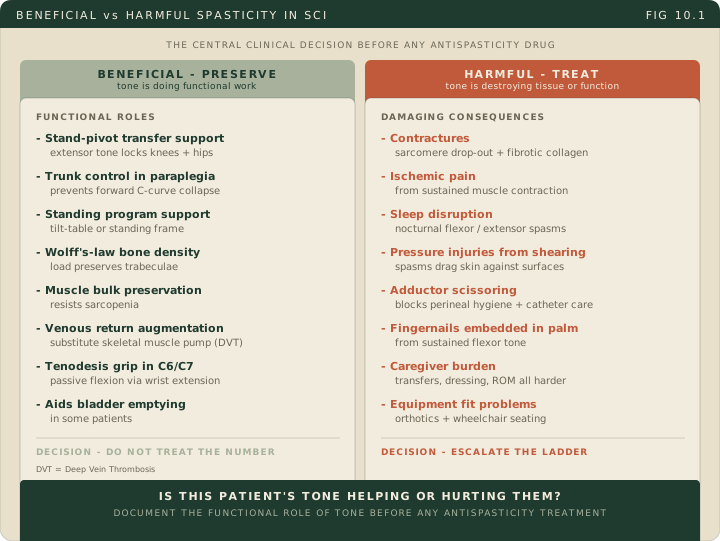
The central clinical decision in spasticity management is whether the patient’s tone is beneficial or harmful. Beneficial spasticity assists transfers when extensor tone in the lower extremities locks the knees and hips into rigid extension during a stand-pivot transfer, supports standing in a frame or with orthotics, maintains trunk control by preventing forward collapse into a C-curve in the wheelchair, preserves muscle bulk, may contribute to skeletal loading, may aid venous return as a partial substitute for the absent skeletal muscle pump, and supports bladder emptying in some patients. Two of those benefits have limits worth stating plainly: the bone-density evidence is inconsistent, so spasticity does not reliably prevent osteoporosis, and any venous-return benefit is not a substitute for indicated venous thromboembolism prophylaxis. Harmful spasticity drives contractures from prolonged shortening, generates ischemic pain, fractures sleep architecture, accelerates pressure injuries through shearing, blocks perineal hygiene through adductor scissoring, and impairs caregiver tasks.
Clinical Pearl — The Spasticity-as-Biological-Brace Concept
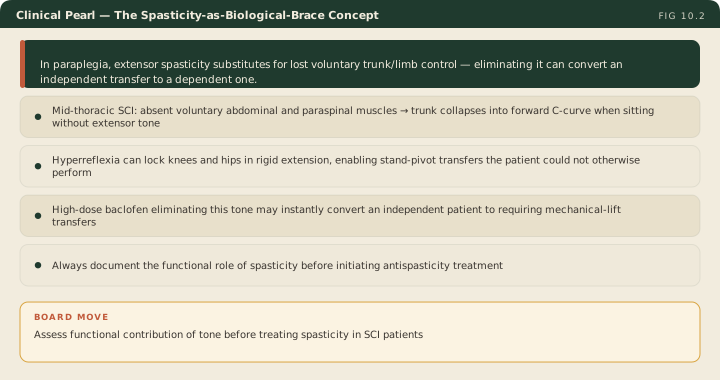
A patient with mid-thoracic paraplegia may have little usable voluntary abdominal and paraspinal musculature, and without extensor tone in the trunk they collapse into a forward C-curve the second they sit up in a wheelchair. The same patient may use hyperreflexia to lock the knees and hips into rigid extension during a modified stand-pivot transfer. Wipe out that tone with high-dose baclofen and you can turn an independent patient into a dependent mechanical-lift transfer. Examine the residual trunk control before you assume it is absent, since it varies between patients, and reassess function during treatment rather than only at the start. Document the functional role of the tone before initiating any antispasticity treatment.
You might pat yourself on the back thinking you cured their spasticity, but what you actually just did was unmask profound underlying weakness. You took away their crutch.
— SCI-10 podcast, ~7:04