Before You Listen
This episode covers the three-tier International Spinal Cord Injury Pain (ISCIP) classification, which separates nociceptive musculoskeletal and visceral pain from at-level and below-level neuropathic pain; the rotator cuff disease that dominates the shoulder differential in long-time manual wheelchair users; the diagnostic trap in which autonomic dysreflexia is the only herald of an acute abdomen; the paradox of burning pain in regions where sensation is impaired; and SCI neuropathic pain management. You will leave knowing every classification tier cold, the Consortium wheelchair fitting numbers, the first-line drugs and the gabapentinoid doses, why chronic opioids are not the starting point, and where tDCS, rTMS and DREZ lesioning sit. Pregabalin carries the FDA indication for neuropathic pain associated with spinal cord injury. The historical podcast contains statements clarified in this updated companion.
What you should already know coming in:
- The Modified Ashworth Scale (MAS) and the spasticity ladder from Episode 10 (baclofen, tizanidine, dantrolene, BoNT, intrathecal baclofen).
- The autonomic dysreflexia (AD) trigger sequence from Episode 9 (bladder first, bowel second, then deeper) and the T6 threshold.
- ASIA Impairment Scale (AIS) grades A through E and the concept of complete versus incomplete injury from Episode 3.
Runtime: 41 minutes.
Vignette. A 34-year-old man with a 6-year-old C6 American Spinal Injury Association (ASIA) Impairment Scale (AIS) A complete tetraplegia presents to your physiatry clinic with two distinct pain complaints. First, he reports a 4-month history of constant, burning, electric pain in both legs and feet that he rates 8 out of 10, worse at night, with no clear positional trigger; he has absent sensation to pinprick below T2 on examination. Second, he reports new right shoulder pain over the past 8 weeks, sharp with overhead reach and during transfers, that limits him to 90 degrees of active flexion. He uses a manual wheelchair full-time. He is on no neuropathic pain medication. Vital signs and recent labs are unremarkable.
Classify each pain syndrome under the ISCIP system, name the most likely shoulder diagnosis given his wheelchair history, choose an initial pharmacologic regimen and describe subsequent options for the leg pain naming the only FDA-approved agent for this indication, and explain why you would not start him on a chronic opioid.
(Answer at the end of this chapter)
Section 1: The Burden of Pain and the ISCIP Three-Tier Classification
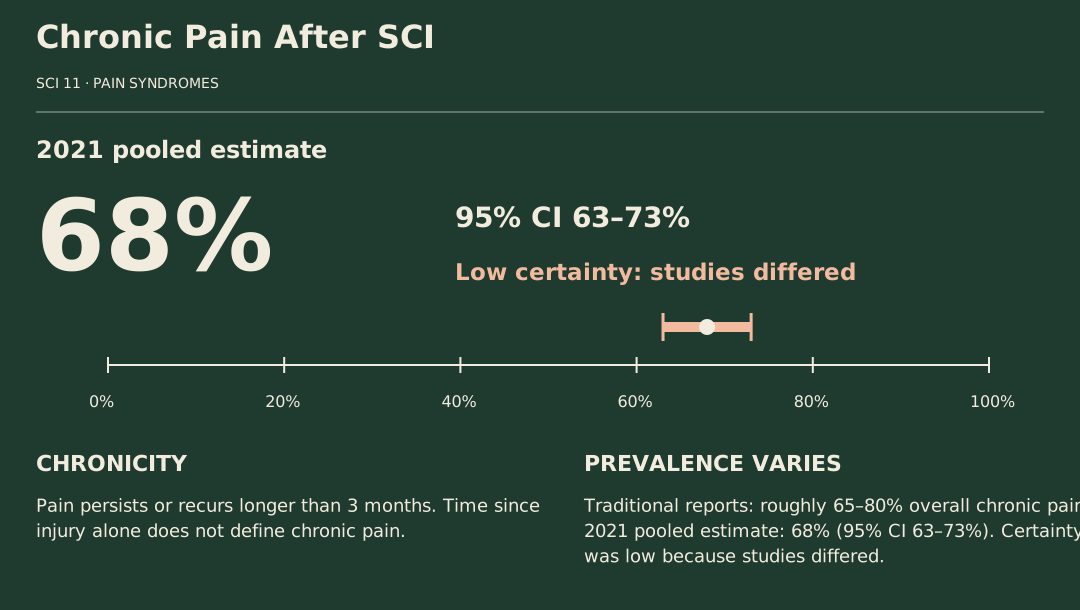
Bottom line: chronic pain means pain persisting or recurring longer than 3 months, and roughly two-thirds to four-fifths of people with SCI develop it, with a 2021 pooled estimate of 68 percent (95 percent CI 63 to 73); the ISCIP taxonomy forces a component-by-component diagnosis (nociceptive versus neuropathic versus other versus unknown at Tier 1, then subtype at Tier 2, then anatomic source at Tier 3) before a single prescription is written, and severity and interference are assessed separately.
Pain after spinal cord injury (SCI) is common and can persist for years. Chronic pain means pain that persists or recurs for longer than 3 months, rather than any pain occurring three months after injury. Reports vary by population and definition: the traditional 65–80% range is an approximation; a 2021 systematic review estimated 68% overall chronic pain (95% CI 63–73%), with low certainty because of unexplained heterogeneity. Severe-pain rates require a specified denominator and severity scale. Pain occurs across levels and completeness grades; a neurologic examination alone cannot predict an individual’s pain, and associations differ by subtype. In one 5-year cohort, 59 of 73 participants (81 percent) reported pain: musculoskeletal in 59 percent, at-level in 41 percent, below-level in 34 percent and visceral in 5 percent. Below-level pain in that cohort was associated with tetraplegia, while overall pain presence was not associated with injury level or completeness. Severe-pain rates require a specified denominator and severity scale, so quote a rate with the cohort it came from.
Distinguishing pain intensity from pain interference is essential. Intensity is the loudness of the alarm; interference is the downstream destruction it causes: disrupted sleep, blocked rehabilitation participation, eroded employment, and social withdrawal. Chronic pain after SCI is independently associated with depression, anxiety, sleep disturbance, fatigue, and reduced participation in rehabilitation. In community-reintegration surveys, pain is consistently cited alongside or even above loss of motor function as the primary barrier to returning to work. This is the framing that motivates the pharmacologic and non-pharmacologic algorithms downstream.
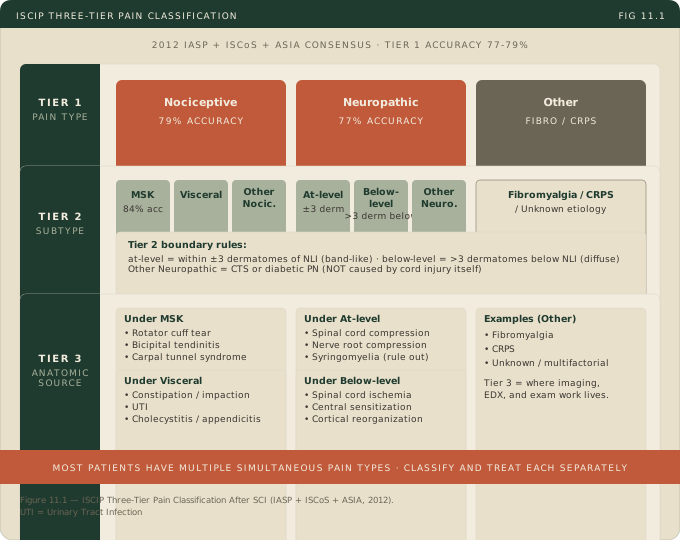
The International Spinal Cord Injury Pain (ISCIP) classification was developed by an international expert group, with feedback from professional societies, and published in 2012. Its three tiers describe pain type, subtype and specific source. Tier 1 has four categories: nociceptive, neuropathic, other and unknown. Nociceptive pain arises from actual or threatened non-neural tissue injury with nociceptor activation; neuropathic pain results from a lesion or disease of the somatosensory nervous system. Other pain includes fibromyalgia and complex regional pain syndrome type I; unknown is separate when the pain cannot be assigned confidently. Tier 2 divides nociceptive pain into musculoskeletal, visceral and other nociceptive, and neuropathic pain into at-level SCI, below-level SCI and other neuropathic. Carpal tunnel syndrome belongs under other neuropathic pain. Tier 3 specifies the source, such as a cuff lesion, fecal impaction or syringomyelia. Multiple pain problems can coexist in one person.
In the original 75-vignette validation exercise, clinicians with minimal training correctly identified nociceptive pain in 79% and neuropathic pain in 77% of classifications. Musculoskeletal correctness was 84%, compared with 85% for visceral pain. These are vignette-classification results, not diagnostic sensitivity in routine practice; the authors described overall reliability as moderate. Classify and treat coexisting shoulder, visceral and neuropathic pain problems separately.
High Yield — ISCIP at-a-glance
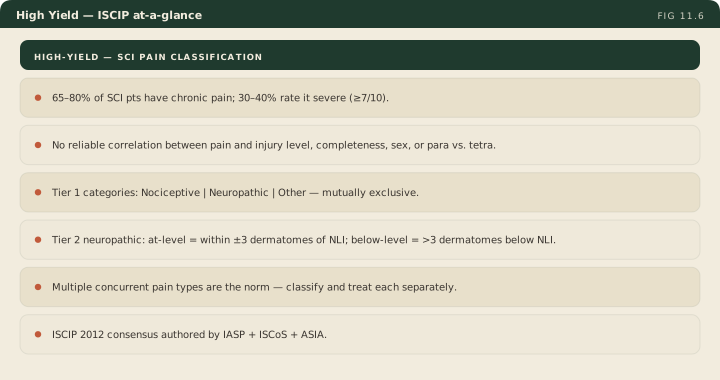
- Chronic pain is common; prevalence depends on population and definition.
- Pain occurs across injury levels and AIS grades.
- Tier 1: Nociceptive | Neuropathic | Other | Unknown.
- At-level: NLI through 3 dermatomes below, may extend 1 above; cauda equina exception.
- Below-level: more than 3 dermatomes below NLI, may extend upward.
- Classify each coexisting pain problem separately.
- Developed by an international expert group, with society feedback.
You can have a patient with an ASIA-D lumbar injury who is in absolute agony. And right next door, an ASIA-A cervical injury patient, with minimal or even no pain complaints whatsoever.
— SCI-11 podcast, ~3:19