Before You Listen
This episode covers the National Pressure Injury Advisory Panel (NPIAP) staging system, the rule against reverse staging, the pressure-shear-friction physics that kills muscle faster than skin, the geographic risk map by body position with the ischial tuberosities as the most common SCI site, the Braden Scale with its six subscales and risk bands and how to score it from observed function in SCI, the prevention numbers (15 to 30 minute pressure relief, 30 to 60 second weight shifts, 30-degree lateral bed positioning every 2 hours, protein 1.25 to 1.5 g/kg/day), moist wound healing principles, negative pressure wound therapy parameters, surgical flap selection by site with the postoperative sitting protocol, and the four life-threatening complications (osteomyelitis, sepsis, Marjolin ulcer, secondary amyloidosis).
What you should already know coming in:
- The autonomic dysreflexia (AD) trigger algorithm from Episode 5: pressure injury and acute abdomen are deep-search triggers after bladder and bowel are cleared.
- Neurogenic bowel and bladder programs from Episodes 6 and 7, because moisture management directly reduces pressure injury risk.
- The American Spinal Injury Association (ASIA) Impairment Scale (AIS) grades and the concept that complete sensory loss eliminates protective discomfort signaling.
Runtime: 29 minutes.
Vignette. A 42-year-old woman with a 9-year-old T4 American Spinal Injury Association (ASIA) Impairment Scale (AIS) A complete paraplegia is admitted from a community wheelchair clinic with a new wound over her right ischial tuberosity. On examination, the wound is 4 cm by 3 cm with a crater depth of 2.5 cm. Subcutaneous adipose tissue is clearly visible in the wound bed, with rolled epibole edges and approximately 30% slough; the tissue-loss extent is assessable and no fascia, muscle, tendon, ligament, cartilage or bone is exposed or directly palpable. Surrounding skin is warm but not fluctuant, and there is no purulent drainage. An intake form records a Braden Scale score of 9, but the subscale observations are not documented. Serum albumin is 2.9 grams per deciliter (g/dL); prealbumin is 12 milligrams per deciliter (mg/dL). She smokes half a pack per day and uses a standard foam wheelchair cushion.
Stage this pressure injury, explain how you would verify the reported Braden score and use all subscales to guide interventions, list the prevention numbers you would change today (cushion, sitting tilt, repositioning, nutrition, smoking), explain whether and when you would offer surgical flap closure, and state the documentation rule you must follow if this wound heals.
(Answer at the end of this chapter)
Section 1: NPIAP Staging — Four Stages, Two Categories, and the No-Reverse-Staging Rule
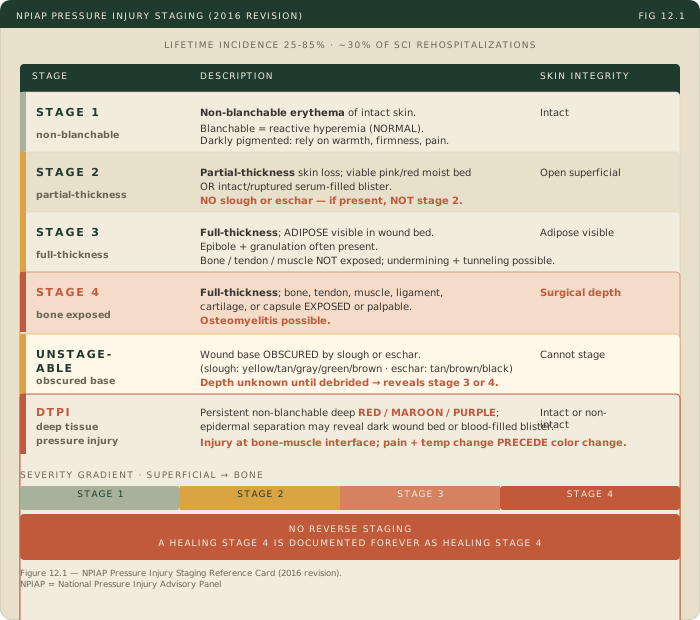
Bottom line: the NPIAP system has 4 numerical stages plus 2 additional categories (unstageable, deep tissue pressure injury); stage 2 is partial-thickness loss with exposed dermis and no slough or eschar, stage 3 is full-thickness loss with visible adipose and nothing deeper exposed, stage 4 has exposed or directly palpable fascia, muscle, tendon, ligament, cartilage or bone, and an injury whose extent is obscured is unstageable until it can be assessed; an open injury is documented as healing at its original stage and a closed one as healed at that stage, never restaged downward, because lost tissue is replaced by scar that regains about 80% of native tensile strength.
Pressure injuries are among the most common and costly complications of spinal cord injury (SCI). Most, but not all, are preventable; physiological constraints can limit prevention even when care is appropriate. The lifetime incidence ranges from 25% to 85%. At any given time, approximately 20 to 30% of community-dwelling individuals with SCI carry at least one pressure injury. Treating a single stage 4 injury costs $20,000 to over $150,000. Mortality in SCI patients with pressure injuries is 2 to 5 times higher than in those without, and sepsis from infected pressure injuries is a leading cause of death in chronic SCI. Read the mortality figure as an association, not a causal multiplier.
Pressure injuries are an important cause of rehospitalization after SCI, but the rank and the share depend entirely on the cohort, the follow-up and how an admission is defined. Two studies show why. Cross-sectional follow-up of 8,668 people at 16 US Model Systems centers from 1995 to 2002 identified genitourinary conditions as the leading cause, with skin and respiratory causes varying by injury group. Australian linked records from 1989 to 2000 found that pressure sores accounted for 6.6% of 977 readmissions but 27.9% of all bed-days. Different denominators, different answers, and the same clinical point: a pressure injury is a long admission. Cardenas 2004, Middleton 2004
Two dates get conflated. The National Pressure Ulcer Advisory Panel (NPUAP) revised the terminology from “pressure ulcer” to “pressure injury” in 2016, along with the stage definitions. The organization itself changed its name to the National Pressure Injury Advisory Panel (NPIAP) in 2019. The system has 4 numerical stages plus 2 additional categories (unstageable and deep tissue pressure injury, DTPI), and the stages describe observed anatomy rather than a required sequence: an injury does not have to pass through stage 1 on its way to stage 4.
Stage 1 is non-blanchable erythema of intact skin. The skin is intact with no break in the epidermis, and the erythema persists after pressure release. The board-favorite distinction: pressing a finger on blanchable erythema turns the skin white and it returns to red on release (reactive hyperemia, normal); non-blanchable erythema stays red under finger pressure because red blood cells have already extravasated into the interstitium, meaning tissue damage has already occurred. In darkly pigmented skin, visible erythema may not be apparent and the clinician must rely on temperature, firmness, and pain changes versus surrounding tissue.
Stage 2 is partial-thickness skin loss with exposed dermis. The wound bed is viable, pink or red, and moist. An intact or ruptured serum-filled blister qualifies. Granulation tissue, slough, and eschar are NOT present in stage 2. If they are, the injury cannot be staged as 2, though slough by itself does not make it a stage 3 either. This stage is also not used for moisture-associated skin damage, medical adhesive-related skin injury, or skin tears unrelated to pressure and shear.
Stage 3 is full-thickness skin loss with adipose tissue visible in the wound bed. Granulation tissue and rolled wound edges (epibole) are often present. Fascia, muscle, tendon, ligament, cartilage and bone are not exposed or directly palpable; those findings make it stage 4. Slough or eschar may be present, but if it obscures the extent of tissue loss the injury is unstageable. Undermining and tunneling may occur. Depth varies by anatomic location: buttocks can develop deep stage 3 injuries, while the occiput or malleolus may be quite shallow.
Stage 4 is full-thickness skin and tissue loss with exposed or directly palpable fascia, muscle, tendon, ligament, cartilage, or bone. Slough or eschar may be present. Undermining and tunneling are often extensive. The injury can extend into supporting structures, making osteomyelitis possible.
Unstageable injuries are full-thickness with the wound base obscured by slough or eschar (slough may be yellow, tan, gray, green, or brown; eschar may be tan, brown, or black). The true depth cannot be determined until enough is removed; the wound is then revealed as either stage 3 or stage 4. Deep tissue pressure injury (DTPI) presents as intact or non-intact skin with localized persistent non-blanchable deep red, maroon, or purple discoloration, or epidermal separation revealing a dark wound bed or blood-filled blister. It results from intense or prolonged pressure and shear at the bone-muscle interface; pain and temperature change often precede skin color changes. The 2016 revision dropped the word “suspected” from the DTPI designation. A DTPI may evolve rapidly to full-thickness injury despite optimal treatment.
The single most-tested documentation principle is the no-reverse-staging rule. While the wound is open and improving, document it as a healing stage 4. Once it is closed, document a healed stage 4, keeping the stage, the history and the prevention plan. Never restage down to 3, 2, 1, or 0. Deep injuries heal by secondary intention: granulation tissue forms, the wound contracts, and re-epithelialization closes the surface. The lost muscle, subcutaneous fat, and dermis are replaced by scar tissue, not by regeneration of the original tissue layers. Scar regains a maximum of about 80% of the tensile strength of native skin, lacks normal elasticity, has reduced vascularity, and lacks the sweat glands and subcutaneous architecture needed to regulate local microclimate. Restaging downward would falsely communicate that the tissue has the resilient architecture of a superficial wound, leading to under-protection. Progress is documented by serial wound dimensions (length, width, depth in centimeters), the percentage of wound bed covered by granulation versus slough/eschar, reduction in undermining and tunneling, and advancement of wound edges.
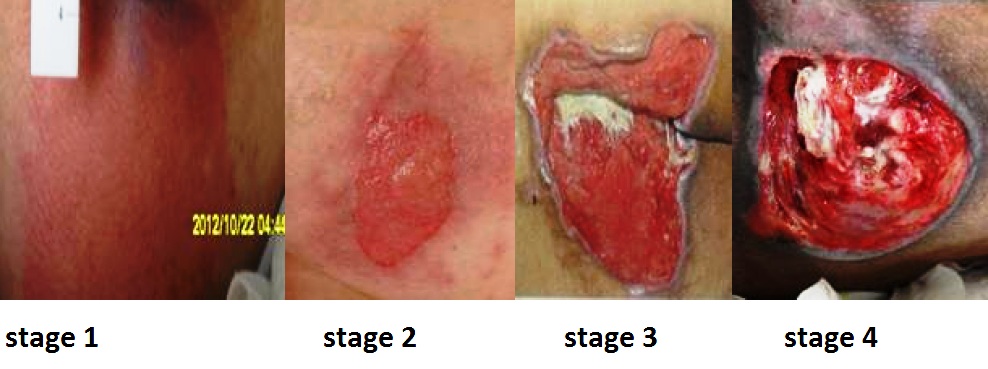
Source: Babagolzadeh, “Stages of wound in pressure ulcer”, via Wikimedia Commons, CC BY-SA 3.0. https://commons.wikimedia.org/wiki/File:Wound_stage.jpg
High Yield — NPIAP staging boundaries
- Stage 1: non-blanchable erythema of intact skin. Blanchable erythema is NOT a pressure injury.
- Stage 2: partial-thickness loss with exposed dermis, or an intact or ruptured serum-filled blister. Slough and eschar exclude it; slough alone does not establish stage 3.
- Stage 3: full-thickness loss with visible adipose and no exposed or directly palpable fascia or deeper structures.
- Stage 4: fascia, muscle, tendon, ligament, cartilage, or bone exposed or directly palpable.
- Unstageable: slough or eschar obscures the extent of full-thickness loss. Once assessable, it becomes stage 3 or stage 4.
- DTPI: intact or non-intact skin with persistent deep red, maroon or purple discoloration, or epidermal separation revealing a dark wound bed or blood-filled blister. Pain and temperature change may precede color change.
- Stages describe observed anatomy, not a required sequence.
- NO reverse staging. Healing stage 4 while open; healed stage 4 once closed. Never stage 0.
- Terminology changed in 2016; the organization was renamed in 2019.
- Lifetime incidence after SCI: 25 to 85%. Community point prevalence 20 to 30%. Stage 4 treatment costs $20,000 to over $150,000.