Before You Listen
- Prerequisites: spinal cord neuroanatomy and the American Spinal Injury Association Impairment Scale (AIS) from SCI-01 and SCI-03; pressure injury prevention and the Braden Scale from SCI-12; autonomic dysreflexia (AD) physiology from SCI-05; basic musculoskeletal anatomy and orthopedic principles.
- Runtime: 53 minutes.
- Topic in one line: heterotopic ossification (HO) of the hip, with a nonspecific alkaline phosphatase (ALP) and a triple-phase bone scan that turns positive before the radiograph; NSAID prophylaxis versus etidronate treatment versus peri-excision radiation; sublesional osteoporosis at the distal femur and proximal tibia; fragility fractures that present painlessly and never get a circumferential cast; carpal tunnel syndrome (CTS) in manual wheelchair users; the functional outcomes table by neurologic level; the tenodesis grasp and the therapeutic error of overstretching the flexor tendons; the orthotic ladder of knee-ankle-foot orthosis (KAFO) through L2 to ankle-foot orthosis (AFO) from L3; the Functional Independence Measure (FIM) and its ceiling effect; driving from C5 down; concurrent traumatic brain injury (TBI); cervical spondylotic myelopathy; and transverse myelitis with the lesion-length distinction.
Vignette. A 32-year-old man with C6 motor-complete tetraplegia (AIS A) is 6 weeks post-injury and medically stable. His admission FIM is 38; today his FIM is 64. The team is preparing him for discharge. His mother asks whether he will walk again, whether he can live alone, what equipment he needs, and what changes the family must make to the house. On exam, his elbow flexes against gravity (biceps), his wrist extends against gravity (extensor carpi radialis), and his triceps test 0 of 5. Sensation is intact to the C6 dermatome and absent below.
Based on his injury level, what realistic functional outcomes should you describe for activities of daily living (ADLs), mobility, and transfers? What rehabilitation principle is most easily violated by a well-meaning therapist or family caregiver? What equipment will he need? What housing modifications are essential? Will he walk?
Section 1: Heterotopic Ossification
Bottom line: HO is mature lamellar bone forming in soft tissues around joints below the SCI lesion, and the hip is the most common site. It becomes apparent in the first few months after injury, most often around two months. ALP rises but is nonspecific, so the diagnosis is made on imaging and a negative early study does not close the question. Acute prophylaxis is an NSAID: slow-release indomethacin 75 mg daily for 3 weeks. Etidronate belongs to the treatment arm and its regimens are historical. Radiation is used around surgical excision, not as acute prophylaxis. Surgical timing is individualized. HO, DVT, infection and fracture all cause a swollen, warm limb: obtain duplex ultrasound when DVT is suspected, and finding HO does not exclude DVT.
HO is mature lamellar bone forming in soft tissues around joints below the SCI lesion. The hip is the most common SCI-associated joint site. Associated brain injury or local trauma produces HO above the lesion. Pathogenesis involves aberrant differentiation of mesenchymal stem cells into osteoblastic lineages, driven by local inflammatory mediators, altered vascular permeability, loss of sympathetic regulation of bone metabolism, circulating osteogenic growth factors, and venous stasis.
Reported HO frequency varies with population, diagnostic method and follow-up. Imaging-detected HO, range-limiting HO and ankylosis are different outcomes with different denominators, so they cannot be read off one another. HO becomes apparent during the first few months after SCI, most often around two months.
More complete injuries, spasticity, pressure injuries, urinary tract infections and coexisting DVT are all associated with HO. Use gentle range of motion and avoid forceful joint mobilization: aggressive stretching by a therapist or family member is counterproductive.
The clinical presentation is swelling, warmth, erythema and decreased range of motion, sometimes with low-grade fever. HO, DVT, infection and fracture all cause a swollen, warm limb. Obtain prompt duplex ultrasound when DVT is suspected and investigate the other causes concurrently. Finding HO does not exclude DVT.
Serum alkaline phosphatase (ALP) reflects osteoblastic activity and rises in HO, but it is nonspecific: a normal value does not exclude early HO and an elevated value does not establish it. Investigate clinical suspicion with imaging (Citak 2016).
Bone scintigraphy detects active HO before mineralization is visible on radiographs. The study is a triple-phase technetium-99m methylene diphosphonate scan, and all three phases (flow, blood pool, delayed) are positive in active HO. Early false-negative scans occur: in a 60-patient suspected-HO series, 24 scans were initially negative at 27 to 57 days after injury, and 7 of the 13 rescanned for persisting suspicion turned positive. Rescan when the suspicion holds, because an early negative scan can precede a positive one. Skilled musculoskeletal ultrasound also detects early changes, and it was suspicious in 193 of 217 confirmed hip HO cases. Radiographs identify mineralized bone and help evaluate alternative diagnoses; CT provides detailed anatomy for diagnosis or surgical planning (early false-negative series; ultrasound study).
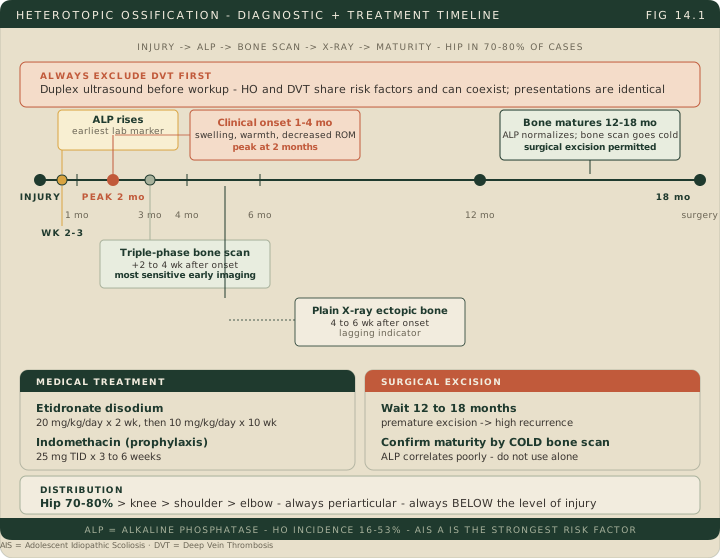
Treatment begins with gentle range of motion, avoiding aggressive stretching. Keep the three drug arms separate, because they answer different questions.
Acute-phase prophylaxis is an NSAID. The randomized acute-SCI trial used slow-release indomethacin 75 mg once daily for 3 weeks, begun about 3 weeks after injury (21 plus or minus 14 days), and it cut early HO from 65 to 25 percent and late radiographic disease from 41 to 12.5 percent. A second randomized trial used a selective COX-2 inhibitor at 25 mg daily for 4 weeks in 76 patients, so the NSAID class rather than the single agent is the point. Pooled across 5 studies and 815 patients the NSAID effect was relative risk 0.32 (95% CI 0.15 to 0.68); the bisphosphonate estimate was relative risk 1.30 (95% CI 0.52 to 3.24), which is inconclusive rather than proof of no effect, and an older 149-patient etidronate trial reported reduced radiographic severity. This is prevention evidence and does not treat established HO (Banovac 2001; Banovac 2004; Yolcu 2020).
Etidronate belongs to the treatment arm, and its regimens are historical. It inhibits mineralization of osteoid rather than preventing osteoid formation. In the uncontrolled 40-person series of scan-positive, radiograph-negative patients, treatment was IV 300 mg daily for 3 days, then oral 20 mg/kg/day for about 6 months, and 11 of the 40 (27.5 percent) still developed radiographic HO, almost all of it mild. An early rise in serum creatine kinase predicts onset and severity, but that is a prognostic association and not a dosing trigger. The original labeled 12-week oral schedule was 20 mg/kg/day for 2 weeks, then 10 mg/kg/day for 10 weeks; it is the historical prophylaxis regimen, not current treatment dosing. Prolonged use causes osteomalacia (Banovac 2000; Sherman 2003).
Radiation is used around surgical excision to prevent recurrence, not as acute prophylaxis. The neurogenic-HO evidence is thin: a matched cohort of 19 radiated versus 76 excision-only patients showed no recurrence benefit, and sepsis requiring revision was associated with radiation, though prior recurrence was far more common in the radiated group and confounds the comparison. No SCI dose or timing protocol is established, so individualize the decision with the radiation oncologist rather than importing an arthroplasty schedule (Honore 2020).
Surgical excision is indicated when HO restricts range enough to impair sitting, transfers or positioning, threatens skin, or compresses neurovascular structures. The classic teaching delays excision to 12 to 18 months after onset and confirms maturity with a cold bone scan, because ALP correlates poorly with bone activity. That wait is not a proven prerequisite: in a 357-patient surgical cohort delay was not associated with recurrence, and 181 procedures done within a year had no recurrence at 6 months. Time the operation to the individual’s function, anatomy and operative risk (Genet 2011).
Board Trap: HO vs DVT
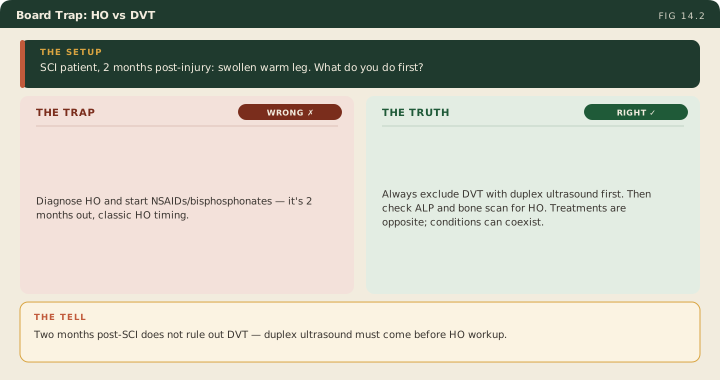
A swollen, warm extremity in an SCI patient 2 months after injury could be HO, DVT, infection or fracture, or more than one at once. Obtain prompt duplex ultrasound when DVT is suspected and investigate the other causes concurrently; finding HO does not exclude DVT. ALP is a nonspecific adjunct, so use ultrasound or bone scintigraphy for early HO. The treatments are opposite: DVT needs anticoagulation, HO needs gentle range of motion plus an NSAID.
High Yield: Heterotopic Ossification
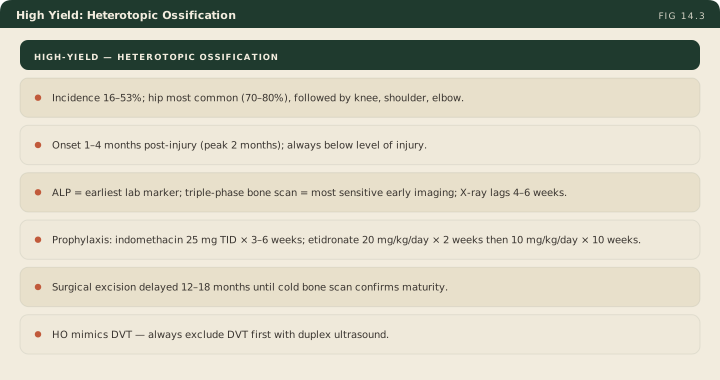
- The hip is the most common SCI-associated joint site. Reported frequency depends on the population, the diagnostic method and whether the outcome counted is imaging-detected HO, range-limiting HO or ankylosis.
- HO becomes apparent during the first few months after SCI, most often around two months. It forms around joints below the lesion; HO above the lesion follows a brain injury or local trauma.
- ALP is nonspecific. The triple-phase technetium-99m bone scan shows all three phases positive in active HO and turns positive before mineralization is visible on plain films; skilled ultrasound also detects early disease. A negative early study does not exclude HO, so rescan when suspicion persists.
- Plain radiographs are negative early, before the bone mineralizes.
- Prophylaxis is an NSAID: slow-release indomethacin 75 mg daily for 3 weeks, started early (early HO 65 to 25 percent, late radiographic disease 41 to 12.5 percent; pooled NSAID RR 0.32). Bisphosphonate prophylaxis is not supported (pooled RR 1.30, CI crosses 1).
- Etidronate is the treatment arm: IV 300 mg daily for 3 days, then oral 20 mg/kg/day for about 6 months, with 27.5 percent still developing radiographic disease. The two-step 12-week schedule is historical.
- Radiation prevents recurrence around excision, not acute HO; no SCI dose or timing protocol is established.
- Surgery is for HO that limits sitting, transfers, positioning or skin. The classic wait is 12 to 18 months with a cold bone scan; the surgical cohorts do not show delay reduces recurrence, so time it to the individual.
- Suspected DVT warrants prompt duplex; HO and DVT coexist, so evaluate both concurrently.
A sudden uncharacteristic jump in baseline spasticity in a patient who is one to four months out from their injury is a massive red flag.
— SCI-14 podcast, ~6:57
An inflamed joint at two months post-injury in a spinal cord injury patient is heterotopic ossification until proven otherwise.
— SCI-14 podcast, ~4:49