Before You Listen
- Prerequisites: basic neuroanatomy of the cranial vault and bridging-vein subdural mechanism; awareness that the Glasgow Coma Scale (GCS) ranges 3 to 15; familiarity with mechanisms of injury terminology (fall, motor vehicle crash [MVC], assault, firearm, blast).
- Runtime: 44 minutes.
- Topic in one line: the silent epidemic burden numbers, the bimodal age distribution, the divergence between leading cause of emergency department (ED) visits (falls) and leading cause of death (firearms), the three competing definitions of mild traumatic brain injury (mTBI) including American Congress of Rehabilitation Medicine (ACRM 1993 plus 2023 revision), World Health Organization (WHO 2004), and Department of Defense / Veterans Affairs (DoD/VA 2007 / 2021), the 2025 NINDS CBI-M framework, the worst-indicator severity rule, the complicated-vs-uncomplicated mild TBI distinction, traumatic brain injury (TBI) as a chronic disease per the 2024 Centers for Medicare and Medicaid Services (CMS) ruling, chronic traumatic encephalopathy (CTE) sulcal-depth tau pattern versus Alzheimer disease gyral-crest pattern, the four blast injury mechanisms with primary blast as the unique tested concept, intimate partner violence (IPV) as the most under-recognized population, and the prevention ladder anchored by the Lystedt Law template.
Vignette. A 17-year-old high school football player takes a hit during practice that briefly leaves him seeing stars but he never loses consciousness. He returns to play later in the game, takes a second routine tackle, and collapses with rapidly progressive obtundation and unilateral pupillary dilation. Head CT shows diffuse cerebral edema without a focal mass lesion. His state has prevention legislation requiring three specific elements before he could have returned to play. On post-mortem examination years later in athletes with similar repetitive impact histories, a hallmark protein deposition is found at a stereotyped anatomical location.
What syndrome did this athlete develop, what is the named state law that should have kept him out of the second play, what three elements does that law require, and where does the chronic traumatic encephalopathy tau protein deposit (and how does that distribution differ from Alzheimer disease)?
Section 1: The Silent Epidemic — Burden, Demographics, and Mechanism Divergence
Bottom line: 2.8 million TBI-related ED visits, hospitalizations and deaths combined per year, 5.3 million Americans living with TBI-related disability, 69,000 deaths per year, $76.5 billion in annual cost; the bimodal age curve peaks in the very young (0-4) and the very old (≥75); falls lead ED visits, but firearms now lead deaths.
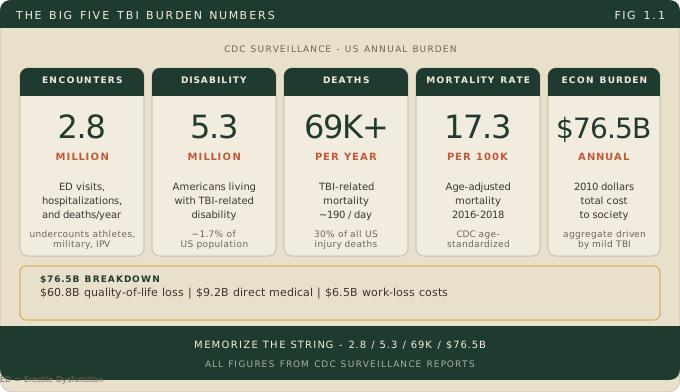
Traumatic brain injury (TBI) is a public health problem so common and so under-counted that the field still calls it a silent epidemic. Centers for Disease Control and Prevention (CDC) surveillance estimates 2.8 million TBI-related emergency department visits, hospitalizations, and deaths annually in the United States. That number captures only patients who reach formal medical care, so it systematically excludes athletes who are quietly removed from play and rested, service members with deployment-acquired blast exposure, and survivors of intimate partner violence (IPV) who never present. An estimated 5.3 million Americans (about 1.7% of the population) live with TBI-related disability, and the Traumatic Brain Injury Model Systems (TBIMS) National Database has demonstrated that the disability trajectory is dynamic rather than static: patients improve, plateau, or decline across decades.
The mortality is dominated by long-term loss of life and lost productivity. More than 69,000 TBI-related deaths occur annually, roughly 190 per day, with a 2016-2018 age-adjusted mortality rate of 17.3 per 100,000 per year. The total economic burden is estimated at $76.5 billion in 2010 dollars. Direct medical costs are only $9.2 billion; work-loss costs add $6.5 billion; the dominant slice ($60.8 billion) is the value of lost quality-adjusted life years. Per-person lifetime cost is highest for fatal injuries at about $400,000, but the aggregate cost is driven by mild TBI because incidence of mild injury is so much higher.
Mortality count by year — More than 69,000 TBI-related deaths occurred in 2021, roughly 190 per day; the count was about 167 per day in 2017 and 176 in 2020, so the figure moves with the surveillance year and 190 per day is the current answer.
Demographics follow two patterns boards test. Males are affected at substantially higher rates than females across nearly every age group: the male-to-female ratio is roughly 2.5:1 for hospitalizations and 3:1 for deaths (28.3 vs 8.4 per 100,000 in the 2020 mortality surveillance). Age distribution is bimodal by rate: the highest ED visit rates occur in children 0-4 years and the highest hospitalization and death rates in adults ≥75 years, while adolescents and young adults 15-24 years carry the highest MVC-related incidence. Adults ≥75 years account for nearly one-third of all TBI hospitalizations and more than one-quarter of TBI deaths.
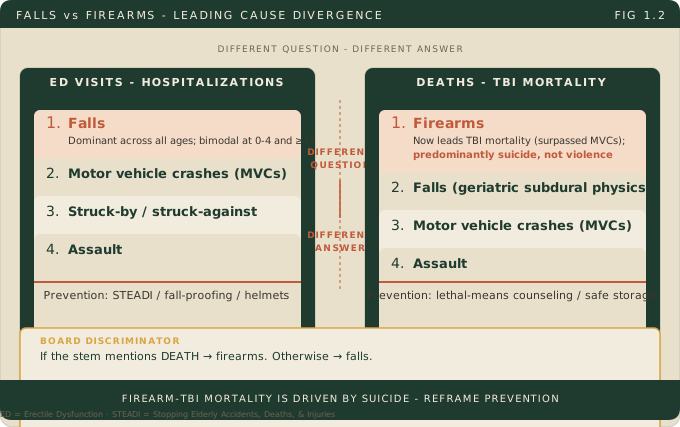
The mechanism distribution is the question writers’ favorite trap. Falls are the number-one cause of ED visits and hospitalizations in the population as a whole, led by young children and older adults, while MVCs lead in adolescents and young adults, with assault second in that band. Firearms are now the number-one cause of TBI-related death, surpassing motor vehicle crashes (MVCs), and the firearm category is driven predominantly by suicide rather than interpersonal violence. Below firearms in the mortality ranking sit falls (second), MVCs (third), and assaults (fourth). If a stem asks the leading cause of TBI without specifying death versus visits, the discriminator is whether mortality is mentioned: ED visits → falls; death → firearms.
High Yield — Burden and demographic anchors
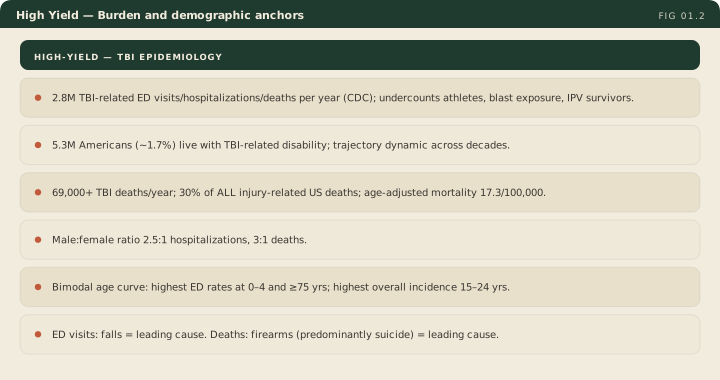
- 2.8 million TBI-related ED visits, hospitalizations, and deaths per year (CDC); under-counts athletes, service members with blast exposure, and IPV survivors.
- 5.3 million Americans (~1.7% of population) live with TBI-related disability; trajectory is dynamic across decades, not static.
- 69,000+ TBI deaths/year; age-adjusted mortality 17.3 per 100,000; 30% of all injury-related deaths in the US.
- Male:female ratio 2.5:1 hospitalizations, 3:1 deaths.
- Bimodal age curve: highest ED visit rates at 0-4 years, highest hospitalization and death rates at ≥75 years; 15-24 years carries the highest MVC-related incidence.
- ED visits leading cause = falls; deaths leading cause = firearms (predominantly suicide).
Mnemonic — The 2-5-69-76 anchor
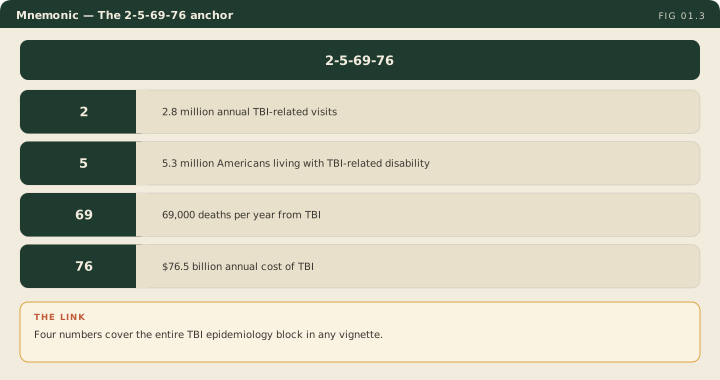
2.8 million visits, 5.3 million living with disability, 69,000 deaths a year, $76.5 billion in annual cost. Memorize the four numbers as a single string and you have the entire epidemiology block of any TBI vignette.
It’s an economy of scale. The individual severe case is a financial catastrophe. But millions of mild cases, each generating thousands of dollars in lost productivity and outpatient care, completely dwarf the severe cases on a national level.
— TBI-01 podcast, ~7:51