Before You Listen
- Prerequisites: familiarity with the TBI severity matrix from Episode 1 (mild / moderate / severe by Glasgow Coma Scale [GCS], loss of consciousness [LOC] duration, post-traumatic amnesia [PTA] duration); awareness that vegetative state has been renamed unresponsive wakefulness syndrome.
- Runtime: 48 minutes.
- Topic in one line: the Teasdale-Jennett Glasgow Coma Scale (GCS) with motor as the highest-yield subscale (decorticate at 3 above the red nucleus vs decerebrate at 2 below); the GCS-Pupils (GCS-P) mortality stratification; the intubated-patient GCS-T workaround and the FOUR Score that fixes both the verbal and brainstem-reflex blind spots; the Glasgow Outcome Scale (GOS) and Glasgow Outcome Scale Extended (GOS-E) trial endpoints; the inverted Disability Rating Scale (DRS); the ten Rancho Los Amigos Levels of Cognitive Functioning (LCFS) with Level 4 (confused-agitated) as the agitation peak; the Functional Independence Measure (FIM) ceiling effect in TBI; the Coma Recovery Scale-Revised (CRS-R) with MCS-plus vs MCS-minus prognostic split and the 40% vegetative-state misdiagnosis rate; Galveston Orientation and Amnesia Test (GOAT) ≥76 × 2 days and Orientation Log (O-Log) ≥25 × 2 days as PTA emergence thresholds; the Mayo Classification, the Marshall / Rotterdam / Stockholm CT scoring systems; the GFAP/UCH-L1 (Banyan Brain Trauma Indicator) and the ALERT-TBI 99.6% negative predictive value (NPV); and cognitive motor dissociation (CMD) in 25% of behaviorally unresponsive patients.
Vignette. A 34-year-old man is brought to the trauma bay after a high-speed motor vehicle crash. He opens his eyes only to a trapezius squeeze, makes incomprehensible groaning sounds, and his upper extremities flex and adduct toward his chest with simultaneous lower extremity extension when his nail bed is pressed. His right pupil is 6 mm and unreactive while his left pupil is 3 mm and briskly reactive. He is intubated for airway protection and brought to the intensive care unit (ICU). On hospital day 30 he opens his eyes spontaneously but does not follow commands, does not visually track, and shows only reflexive movements; on hospital day 45, formal Coma Recovery Scale-Revised (CRS-R) testing demonstrates inconsistent visual pursuit and localization to a noxious stimulus, but no command following, no functional object use, and no intelligible verbalization.
What are this patient’s initial Glasgow Coma Scale (GCS) and Glasgow Coma Scale-Pupils (GCS-P) scores, what motor posturing pattern is he showing and what is its prognostic implication, why is the Coma Recovery Scale-Revised (CRS-R) the recommended (Level B) bedside instrument here, and what disorder of consciousness category does the day-45 examination place him in (and which subcategory carries the better prognosis)?
Section 1: The Glasgow Coma Scale and Its Limitations
Bottom line: the GCS scores eye (1-4), verbal (1-5), and motor (1-6) for a total of 3-15; motor is the highest-yield subscale (decorticate = 3 above the red nucleus, decerebrate = 2 below); GCS ≤8 = coma and intubation; the verbal blind spot in intubated patients is recorded as “T” suffix.
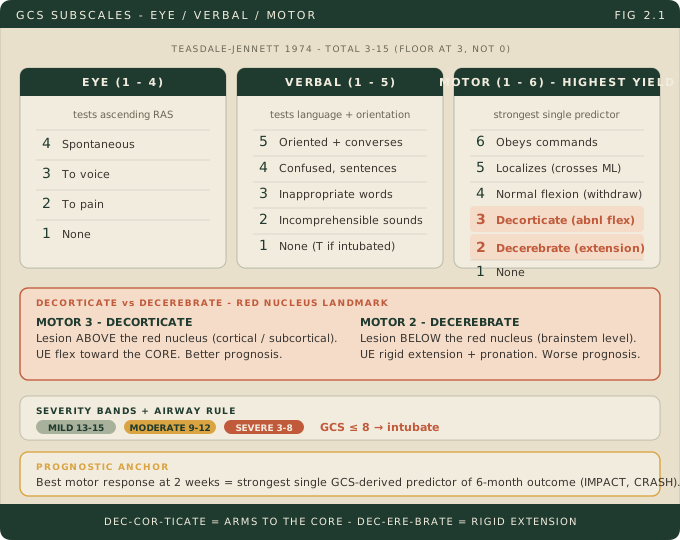
The Glasgow Coma Scale (GCS) was introduced by Graham Teasdale and Bryan Jennett at the University of Glasgow in 1974 to replace the vague vocabulary of stuporous, obtunded, and lethargic with a standardized, reproducible bedside score. It assesses three independent neurological domains: eye opening (1-4), verbal response (1-5), and motor response (1-6), summing to a composite of 3-15. The minimum is 3, not 0, because each subscale floors at 1 (no response).
Eye opening (1-4) tests the ascending reticular activating system (ARAS) of the brainstem. Score 4 = spontaneous eye opening; 3 = opens to voice; 2 = opens only to pain (trapezius squeeze, nail bed pressure); 1 = no eye opening. Verbal response (1-5) tests language and orientation: 5 = oriented and converses; 4 = confused but speaks in grammatical sentences; 3 = inappropriate words; 2 = incomprehensible sounds; 1 = none. Motor response (1-6) is the highest-yield subscale: 6 = obeys commands; 5 = localizes pain (movement crosses the midline toward the stimulus); 4 = normal flexor withdrawal (a spinal reflex, not purposeful); 3 = abnormal flexion (decorticate posturing) with upper-extremity flexion at the elbows toward the core; 2 = extension (decerebrate posturing) with rigid upper-extremity extension and pronation; 1 = no motor response.
The decorticate-vs-decerebrate distinction is the single most heavily tested motor concept in this episode. Decorticate posturing (motor 3) indicates a lesion above the red nucleus (cortical or subcortical) and carries a relatively better prognosis. Decerebrate posturing (motor 2) indicates a brainstem-level lesion below the red nucleus and carries a substantially worse prognosis. The mnemonic that anchors the difference: decCORticate flexes the arms toward the core (heart); decerebrate extends rigidly with the arms straight down at the sides.
Among the three subscales, the motor component carries the strongest prognostic value across multiple large databases including the International Mission for Prognosis and Analysis of Clinical Trials (IMPACT) and the Corticosteroid Randomization After Significant Head Injury (CRASH) datasets. The best motor response at 2 weeks post-injury is the strongest single GCS-derived predictor of 6-month outcome, and the motor score alone performs nearly as well as the full composite for prognostication. The total GCS classifies severity into mild (13-15), moderate (9-12), and severe (3-8). The GCS ≤8 → intubate rule reflects the high aspiration risk that attends coma, in which airway-protective reflexes (gag, swallow) are often impaired.
The GCS has well-known limitations boards exploit. The verbal component cannot be assessed in intubated patients: by convention, the verbal score is recorded with a T suffix (e.g., E2 VT M4), reducing the scale to a 10-point range. Sedation depresses the score by roughly 1.5 to 2 points on average, and neuromuscular blockade renders the motor subscale unreliable. Alcohol, opioids, benzodiazepines, and stimulants each confound different components, making toxicology screening essential. Inter-rater variability is moderate, with the motor component paradoxically showing the greatest disagreement at the withdrawal-vs-localization (4 vs 5) cut. The floor effect at 3 provides no discrimination among the most severely injured patients and does not distinguish brain death. The GCS does not evaluate brainstem reflexes (pupillary, corneal, cough), all of which carry critical prognostic information.
The ideal assessment timing is after resuscitation (after blood pressure, oxygenation, and glucose are corrected) and before sedatives or paralytics are given. A patient who arrives hypotensive and hypoxic from a leg wound may look comatose; correct the systemic insult, and the residual GCS is the true neurological baseline.
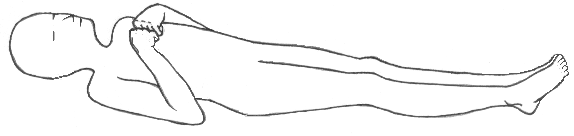
Source: Delldot at English Wikipedia, via Wikimedia Commons, public domain. https://commons.wikimedia.org/wiki/File:Decorticate.PNG
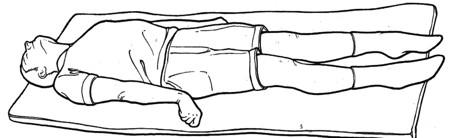
Source: CueFlash, Wikimedia Commons, copyrighted free use. https://commons.wikimedia.org/wiki/File:Decerebrate.jpg
Board Trap — The intubated GCS
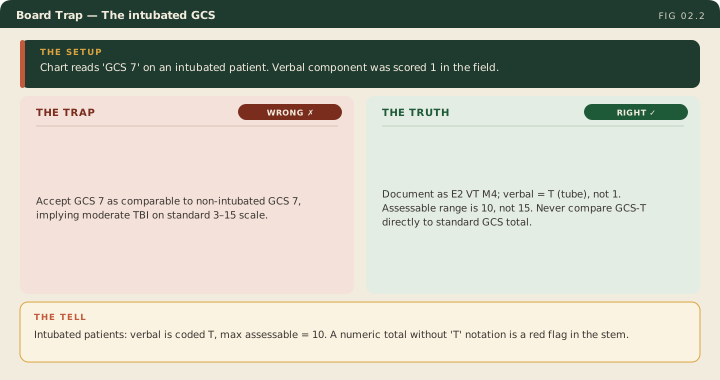
A patient labeled “GCS 7” while intubated who arrived from the field with a verbal score of 1 is misleading: the chart should read E2 VT M4 (verbal recorded as T for tube), making the assessable range 10 instead of 15. Never compare an intubated GCS-T directly to a non-intubated GCS total. If a stem gives you only a numeric total in an intubated patient, suspect the writer is testing whether you recognize the verbal blind spot.
High Yield — GCS
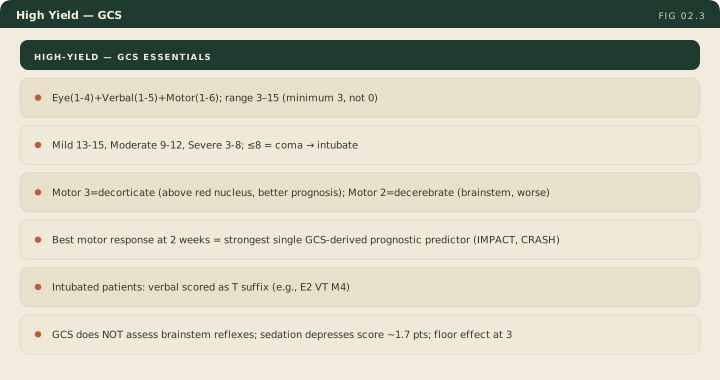
- GCS = eye (1-4) + verbal (1-5) + motor (1-6); range 3-15, minimum 3 not 0.
- Severity: mild 13-15, moderate 9-12, severe 3-8; ≤8 = coma and intubation.
- Motor 3 = decorticate (above red nucleus, better prognosis); motor 2 = decerebrate (below red nucleus, brainstem level, worse).
- Best motor response at 2 weeks = strongest single GCS-derived acute prognostic indicator; the IMPACT and CRASH models use admission predictors.
- Intubated patients: verbal recorded as T suffix (e.g., E2 VT M4).
- GCS does NOT assess brainstem reflexes; sedation depresses by ~1.5-2 points; floor effect at 3.
A patient who has suffered brain death will score a 3. And a patient with a devastating but potentially survivable injury will also score a 3. So the scale is basically a ladder missing its bottom rungs.
— TBI-02 podcast, ~13:24
The spinal cord senses pain and jerks the limb away. But a motor score of 5, localization, that is a purposeful act. So to cross the midline and actively try to remove the source of pain, the signal has to travel all the way up to the cortex.
— TBI-02 podcast, ~5:44