Before You Listen
- Prerequisites: the severity matrix from Episode 1; familiarity with the Glasgow Coma Scale (GCS) and the decorticate-vs-decerebrate distinction from Episode 2; basic awareness that the cranial vault is a rigid box with brain, blood, and cerebrospinal fluid as its three compartments.
- Runtime: 34 minutes.
- Topic in one line: primary vs secondary injury; rotational acceleration as the most damaging mechanism; inferior frontal and anterior temporal contusion preference; epidural hematoma (EDH) lens vs subdural hematoma (SDH) crescent boundaries; diffuse axonal injury (DAI) Adams 1-2-3 (white matter, corpus callosum, brainstem); excitotoxicity cascade with calcium central; Monro-Kellie doctrine; Brain Trauma Foundation (BTF) intracranial pressure (ICP) threshold 22 mmHg and cerebral perfusion pressure (CPP) 60-70 mmHg; SBP <90 doubles mortality; CRASH corticosteroid contraindication; the 7-10 day concussion vulnerability window; vasogenic vs cytotoxic edema; apoptosis vs necrosis; glymphatic dysfunction; ferroptosis; cortical spreading depolarization.
Vignette. A 28-year-old woman is brought to the trauma bay after a high-speed motor vehicle crash. She has a Glasgow Coma Scale (GCS) of 8, a systolic blood pressure of 86 mmHg in the field that has just been corrected to 110 mmHg with crystalloid, and an oxygen saturation of 96%. Initial CT shows bilateral inferior frontal and anterior temporal contusions, a thin crescent-shaped hyperdense subdural hematoma over the right hemisphere, scattered petechial hemorrhages at the gray-white junction, and a small focus of hemorrhage in the splenium of the corpus callosum. Cisterns are partially effaced and there is 4 mm of midline shift. An external ventricular drain (EVD) is placed; opening intracranial pressure (ICP) is 28 mmHg and mean arterial pressure (MAP) is 78 mmHg. The neurosurgery resident asks whether mannitol or hypertonic saline should be given first and whether high-dose methylprednisolone should be added.
Why does this patient’s contusion distribution favor the inferior frontal and anterior temporal lobes regardless of impact site, what diffuse axonal injury (DAI) Adams grade does the splenium lesion place her in, what is her cerebral perfusion pressure (CPP) and how does it compare to the Brain Trauma Foundation (BTF) target, why is hypertonic saline the correct first choice over mannitol in this case, and what is the only Level I evidence-based BTF recommendation regarding methylprednisolone?
Section 1: Primary vs Secondary Injury and Mechanical Forces
Bottom line: primary injury is the structural damage at the instant of impact and is irreversible (only prevention works); secondary injury is the cascade of cellular and physiological events that unfolds over minutes to weeks and is the target of every acute TBI intervention; rotational acceleration is the most damaging mechanism because it shears axons across tissue density interfaces.
The conceptual framework that organizes every clinical decision in TBI is the primary versus secondary injury dichotomy. Primary injury encompasses all structural damage that occurs at the instant of mechanical force application. Its extent is determined by the physics of the impact: magnitude, direction, duration, and type of force. Once primary injury has happened, it cannot be reversed. The only intervention that reduces primary injury is prevention, which is why helmet laws, seatbelt legislation, and fall prevention programs covered in Episode 1 are the only tools that change the primary injury burden.
Secondary injury encompasses the cascade of molecular, cellular, and physiological events triggered by the primary insult. It evolves over minutes, hours, days, and even weeks after the initial trauma. Unlike primary injury, secondary injury is potentially preventable and treatable, and it is the target of nearly every therapeutic intervention in acute TBI care. The clinical mantra is preventing the injury after the injury. When boards ask what the primary target of acute TBI management is, the answer is always prevention and mitigation of secondary injury.
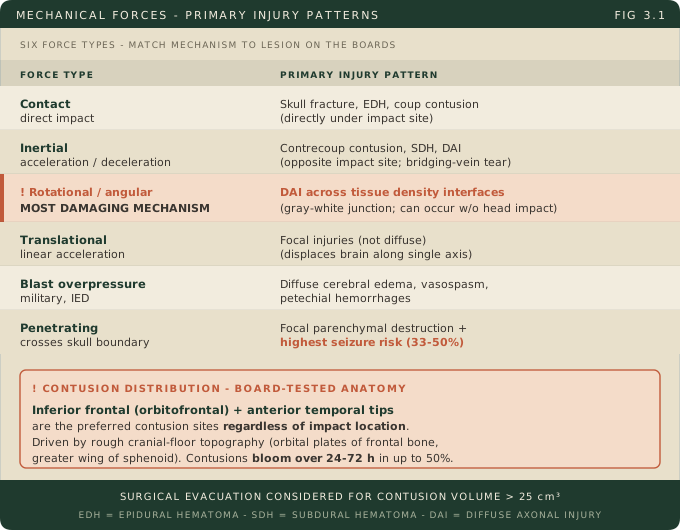
Six categories of mechanical force determine the pattern of primary injury, and boards expect you to match force type to injury pattern. Contact forces involve direct impact and produce skull fractures, epidural hematomas, and coup contusions directly beneath the impact site. Inertial forces (acceleration and deceleration without direct contact) cause the brain to move within the skull, producing contrecoup contusions opposite the impact, subdural hematomas from bridging-vein rupture, and DAI. Rotational and angular acceleration forces are the most damaging biomechanical mechanism: they produce differential motion at interfaces between tissues of different densities (gray-white junction, brain-CSF interface), creating shearing across wide brain areas. Translational (linear) acceleration displaces the brain along a single axis and tends to produce focal rather than diffuse injuries. Blast overpressure propagates a pressure wave through brain tissue and produces diffuse cerebral edema, vasospasm, and petechial hemorrhages (covered as the unique military tested concept in Episode 1). Penetrating injury crosses the skull boundary, causing focal parenchymal destruction and carrying the highest seizure risk: early seizures in 15-20% and late post-traumatic seizures in 33-50%.
The single most important teaching point is that rotational forces are the most dangerous because they damage axons diffusely. A patient who sustains a rotational acceleration injury without ever striking their head can still develop severe DAI. Cerebral contusions (bruises of the cortical parenchyma resulting from contact between the brain surface and the inner table of the skull) preferentially affect the inferior frontal lobes (orbitofrontal cortex) and anterior temporal tips regardless of where the impact occurs on the head. This distribution reflects the irregular bony topography of the anterior and middle cranial fossae: the orbital plates of the frontal bone and the greater wing of the sphenoid have rough ridges that create friction and shearing against the brain surface during acceleration-deceleration. This anatomical fact directly explains the high prevalence of personality changes, disinhibition, impaired social judgment, executive dysfunction (orbitofrontal contusions), and memory deficits, emotional dysregulation, and language impairment when dominant (anterior temporal contusions). Contusions may evolve or blossom over 24-72 hours, occurring in up to 50% within the first 24 hours, which is why serial CT monitoring is essential. The Brain Trauma Foundation operative criteria for a parenchymal lesion are a frontal or temporal contusion greater than 20 cm³ with midline shift of at least 5 mm or cisternal compression in a patient with GCS 6-8, or any parenchymal lesion greater than 50 cm³. The frequently quoted 25 cm³ figure is Marshall’s classification cutpoint defining a mass lesion, not a surgical threshold.
Board Trap — The “DAI without head impact” patient
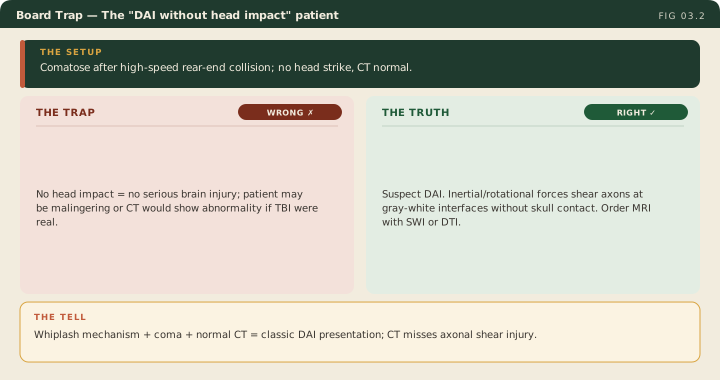
A passenger in a high-speed rear-end collision who never strikes their head can develop severe DAI. Inertial and rotational forces (acceleration/deceleration of the head and neck) are sufficient to shear axons at gray-white interfaces without any direct skull contact. If the stem describes a comatose patient with a normal CT after a whiplash mechanism with no head strike, the writer wants you to suspect DAI and order MRI with susceptibility-weighted imaging (SWI) or diffusion tensor imaging (DTI), not to assume the patient is malingering.
High Yield — Primary vs secondary, mechanical forces
- Primary injury = irreversible structural damage at instant of impact; only prevention works.
- Secondary injury = cellular/physiological cascade over minutes to weeks; target of all acute care.
- Rotational acceleration = most damaging force; produces DAI at tissue density interfaces; can occur without head impact.
- Coup = under impact site (contact); contrecoup = opposite impact site (inertial).
- Penetrating = highest seizure risk (early 15-20%, late 33-50%).
- Contusion preference = inferior frontal + anterior temporal regardless of impact site (rough cranial-floor topography).
- Contusion blossoming in up to 50% within 24-72 hours; BTF operative criteria = frontal/temporal contusion >20 cm³ with midline shift ≥5 mm or cisternal compression (GCS 6-8), or any lesion >50 cm³. 25 cm³ is Marshall’s classification cutpoint, not a surgical threshold.
The anterior and middle cranial fossae have incredibly rough bony floors, specifically the orbital plates of the frontal bone and the greater wing of the sphenoid bone. They’re sharp, basically. They act like a bony cheese grater.
— TBI-03 podcast, ~6:08
Primary injury is the structural damage happening at the exact instant the mechanical force is applied. It’s immediate and it is locked in the millisecond the impact ends.
— TBI-03 podcast, ~1:22