Before You Listen
- Prerequisites: primary versus secondary brain injury, the Monro-Kellie doctrine, the basics of cerebral perfusion pressure (CPP) and cerebral autoregulation, and the Glasgow Coma Scale (GCS) categories of severe traumatic brain injury (TBI) at GCS 3-8.
- Runtime: 1 hour 3 minutes.
- Topic in one line: the Brain Trauma Foundation (BTF) fourth-edition guidelines and their single Level I recommendation that steroids are contraindicated (per the CRASH trial); the three numbers to memorize cold (intracranial pressure [ICP] threshold 22 mmHg, CPP target 60-70 mmHg, seizure prophylaxis 7 days) and the mannitol osmolality ceiling the fourth edition does not set; the external ventricular drain (EVD) as the gold-standard ICP monitor; the Seattle International Severe TBI Consensus Conference (SIBICC) three-tier algorithm with the mean arterial pressure (MAP) challenge for autoregulation; mannitol versus hypertonic saline; the Temkin trial that established phenytoin for early post-traumatic seizures only; herniation syndromes (uncal, central, tonsillar, subfalcine) including the Kernohan notch false-localizing sign; the CRASH-3 trial that showed tranexamic acid (TXA) helps mild-to-moderate but not severe TBI; failed neuroprotection trials (steroids, progesterone, prophylactic and early hypothermia, erythropoietin); multimodal neuromonitoring (brain tissue oxygen [PbtO2], jugular venous oximetry [SjvO2], cerebral microdialysis); and the DECRA versus RESCUEicp decompressive craniectomy trials.
Vignette. A 52-year-old man arrives intubated after a fall from scaffolding with a GCS of 6 (E1 V1T M4). Initial CT shows a 6 mm right-sided acute subdural hematoma, effaced basal cisterns, and 4 mm midline shift. An external ventricular drain is placed and the opening intracranial pressure is 28 mmHg. Mean arterial pressure is 82 mmHg. He is normotensive and well resuscitated.
Calculate the cerebral perfusion pressure, state whether it is in the BTF target range, list the SIBICC tier 1 maneuvers to apply now, and explain why methylprednisolone would be the wrong answer.
(Answer at the end of this chapter)
Section 1: The BTF Fourth Edition and the One Level I Recommendation
Bottom line: The BTF fourth-edition guideline contains exactly one Level I recommendation, and it is that steroids are contraindicated in severe TBI. The CRASH trial showed methylprednisolone increased mortality by ~3 percentage points at 6 months across more than 10,000 patients.
The acute management of severe TBI is governed by one overriding principle: the primary injury, meaning the mechanical damage at the moment of impact, is irreversible. Every intervention afterward targets the secondary injury cascade, which is the destructive sequence of ischemia, excitotoxicity, cerebral edema, and metabolic failure unfolding over hours to days. The Brain Trauma Foundation (BTF) published its fourth-edition guideline in 2016, and that document remains the evidence-based framework for neurocritical care in severe TBI.
The fourth edition raised the evidence threshold substantially compared to earlier versions, and many older recommendations were downgraded or eliminated. Evidence is classified into four tiers: Level I (strongest, high-quality randomized controlled trial data), Level II-A (moderate-quality trials), Level II-B (lower-quality randomized trials or well-designed cohort studies), and Level III (case series or expert opinion). The structural fact to memorize is that the entire fourth edition contains exactly one Level I recommendation. That one recommendation is that steroids are contraindicated in severe TBI. Every other recommendation in the document falls to Level II or Level III. When a board question asks about the only Level I BTF recommendation, the answer is always steroids.
The evidence comes from the Corticosteroid Randomisation After Significant Head Injury (CRASH) trial published in The Lancet in 2004. More than 10,000 patients with moderate-to-severe TBI (GCS ≤14 within 8 hours of injury) were randomized to high-dose methylprednisolone (a 2 g loading dose followed by 0.4 g/h for 48 hours) or placebo. The results were unequivocal: methylprednisolone increased mortality. At 2 weeks, mortality was 21.1% in the steroid group versus 17.9% in placebo, a risk ratio of 1.18. At 6 months, mortality was 25.7% versus 22.3%, a risk ratio of 1.15. The harm was consistent across every severity subgroup and every geographic region. The proposed mechanisms include steroid-induced hyperglycemia worsening ischemic injury, immunosuppression that increases infection risk, and possible exacerbation of excitotoxic injury.
This finding must not be confused with spinal cord injury (SCI) protocols, where methylprednisolone was historically used based on the National Acute Spinal Cord Injury Study (NASCIS) trials. The pathophysiology and treatment paradigms are distinct. The brain is metabolically greedy with massive cytotoxic and excitotoxic vulnerability; loading it with glucose-spiking, immunosuppressive steroids accelerates death. On the boards, any answer choice suggesting steroids for TBI is wrong. The one Level I recommendation is a “do not” rule.
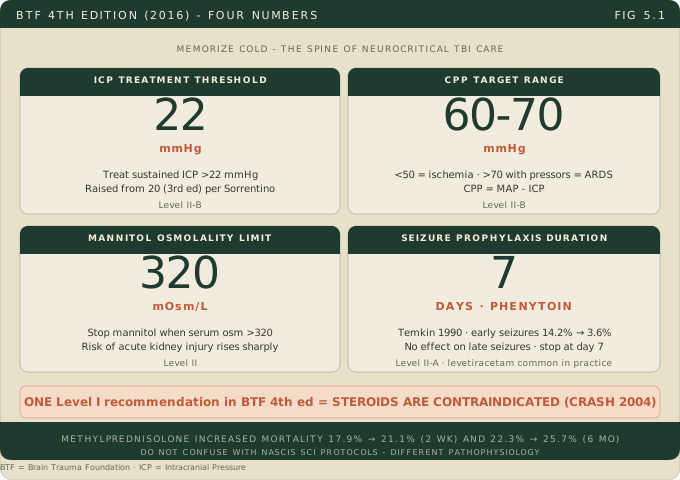
There are three BTF numbers to memorize cold, because they cover the most commonly tested parameters: ICP treatment threshold = 22 mmHg, CPP target = 60-70 mmHg, and duration of seizure prophylaxis = 7 days. A fourth number is traditionally taught beside them, a mannitol serum osmolality ceiling of 320 mOsm/L, and it is not a BTF number. The fourth edition found the evidence insufficient to make any hyperosmolar recommendation at all, and it prints no osmolality threshold. These three are the spine of the rest of the chapter.
High Yield — The one Level I recommendation
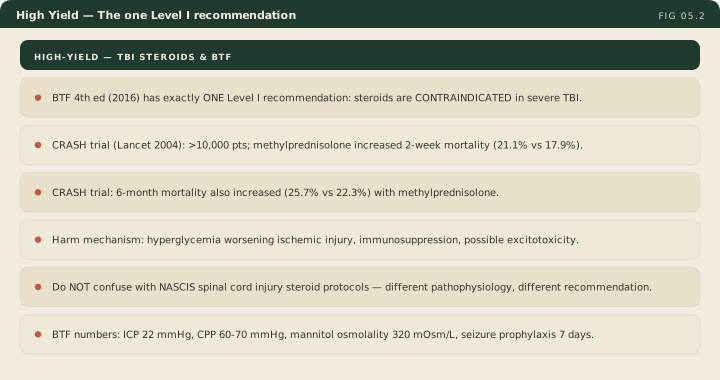
- BTF 4th edition (2016) contains exactly one Level I recommendation: steroids are contraindicated in severe TBI.
- Source: CRASH trial (Lancet 2004), >10,000 patients, methylprednisolone increased mortality at 2 weeks (21.1% vs 17.9%) and 6 months (25.7% vs 22.3%).
- Mechanism of harm: hyperglycemia worsening ischemic injury, immunosuppression, possible exacerbation of excitotoxicity.
- Do NOT confuse with NASCIS spinal cord injury steroid protocols. Different pathophysiology, different recommendation.
- The three BTF numbers to memorize: ICP 22 mmHg, CPP 60-70 mmHg, 7 days seizure prophylaxis. The fourth edition sets no hyperosmolar threshold, and the traditional 320 mOsm/L mannitol ceiling is not a validated cutoff.
So when you are sitting in the Prometric Center and a board stem asks for the only level one recommendation in the BTF guideline, you don’t even need to read the rest of the options. The answer is always steroids.
— TBI-05 podcast, ~3:47