Before You Listen
- Prerequisites: the brainstem reticular activating system, the Glasgow Coma Scale (GCS) categories, the difference between traumatic and anoxic brain injury, and the basic time course of recovery from severe traumatic brain injury (TBI).
- Runtime: 1 hour.
- Topic in one line: the two-component model of consciousness (wakefulness/arousal and awareness/content); the spectrum from coma → vegetative state / unresponsive wakefulness syndrome (VS/UWS) → minimally conscious state minus (MCS-) and plus (MCS+) → emergence; the Coma Recovery Scale-Revised (CRS-R) and the Wannez 2017 5-assessment rule; locked-in syndrome and the FOUR score; cognitive motor dissociation in 15-25% of unresponsive patients (Owen 2006, Bodien 2024); the Giacino 2012 amantadine trial; the zolpidem paradox; tDCS; prognostic biomarkers; and the Quinlan/Cruzan/Schiavo legal framework.
Vignette. A 26-year-old woman is 8 weeks out from a severe TBI sustained in a motor vehicle collision. She has eye-opening with sleep-wake cycles, is breathing without a ventilator, and has intact pupillary, corneal, and gag reflexes. On a single bedside exam, the resident notes only an auditory startle and reflexive flexion withdrawal to nail-bed pressure and writes “vegetative state.” Two days later, a structured Coma Recovery Scale-Revised (CRS-R) assessment by trained staff at a different time of day documents smooth visual pursuit of a mirror through 45 degrees on 2 of 4 trials, plus localization to noxious stimulus, with the right hand reaching across to contact the stimulated left nail bed on 2 of 4 trials.
State the corrected diagnosis, name the single most common behavior that distinguishes this category from VS, identify the named scale used for diagnosis, and propose the next pharmacological intervention with its dosing and the trial that established its evidence.
(Answer at the end of this chapter)
Section 1: The Two Components of Consciousness and the Coma-VS-MCS Spectrum
Bottom line: Consciousness has two components — wakefulness (arousal) and awareness (content) — and every disorder of consciousness is defined by the ratio. Coma lacks both, vegetative state has wakefulness without awareness, MCS has wakefulness with inconsistent awareness, and emergence restores reliable awareness.
Disorders of consciousness span the spectrum from coma through the vegetative state and the minimally conscious state to emergence, and understanding these conditions starts with recognizing that consciousness has two fundamental components. The first is wakefulness, also called arousal, which is the capacity for eye-opening and sleep-wake cycling. The second is awareness, which is the subjective experience of self and environment. Every disorder of consciousness is defined by the presence or absence of each component. Coma lacks both. The vegetative state has wakefulness without awareness. The minimally conscious state has wakefulness with minimal but discernible awareness. Emergence restores reliable awareness.
Coma is a state of unarousable unresponsiveness. The patient lies with eyes closed and cannot be awakened by any stimulus, including deep pain. There are no purposeful behaviors. There are no sleep-wake cycles on electroencephalography (EEG). It results from either bilateral hemispheric dysfunction or disruption of the brainstem reticular activating system (RAS), which is the ascending arousal network that keeps the cortex alert. The Glasgow Coma Scale (GCS) score is 8 or below. Coma is inherently time-limited, and this is a commonly tested fact. Within 2-4 weeks, patients either recover consciousness, progress to brain death, or evolve into a vegetative state. Coma rarely persists beyond 4 weeks.
The vegetative state was first described by Jennett and Plum in 1972. The term unresponsive wakefulness syndrome (UWS) was proposed by Laureys and colleagues in 2010 as a less pejorative alternative; both terms describe the same clinical entity. The patient opens their eyes spontaneously or with stimulation, has sleep-wake cycles on EEG, has intact brainstem reflexes (pupillary, oculocephalic, corneal, gag), and maintains autonomic function (breathing, blood pressure regulation, thermoregulation). However, there is no sustained visual fixation (more than 2 seconds) and no visual pursuit, no reproducible purposeful behavior, no language comprehension or expression, and no localization to stimuli. The patient may exhibit a startle reflex, reflexive posturing, oral reflexes, or non-purposeful movement, but none of these indicate awareness.
The temporal classifications are heavily tested. A persistent vegetative state is defined as VS lasting 1 month or more after any brain injury; this is a descriptive term only and does not imply permanence. A permanent vegetative state after TBI is defined as VS lasting more than 12 months. After non-traumatic injury (such as anoxic brain injury), the threshold for permanence is only 3 months. The 9-month difference reflects cellular pathology: TBI produces diffuse axonal injury (white-matter shearing) where neurons may remain alive and neuroplasticity can rebuild over months to years, while anoxic injury produces diffuse cortical and thalamic neuronal loss, so recovery is less likely, although prognosis is read from the examination and physiological markers rather than from etiology alone. The 2018 American Academy of Neurology / American Congress of Rehabilitation Medicine / National Institute on Disability, Independent Living, and Rehabilitation Research (AAN/ACRM/NIDILRR) joint guidelines recommend against using the term permanent because late recoveries beyond traditional thresholds have been documented; the guideline replaces permanent VS with chronic VS/UWS with the duration specified, under the umbrella term prolonged disorder of consciousness for any disorder of consciousness lasting beyond 28 days. Despite this update, the boards still test the 12-month traumatic and 3-month non-traumatic thresholds for permanence.
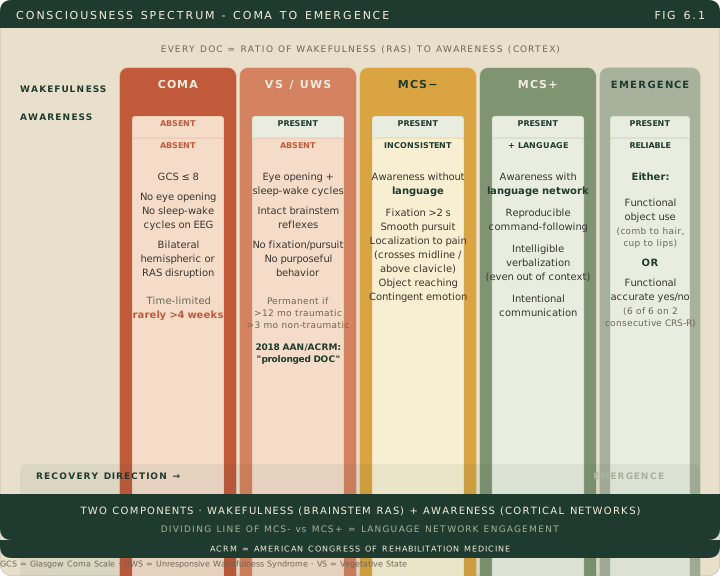
The minimally conscious state (MCS) was formally defined by Giacino and colleagues in 2002 and is characterized by inconsistent but clearly discernible behavioral evidence of awareness. The word inconsistent is critical: purposeful behavior in MCS is by definition present sometimes and absent other times, even within a single day, because the injured brain operates with massive metabolic deficits. The key distinction from VS is that MCS patients demonstrate purposeful behavior that exceeds reflexive or random responses.
Bruno 2011 introduced a further subdivision into MCS- and MCS+. MCS- describes non-reflexive behaviors that do not require language: sustained visual fixation >2 seconds, smooth visual pursuit, localization to noxious stimulation (the non-stimulated limb contacts the stimulated body part or the examiner on at least 2 of 4 trials), object reaching, contingent emotional responses (smiles only at family, not at strangers), and automatic motor responses. MCS+ describes language-mediated behaviors that require cortical language network integrity: reproducible command-following above chance, intelligible verbalization (at least two different intelligible words on the CRS-R, even out of context), and intentional communication. MCS+ indicates preserved language processing and carries a substantially better outlook: the probability of emerging into full consciousness approaches 100% for MCS+, versus roughly 50% for MCS-, because it proves the cortical language circuitry is still working.
Emergence from MCS requires demonstration of at least one of two functional abilities. Functional object use means the patient demonstrates knowledge of an object’s function by using it appropriately, such as bringing a comb to the hair, a pen to paper, or a cup to the lips; on the CRS-R, two different objects are each tested twice, and all four trials must show appropriate use. Functional accurate communication means reliable yes/no responses to basic situational orientation questions, specifically 6 of 6 correct on 2 consecutive evaluations on the Coma Recovery Scale-Revised. The key word is functional. Recognizing an object is not enough. Producing an inconsistent yes or no is not enough.
High Yield — Spectrum and definitions
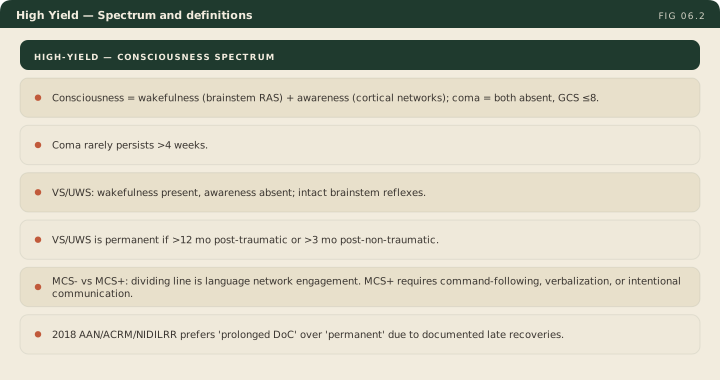
- Two components of consciousness: wakefulness (arousal, brainstem RAS) + awareness (content, cortical networks).
- Coma: both absent; GCS ≤8; rarely persists >4 weeks.
- VS / UWS: wakefulness present, awareness absent; intact brainstem reflexes; permanent if >12 months traumatic or >3 months non-traumatic.
- MCS- vs MCS+: the dividing line is language network engagement. MCS- = visual pursuit, localization to pain (~50% probability of emergence). MCS+ = command-following, verbalization, intentional communication (~100% probability of emergence).
- Emergence: functional object use (two different objects, two trials each, all four used appropriately) OR functional accurate yes/no communication (6 of 6 on 2 consecutive CRS-R).
- 2018 AAN/ACRM/NIDILRR replaces “permanent VS” with “chronic VS/UWS” (duration specified) because of documented late recoveries; “prolonged disorder of consciousness” is the umbrella term for any DoC beyond 28 days.
You can have power without an operating system, but you cannot have an operating system without power.
— TBI-06 podcast, ~4:46