Before You Listen
- Prerequisites: GABA-A vs GABA-B receptor pharmacology; basic catecholamine synthesis (dopamine, norepinephrine); cytochrome P450 (CYP450) inducer/inhibitor framework; the difference between presynaptic reuptake blockade and postsynaptic agonism; the Glasgow Coma Scale (GCS) severity strata.
- Runtime: 27 minutes.
- Topic in one line: the neurotransmitter hypothesis of TBI recovery (dopaminergic and noradrenergic — the catecholamine systems — plus cholinergic, since acetylcholine is not a catecholamine), the AVOID list (haloperidol, chronic phenytoin, benzodiazepines, anticholinergics, metoclopramide, phenobarbital), the PROMOTE list (methylphenidate, amantadine, bromocriptine, donepezil, modafinil), the Giacino 2012 trial as the only Class one evidence in disorders of consciousness (DOC), the dopaminergic decision framework (deficit-to-drug matching), selective serotonin reuptake inhibitor (SSRI) vs apathy distinction, trazodone for sleep, and the start-low-go-slow principle that governs every prescription in this population.
Vignette. A 38-year-old woman is in week 6 of inpatient rehabilitation after a severe TBI from a motor-vehicle collision. She has emerged from minimally conscious state but remains profoundly inattentive, falls asleep in therapy, and cannot sustain a 10-minute task. Her medication list includes phenytoin (started day 1 for seizure prophylaxis, never discontinued), diphenhydramine 50 mg at bedtime for sleep, ondansetron as needed for nausea, and oxybutynin 5 mg three times daily for urinary urgency. She has had no clinical seizure activity, and her electroencephalogram (EEG) is unremarkable. Her family asks why her cognition has plateaued.
Which three medications are sabotaging her recovery, what is the single highest-yield substitution for each, which one stays, and which neurostimulant is first-line for her primary attention deficit?
Section 1: The Catecholaminergic Hypothesis and the AVOID List
Bottom line: three neurotransmitter systems drive TBI recovery (dopaminergic, noradrenergic, cholinergic); medications that suppress them slow recovery and medications that augment them accelerate it; haloperidol is the prototypical AVOID drug because D2 blockade across all four dopamine pathways stalls neuroplasticity.
The central organizing principle of TBI pharmacology is the neurotransmitter hypothesis of recovery — traditionally called the catecholaminergic hypothesis, though only two of its three systems are true catecholamines — supported by both animal and human data. Three neurotransmitter systems are critical for neural repair. The dopaminergic system mediates attention, executive function, motor initiation, motivation, and reward-based learning through four pathways (mesolimbic, mesocortical, nigrostriatal, tuberoinfundibular). The noradrenergic system modulates arousal, attention, vigilance, and stress responses through projections from the locus coeruleus. Dopamine and norepinephrine are the two catecholamines. The cholinergic system, which uses acetylcholine — a neurotransmitter that is not a catecholamine — supports memory formation, attention, and learning through basal forebrain projections (including the nucleus basalis of Meynert) to the hippocampus and cortex. After TBI, all three systems are disrupted by diffuse axonal injury (DAI), neuronal death, receptor downregulation, and neurotransmitter depletion. Drugs that further reduce activity in these already-impaired systems compound deficits and slow recovery; drugs that enhance them may accelerate functional restoration.
Haloperidol is the prototypical medication to avoid and the single most commonly tested AVOID drug. It is a potent D2 antagonist that blocks dopaminergic neurotransmission across all four dopamine pathways. Animal studies consistently show that haloperidol hinders spatial learning, delays motor recovery, and prolongs disability after experimental brain injury. The mechanism is direct: by blocking D2 receptors in frontal-subcortical circuits that mediate executive function, motivation, motor initiation, and cognitive flexibility, haloperidol antagonizes the neurochemical substrates of recovery itself. Beyond dopamine blockade, haloperidol produces extrapyramidal symptoms (acute dystonia, akathisia, parkinsonism), risk of neuroleptic malignant syndrome (NMS) that can mimic paroxysmal sympathetic hyperactivity (PSH), QTc prolongation with torsades risk, prolongation of post-traumatic amnesia (PTA), and a lowered seizure threshold. If a clinical scenario absolutely requires an antipsychotic for severe refractory psychotic agitation, the correct answer is an atypical antipsychotic at the lowest effective dose for the shortest duration (quetiapine is generally preferred for its weaker D2 binding and stronger 5-HT2A antagonism). The board-ideal answer remains avoiding antipsychotics entirely and using the agitation hierarchy starting with beta-blockers.
Phenytoin beyond 7 days belongs on the AVOID list. Acute use for seizure prophylaxis in the first 7 days is BTF Level 2A per the Temkin trial (TBI-07), but chronic use beyond 7 days provides no benefit for late post-traumatic epilepsy and imposes substantial harm: cognitive impairment with reduced attention, processing speed, and memory; impaired motor recovery; CYP450 induction (CYP2C9, CYP2C19, CYP3A4) that cuts levels of warfarin, oral contraceptives, corticosteroids, methadone, and many antibiotics; and the need for therapeutic drug monitoring because of a narrow therapeutic index. Chronic adverse effects include gingival hyperplasia, cerebellar toxicity, osteoporosis, peripheral neuropathy, and folate deficiency. After day 7, discontinue unless documented post-traumatic epilepsy (PTE) requires ongoing therapy. Established PTE is treated by seizure type and tolerability rather than by a mandatory switch: levetiracetam is commonly first-line for its renal clearance, lack of CYP interactions, and lower cognitive burden, while carbamazepine suits focal seizures and valproate generalized seizures. The caveat is levetiracetam-induced behavioral irritability (“Keppra rage”), which is ironic given the TBI population’s susceptibility to agitation.
Benzodiazepines are GABA-A positive allosteric modulators that increase chloride channel opening frequency. Barbiturates (phenobarbital) increase channel opening duration and at high doses can directly open the channel without GABA, which is the basis for their lethal respiratory depression. Both broadly enhance GABAergic inhibition across the central nervous system (CNS). In TBI, this is particularly harmful: brain-injured patients are highly susceptible to paradoxical excitation, so benzodiazepines can dramatically worsen agitation rather than treat it. Additional harms include impaired attention, memory encoding, processing speed, and new learning; suppressed synaptic remodeling that underlies neuroplasticity; physiologic dependence with seizure risk on abrupt discontinuation; and increased falls. Chronic exposure also impairs cognition. The exceptions are acute seizure management (intravenous lorazepam remains first-line for status epilepticus, including in TBI patients) and acute danger when environmental measures fail, where a rapidly acting benzodiazepine is an accepted emergency option before a maintenance regimen is chosen.
Anticholinergics further suppress an already-compromised cholinergic system. The basal forebrain cholinergic nuclei and their long cortical projections are particularly vulnerable to DAI, so anticholinergic load produces dramatic worsening of cognition, delirium, confusion, and paradoxical agitation. Common offenders include diphenhydramine (one of the most harmful over-the-counter medications after TBI; commonly used for sleep and allergies), oxybutynin (crosses the blood-brain barrier readily, covered in TBI-07), tricyclic antidepressants (amitriptyline, nortriptyline, imipramine), promethazine, and first-generation antihistamines as a class. The Anticholinergic Cognitive Burden (ACB) Scale scores each medication 0 to 3; in TBI patients, cumulative scores ≥3 correlate with measurable cognitive impairment, and the effect is additive. Calculate the total ACB at every medication review and substitute high-burden agents for lower-burden alternatives. The deprescribing review for a patient recovering from a disorder of consciousness targets four classes: anticholinergics, benzodiazepines, typical antipsychotics, and unnecessary H2 blockers (indicated stress-ulcer prophylaxis stays).
Dopamine antagonists beyond antipsychotics are easy to miss. Metoclopramide is a D2 antagonist used as antiemetic and prokinetic that impairs recovery through the same mechanism as antipsychotics; the alternative is ondansetron, a 5-HT3 antagonist that does not block dopamine receptors. Prochlorperazine and droperidol are also D2 antagonists to avoid. Phenobarbital enhances GABA-A by increasing chloride channel opening duration and produces profound sedation, cognitive impairment, and respiratory depression; high-dose pentobarbital-induced coma is reserved for refractory intracranial hypertension only.
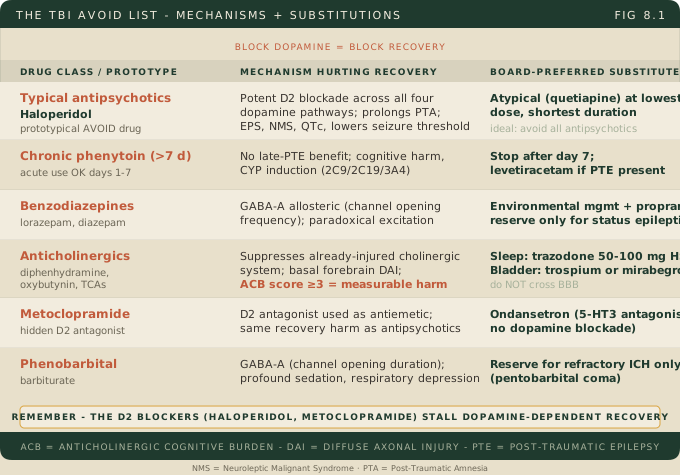
High Yield — The AVOID list
- Haloperidol = the prototypical AVOID drug; D2 blockade across all four dopamine pathways stalls recovery. Board-ideal: avoid all antipsychotics, use beta-blocker first-line for agitation.
- Phenytoin beyond 7 days = no late-PTE benefit; established PTE is treated by seizure type and tolerability (levetiracetam commonly first-line; carbamazepine for focal, valproate for generalized seizures).
- Benzodiazepines cause paradoxical excitation in TBI and impair cognition with chronic exposure; reserved for status epilepticus and for acute danger when environmental measures fail.
- Diphenhydramine and oxybutynin worsen cognition through high anticholinergic burden; total ACB score ≥3 correlates with measurable impairment. The deprescribing review also removes unnecessary H2 blockers alongside anticholinergics, benzodiazepines, and typical antipsychotics.
- Metoclopramide is a hidden D2 antagonist; ondansetron is the safe substitute.
- Phenobarbital is an AVOID-list barbiturate; pentobarbital (barbiturate coma), not phenobarbital, is the agent reserved for refractory intracranial hypertension. Barbiturates prolong chloride-channel-opening duration, distinct from benzodiazepines (which increase opening frequency).
Board Trap — Treating TBI agitation with haloperidol
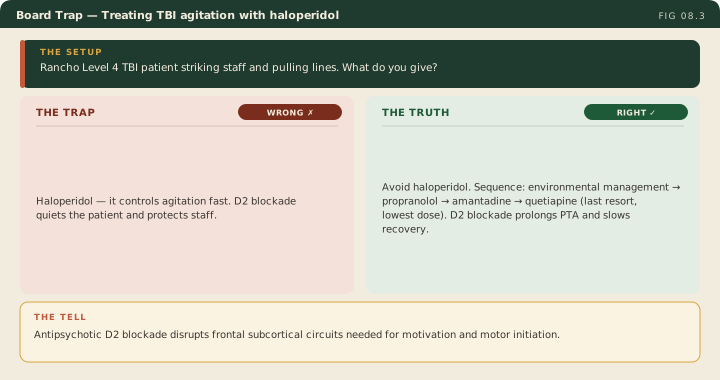
A vignette describing a Rancho Level 4 patient who is striking the staff and pulling lines may set up haloperidol as the obvious answer. It is not. Antipsychotic D2 blockade prolongs PTA and slows recovery for weeks of perceived hours of “control.” The board-correct maintenance ladder is environmental management first, then beta-blocker (propranolol), then a dopaminergic agent like amantadine for dual benefit, then a low-dose atypical antipsychotic (quetiapine) for maintenance. Acute unsafe escalation is its own branch, in which immediate injury risk is treated at once with an atypical antipsychotic (or a benzodiazepine) before the maintenance regimen is chosen.
Animal models show that giving haloperidol leads to worse spatial learning, significantly delayed motor recovery, and a much longer period of post-traumatic amnesia.
— TBI-08 podcast, ~4:33