Before You Listen
- Prerequisites: Rancho Los Amigos Levels of Cognitive Functioning; basic upper motor neuron syndrome; the GABA-A vs GABA-B distinction; and the role of dopamine in neuroplasticity (TBI-08).
- Runtime: 43 minutes.
- Topic in one line: posttraumatic agitation defined as non-purposeful behavior at Rancho Level 4, the 14-item Agitated Behavior Scale (ABS) with the >21 clinical-significance threshold, the medical-causes-first differential (pain, urinary tract infection [UTI], nonconvulsive status epilepticus [NCSE], constipation, urinary retention), environmental modification as first-line management, the pharmacotherapy hierarchy with propranolol at the top because it is recovery-neutral, paroxysmal sympathetic hyperactivity (PSH) with the four-of-six diagnostic features and morphine-plus-propranolol treatment, intrathecal baclofen (ITB) for refractory PSH with the lethal withdrawal syndrome, and the chronic neurobehavioral syndromes of aggression, disinhibition, and pseudobulbar affect (PBA).
Vignette. A 28-year-old man, 4 weeks out from a severe traumatic brain injury (TBI) sustained in a motorcycle collision, has been transferred from the intensive care unit (ICU) to acute inpatient rehabilitation. Over the past 72 hours he has become increasingly restless, pulling at his Foley catheter, attempting to climb out of bed, and yelling at staff in fragmented sentences. The nursing Agitated Behavior Scale score is 38. He is afebrile. Vital signs show heart rate 96, blood pressure 134/82. He follows simple commands inconsistently and cannot recall his nurse’s name from one minute to the next. Physical restraints have been ordered by the covering hospitalist.
What Rancho level is he, what is the first management step before any drug is added, what is the first-line pharmacologic agent if environmental measures fail, and what one diagnosis must you exclude before attributing his behavior to the brain injury itself?
Section 1: Posttraumatic Agitation, Rancho Level 4, and the Agitated Behavior Scale
Bottom line: posttraumatic agitation is non-purposeful, harmful behavior in roughly one third of acute-rehab TBI patients, peaking at Rancho Los Amigos Level 4 during emergence from post-traumatic amnesia (PTA), quantified by the 14-item Agitated Behavior Scale (ABS) with clinically significant agitation defined as a score above 21.
Posttraumatic agitation is defined as a state of excess physical or verbal activity that is non-purposeful, potentially harmful, and interferes with medical care and rehabilitation. Three elements separate it from goal-directed anger or frustration. First, the activity level exceeds what the clinical situation warrants. Second, the behavior serves no identifiable adaptive goal, even when it reflects the patient’s confused attempts to make sense of an incomprehensible environment. Third, the behavior creates risk of harm to the patient through falls and line removal, or to staff and family through aggression. Roughly one third of TBI patients admitted to acute inpatient rehabilitation develop clinically significant agitation, and most episodes resolve within 1 to 2 months as the brain continues to recover.
Agitation peaks at Rancho Los Amigos Level 4, the Confused-Agitated level, and typically appears during emergence from PTA between weeks 2 and 8 after injury. The cognitive landscape at Level 4 is the entire reason that standard psychiatric interventions fail in this population. Five features define it. The patient has no short-term memory formation, so explanations and reorientation do not stick. Disorientation to person, place, time, and situation is total, and the brain often invents narratives (confabulation) to fill the vacuum. New explicit learning is impaired, which means a complex behavior contract (remembering hours later which act earned which reward) fails; immediate reinforcement, redirection, and environmental management remain the behavioral tools. Despite these deficits, emotional responses persist but are disproportionate and inappropriate rather than intact: fear, frustration, and confusion are felt through the limbic system and expressed out of proportion to the situation. Finally, the patient has heightened stimulus sensitivity because the cortex has lost its ability to filter sensory input.
The standardized instrument for tracking agitation is the Agitated Behavior Scale (ABS), developed by Corrigan in 1989 and validated specifically for TBI rehabilitation. The scale contains 14 behavioral items, each scored from 1 (absent) to 4 (present to an extreme degree), for a total range of 14 to 56. It is scored by clinical observation, typically over a single nursing shift, two to three times per day. Scoring is not a self-report. The 14 items capture short attention span, impulsiveness, uncooperativeness, violent or threatening behavior, explosive anger, self-stimulating rocking or moaning, pulling at tubes, wandering, restlessness, repetitive behaviors, rapid loud talking, sudden mood changes, easily initiated or excessive crying and laughter, and self-abusiveness (the final two items on the form; there is no separate bed-exit item). Other agitation and aggression instruments exist: the Overt Aggression Scale (OAS), its scored version (OASS) that rates 47 characteristics by severity and frequency, and the Modified OAS (MOAS), which separates verbal, property-directed, self-directed, and interpersonal aggression. The ABS is the one validated for TBI rehabilitation and the one the boards test.
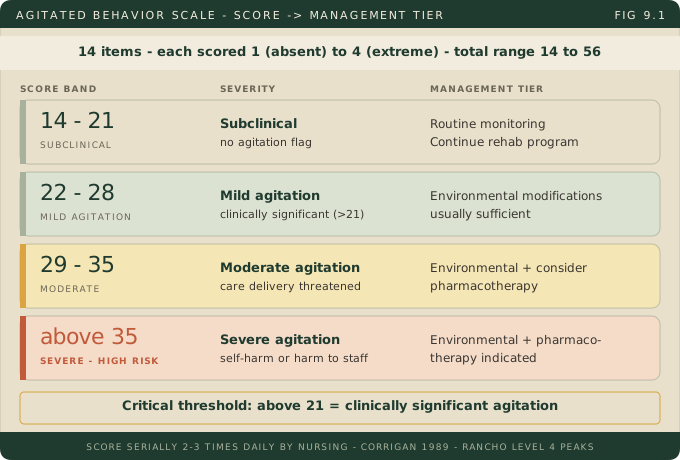
Score interpretation drives the management ladder. A score of 14 to 21 is subclinical, with routine monitoring continuing the rehab program. 22 to 28 is mild agitation, where environmental modifications are usually sufficient. 29 to 35 is moderate agitation, where environmental modifications are augmented with pharmacotherapy. Above 35 is severe agitation with high risk of injury, where environmental modifications plus pharmacotherapy are indicated. The single threshold to memorize is greater than 21 for clinically significant agitation. The fundamental board concept is that agitation at Level 4 is a normal stage of recovery, not a behavioral disorder requiring suppression. The management goal is safety during the transient phase, not elimination of behavioral output through sedation.
High Yield: Posttraumatic Agitation Core Facts
- Definition: non-purposeful excess activity that interferes with care and creates risk; affects ~1/3 of acute-rehab TBI patients.
- Peak window: emergence from PTA, weeks 2–8 post-injury, corresponding to Rancho Level 4.
- Five Level-4 cognitive features: no short-term memory, no orientation, impaired new learning (delayed-reward contracts fail; immediate reinforcement still works), disproportionate emotional responses (present but not intact), heightened stimulus sensitivity.
- ABS: 14 items, score 1–4 each, range 14–56; clinically significant >21, severe >35; the last two items are crying/laughter and self-abusiveness (no bed-exit item). Other instruments: OAS, OASS (47 characteristics), MOAS (verbal, property, self, interpersonal).
- Course: self-limited, most episodes resolve in 1–2 months.
- Goal: safety during the transient phase, not chemical silencing.
Board Trap: Operant Conditioning at Level 4
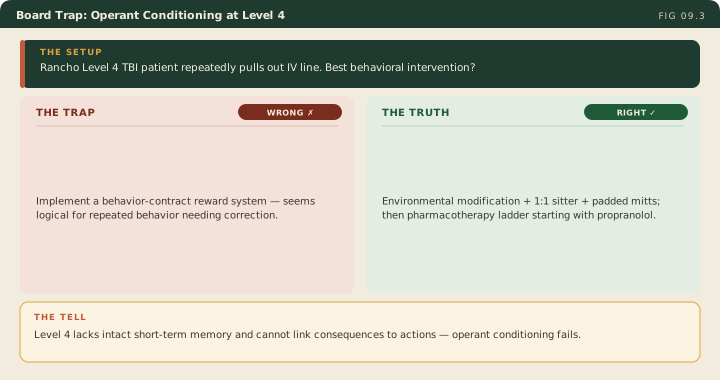
A vignette describes a Rancho Level 4 patient who repeatedly pulls out an intravenous (IV) line. The wrong answer is “implement a behavior-contract reward system.” A behavior contract requires the patient to remember, hours later, which act earned which reward; the Level 4 patient cannot carry that link across time, although immediate reinforcement and redirection in the moment still work. The right answer is environmental modification plus a one-to-one sitter and padded mitts, and only then a pharmacotherapy ladder beginning with propranolol.
14 is a normal patient. A score of 14 does not indicate a mild degree of agitation. It means absolute zero agitation based on the scales design.
— TBI-09 podcast, ~8:35