EP 096·TBI·Chapter 11·Free preview

Neuroendocrine Disorders After TBI

19 pages·~11 min read·10 linked questions

Neuroendocrine Disorders After TBI

TBI · EP 11 · NEUROENDOCRINE


Before You Listen

This episode tackles the most underdiagnosed complication of moderate-to-severe traumatic brain injury (TBI): post-traumatic hypopituitarism. Roughly 27.5% of TBI patients develop some degree of pituitary failure, and the majority are never screened because the symptoms (fatigue, cognitive slowing, depression, weight gain) look exactly like the brain injury itself. You will learn the anatomic vulnerability of the hypothalamic-pituitary axis, the screening timeline at 3 months and 12 months, the four anterior pituitary deficiency patterns, the lethal sodium disorder triad, and the triphasic response that turns desmopressin from a lifesaving drug into a fatal one within a week. Memorize the cortisol-before-thyroid rule cold.

What you should already know coming in:

  • Basic anatomy of the sella turcica, pituitary stalk, and hypophyseal portal system.
  • The hypothalamic-pituitary-target-gland axes (cortisol, thyroid, gonadal, growth hormone, prolactin, vasopressin).
  • Sodium homeostasis fundamentals (serum osmolality, urine osmolality, free water balance).

Runtime: approximately 42 minutes 41 seconds.


Vignette. A 28-year-old man is 14 months out from a severe TBI sustained in a motorcycle crash with a basilar skull fracture and prolonged ICU stay. He was discharged from inpatient rehabilitation 11 months ago. He returns to clinic reporting profound fatigue that is unrelieved by rest, a 25-pound weight gain concentrated in the abdomen, decreased libido, refractory low mood, and difficulty concentrating during his return-to-work trial. Morning labs show cortisol 2 mcg/dL, free T4 0.6 ng/dL with a TSH of 1.8, total testosterone 180 ng/dL with low luteinizing hormone (LH), prolactin 65 ng/mL, and a normal sodium of 138 mEq/L. His insulin-like growth factor-1 (IGF-1) is borderline low.

What four anterior pituitary axes are deficient, in what order must replacement be initiated, what does the prolactin pattern indicate about the mechanism, and which axis must be definitively confirmed with stimulation testing rather than basal levels?

(Answer at the end of this chapter)

Section 1: Why Pituitary Damage Is the Hidden Epidemic of TBI

~1:33 – Why Pituitary Damage Is the Hidden Epidemic of TBI

Bottom line: post-traumatic hypopituitarism affects ~27.5% of moderate-to-severe TBI patients, but the symptoms perfectly mimic post-TBI recovery, so the majority are never screened.

Neuroendocrine dysfunction is the most commonly underdiagnosed complication of moderate-to-severe TBI. Meta-analytic data place the prevalence of post-traumatic hypopituitarism at roughly 27.5%, meaning more than one in four patients carries a treatable hormonal deficiency that never gets diagnosed. The reason is not subtle: the symptoms of pituitary failure (fatigue, cognitive slowing, depression, poor motivation, decreased lean body mass, increased visceral fat) are also the expected symptoms of recovering from a brain injury. The provider attributes the patient’s stalled progress to bruised tissue and healing synapses, when in reality the neural architecture may be fine but the hormonal fuel for that architecture is gone.

The deficits do not occur randomly. They follow a predictable hierarchy that reflects the underlying anatomy. Growth hormone (GH) deficiency is the most common permanent anterior pituitary deficit, affecting 10–20% of moderate-to-severe TBI patients. Gonadotropin deficiency, producing central hypogonadism, is second at 10–15%. Adrenocorticotropic hormone (ACTH) deficiency, producing secondary adrenal insufficiency, occurs in 5–10% and is the single most dangerous deficit because it can kill during physiologic stress. Thyroid-stimulating hormone (TSH) deficiency producing central hypothyroidism also occurs in 5–10%. Posterior pituitary dysfunction, where the patient produces enormous volumes of dilute urine, occurs acutely in up to 25% of severe TBI but persists permanently in only 2–5%.

A critical timing concept the boards love: hormonal abnormalities within the first 3 months after injury may be transient and resolve as post-injury edema and inflammation subside. Deficiencies persisting beyond 12 months are likely permanent and warrant replacement therapy. This is why the screening timeline is split into a 3-month foundational panel and a 12-month panel that adds GH testing.

The anatomic explanation for why the pituitary fails so reliably comes down to where it sits and how it gets blood. The pituitary occupies the sella turcica, a bony cavity at the skull base enclosed by rigid sphenoid bone on three sides. While this protects against penetrating injury, it creates a confined compartment where edema and hemorrhage produce compressive damage with nowhere for the swelling to vent. The pituitary stalk, also called the infundibulum, traverses the suprasellar cistern connecting the hypothalamus to the pituitary, and this delicate stalk is exquisitely susceptible to the same shearing forces that cause diffuse axonal injury during acceleration-deceleration trauma. Basilar skull fractures are particularly associated with pituitary stalk injury, and the fracture line may directly damage the posterior pituitary or hypothalamus, producing the condition where the patient produces enormous volumes of dilute urine.

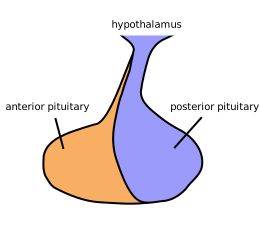
The vascular geometry seals the pattern. The anterior pituitary has no direct arterial supply; it depends entirely on the hypophyseal portal system, long low-pressure portal veins that descend from the hypothalamus along the stalk. Trauma stretches or compresses these portal veins, producing anterior pituitary ischemia and infarction. The somatotroph cells that secrete GH are concentrated in the lateral wings of the anterior pituitary, the most distal territory of the portal supply, and they are the first cells to starve when portal flow is disrupted. That single anatomic fact explains why GH deficiency is the most common permanent deficit. The posterior pituitary receives a direct arterial supply from the inferior hypophyseal artery and is therefore more resistant to ischemic injury, although it remains vulnerable to direct mechanical damage and stalk shearing.

Figure 11.1 — Hypothalamic-Pituitary Vulnerability After TBI

Source: Diberri (original); vector conversion by Icewalker_cs, “Pituitary gland representation.svg”, via Wikimedia Commons, CC BY-SA 3.0. https://commons.wikimedia.org/wiki/File:Pituitary_gland_representation.svg

High Yield: Hypopituitarism after TBI
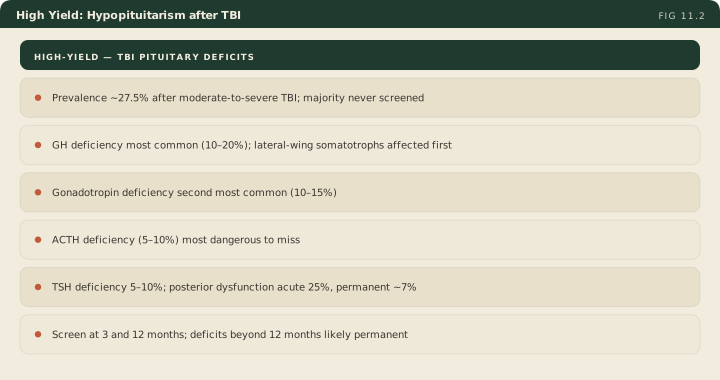
  • Prevalence ~27.5% of moderate-to-severe TBI; majority never screened.
  • GH 10–20% (most common permanent deficit) → lateral-wing somatotrophs starve first.
  • Gonadotropins 10–15% (second most common).
  • ACTH 5–10% (most dangerous to miss).
  • TSH 5–10%; posterior dysfunction acute 25%, permanent 2–5%.
  • Screening at 3 and 12 months; deficits beyond 12 months are likely permanent.

Pituitary deficiencies cause fatigue, cognitive slowing, depression, increased visceral fat. Isn’t that exactly what normal traumatic brain injury recovery looks like? That’s the exact problem. It’s like trying to hear a whisper at a heavy metal rock concert — the expected brain injury symptoms completely drown out the endocrine warning signs.

— TBI-11 podcast, ~02:38


── Section 2 onward · The Reps

Read the rest of Neuroendocrine Disorders After TBI

You’ve seen the first section. The full 19-page chapter — every callout, every figure, every Board-Trap warning — opens with a Reflex subscription. Plus all 166 chapters and 10+ linked questions for this chapter alone.

Cancel anytime · Progress saved if you lapse
Up next
TBI-12