Before You Listen
This episode covers the modern paradigm of concussion management: the 1993 American Congress of Rehabilitation Medicine (ACRM) definition of mild TBI, the 2022 Amsterdam consensus that retired strict rest in favor of early light activity and prescribed sub-symptom-threshold exercise, the six-step graduated return-to-sport protocol with medical clearance before the steps that reintroduce head-impact risk, the catastrophic but rare second impact syndrome, the neurometabolic cascade that explains why concussion is a functional rather than structural injury, and the postmortem tau pathology that defines chronic traumatic encephalopathy (CTE). You will learn the SCAT6 sideline assessment, the Vestibular and Ocular Motor Screening (VOMS), the Buffalo Concussion Treadmill Test, the GFAP plus UCH-L1 blood biomarker that rules out structural lesions, and how to disentangle the cervical spine “decoy” from true persistent post-concussion symptoms.
What you should already know coming in:
- The Glasgow Coma Scale (GCS) and the mild/moderate/severe TBI severity bands by GCS, loss of consciousness duration, and post-traumatic amnesia.
- Basic ocular motor anatomy (saccades, smooth pursuit, vestibulo-ocular reflex) and the cervical spine’s proprioceptive role.
- The difference between hyperphosphorylated tau and amyloid-beta in tauopathies versus Alzheimer disease.
Runtime: 53 minutes.
Vignette. A 16-year-old female soccer player takes a shoulder to the head during practice. She does not lose consciousness but feels dazed for about 90 seconds, returns to drills, and finishes practice. Two hours later her parent brings her to the emergency department because she has developed a worsening headache, mild nausea, and feels “foggy.” On evaluation her Glasgow Coma Scale (GCS) is 15, she has no focal deficits, and a computed tomography (CT) scan of the head is normal. Her near point of convergence (NPC) is 9 cm, smooth pursuit provokes a 3-point increase in dizziness on a 0–10 scale, and the Buffalo Concussion Treadmill Test the next morning shows a heart-rate symptom threshold of 130 beats per minute. She asks when she can return to play in Saturday’s game.
Does she meet ACRM criteria for mild TBI even without loss of consciousness, what does the VOMS and treadmill test tell you about her recovery trajectory, what exercise prescription do you write, and what is the absolute earliest she can return to game competition under the 2022 Amsterdam consensus protocol?
(Answer at the end of this chapter)
Section 1: Defining Mild TBI and the Amsterdam Consensus
Bottom line: only one of four ACRM criteria is needed for diagnosis, loss of consciousness is not required, and the 2022 Amsterdam consensus replaced strict rest with early light activity followed by prescribed sub-symptom-threshold exercise.
The American Congress of Rehabilitation Medicine (ACRM) established the foundational definition of mild traumatic brain injury (mild TBI) in 1993, and it remains the most widely used diagnostic framework in rehabilitation medicine. Mild injuries account for about 80–90% of TBI in the United States. Mild TBI is defined as a traumatically induced physiologic disruption of brain function manifested by at least one of four criteria: (1) any period of loss of consciousness (LOC), (2) any loss of memory for events immediately before or after the accident (post-traumatic amnesia, PTA), (3) any alteration in mental state at the time of the accident such as feeling dazed or confused, or (4) focal neurological deficits that may or may not be transient.
Two board concepts emerge directly from this definition. Only one criterion is needed for diagnosis. A patient who felt dazed at the scene but never lost consciousness and has no amnesia still meets ACRM criteria. Loss of consciousness is not required. More than 90% of concussions occur without any LOC. The upper bounds that keep an injury in the mild category: LOC must be <30 minutes, PTA must be <24 hours, and the initial Glasgow Coma Scale (GCS) must be 13–15 when assessed at 30 minutes or later after injury. Moderate TBI = GCS 9–12, LOC 30 minutes to 24 hours, PTA 1–7 days. Severe TBI = GCS 3–8, LOC >24 hours, PTA >7 days.
The Sixth International Conference on Concussion in Sport convened in Amsterdam in October 2022 and published in the British Journal of Sports Medicine in 2023, replacing the 2016 Berlin consensus. The Amsterdam consensus defines sport-related concussion (SRC) as a traumatic brain injury caused by a direct blow to the head, neck, or body with an impulsive force transmitted to the brain that produces neurological impairment evolving rapidly within minutes to hours, resolves spontaneously typically within days to weeks in adults, has largely normal structural neuroimaging, and results from functional rather than structural injury. The Amsterdam document addresses sport-related concussion. The recommendation that concussion and mild TBI be used as synonymous clinical terms comes from the 2023 ACRM diagnostic criteria for mild TBI, which apply it when neuroimaging is normal or not clinically indicated.
Six key updates from 2022 deserve emphasis. Symptom onset may be delayed. Symptoms can take hours to fully develop. Early activity is now recommended. Light activity is allowed during the first 24–48 hours after injury, replacing complete rest until asymptomatic; prescribed sub-symptom-threshold aerobic exercise is a separate treatment started after evaluation, with the evidence-based window for test-guided exercise prescription at 2–10 days post-injury. Prolonged rest is harmful. Strict rest beyond 48 hours may delay recovery, a major paradigm shift from the prior “cocoon therapy” model. Recovery timelines overlap across ages. A meta-analysis of 278 studies found similar recovery patterns by age: most children recover within 2–3 weeks and most adults within 2 weeks, and symptom resolution and return to sport are different outcomes. Same-day return to play is never recommended for any athlete with suspected concussion. Sleep disturbances independently delay recovery if not addressed.
Epidemiology grounds the urgency. An estimated 1.6 to 3.8 million sports-related concussions occur per year in the United States, with approximately 300,000 annually among high school athletes. The highest-incidence sports are football, ice hockey, lacrosse, soccer (from heading), and rugby. Female athletes have higher concussion rates than males in comparable sports including soccer, basketball, and softball compared to baseball. The repeat concussion risk is increased 3 to 6 times after a first concussion. Other risk factors for prolonged recovery include female sex, younger age, pre-existing depression, anxiety, post-traumatic stress disorder, premorbid migraine, learning disabilities and attention deficit hyperactivity disorder (ADHD), higher initial symptom burden, and LOC or amnesia at injury. Most adults recover within 2 weeks and most children within 2–3 weeks, with overlapping timelines across ages. About 10–30% develop persistent post-concussive symptoms beyond the expected window, and the “miserable minority” of 10–15% have symptoms persisting beyond one year.
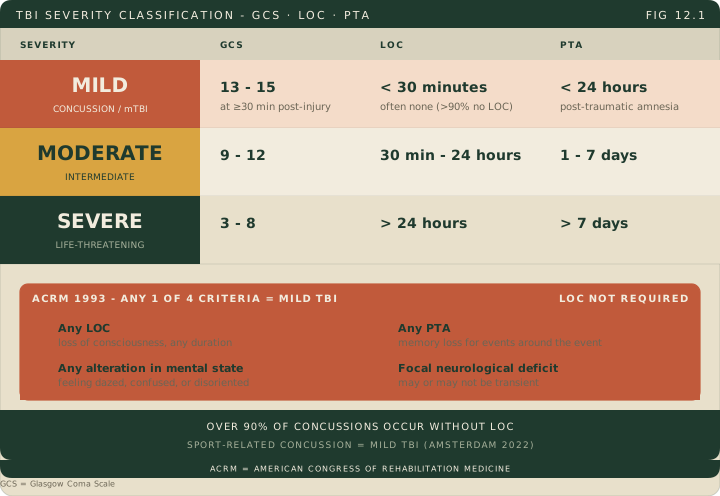
High Yield: ACRM mild TBI thresholds
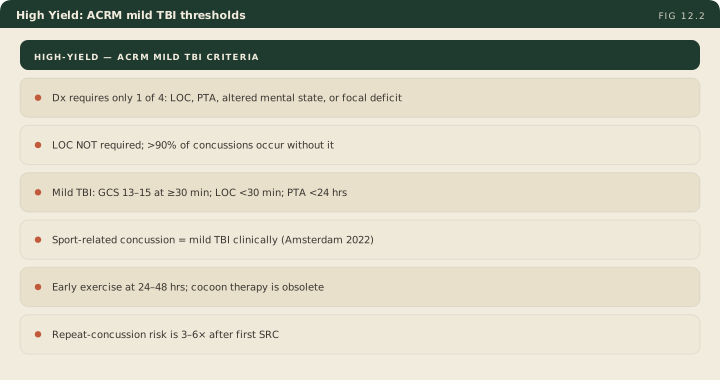
- Only 1 of 4 criteria needed for diagnosis (LOC, PTA, altered mental state, or focal deficit).
- LOC NOT required; >90% of concussions occur without it.
- Mild TBI: GCS 13–15 at ≥30 minutes; LOC <30 minutes; PTA <24 hours.
- Concussion = mild TBI as clinical terminology (ACRM 2023 diagnostic criteria, when neuroimaging is normal or not indicated); Amsterdam 2022 addresses sport-related concussion.
- Light activity in the first 24–48 hours, then prescribed sub-symptom-threshold aerobic exercise after evaluation (test-guided prescription window 2–10 days); cocoon therapy is dead.
- 3–6× repeat-concussion risk after a first SRC.