Before You Listen
- Prerequisites: the Glasgow Coma Scale (GCS) and severity bands; Rancho Los Amigos cognitive levels from TBI-06; the TBI pharmacology framework (avoid vs promote drugs) from TBI-08; spasticity management from TBI-10; the Modified Ashworth Scale (MAS) from prior episodes.
- Runtime: 1 hour 10 minutes.
- Topic in one line: the levels of rehabilitation care, the inpatient rehabilitation facility (IRF) admission criteria including the 3-hour rule and the 60% rule, the interdisciplinary team versus multidisciplinary distinction, the Functional Independence Measure (FIM), acute care management priorities (deep vein thrombosis [DVT] prophylaxis, hypermetabolism, seizure prophylaxis, intracranial pressure [ICP] ladder), the three cognitive rehabilitation philosophies (restorative, compensatory, metacognitive) and the Cicerone systematic reviews, neurogenic bowel and bladder, dysphagia management with the silent aspiration trap, vocational rehabilitation with the Individual Placement and Support (IPS) place-then-train model, driving assessment with Trail Making Test B and the Useful Field of View, sexuality after TBI with post-traumatic hypopituitarism, caregiver burden and ambiguous loss, the TBI Model Systems (TBIMS) database, the IMPACT prognostic calculator, life care planning, and the capacity-versus-competency framework.
Vignette. A 28-year-old man is 6 weeks out from a severe traumatic brain injury (TBI) sustained in a motorcycle crash. He has cleared post-traumatic amnesia (PTA), with a Galveston Orientation and Amnesia Test (GOAT) score of 78 on two consecutive days. He walks with supervision, manages basic self-care with cueing, and converses normally about his family and current events. His admission FIM was 38; today his FIM is 102. The team is preparing him for discharge home, where he will live alone in his apartment. He insists he is fully recovered, requests his car keys, and asks his physiatrist to clear him to return to work as a financial advisor next week. On bedside testing, his Trail Making Test B time is 142 seconds. He confidently predicts he will remember 18 of 20 words on a list test; he remembers 5.
What rehabilitation outcome metric is overestimating his readiness for community function, what screening test result flags him for a formal driving evaluation, what neurological phenomenon explains his confident self-prediction despite poor performance, what cognitive rehabilitation approach is most appropriate, and which vocational rehabilitation model is most likely to return him to competitive employment?
(Answer at the end of this chapter)
Section 1: Levels of Care, IRF Criteria, and the Interdisciplinary Team
Bottom line: the rehabilitation continuum spans 8 settings from intensive care unit (ICU) to home health; IRF admission requires the 3-hour rule, 2 disciplines, physiatrist visits 3 days a week face-to-face, and an interdisciplinary team; CMS enforces the 60% rule on IRF case mix; interdisciplinary teams share a single set of patient-centered goals while multidisciplinary teams operate in silos.
TBI rehabilitation follows a structured continuum from the ICU through community reintegration, with the physiatrist serving as the central coordinator. The continuum is dynamic; patients may move between levels in either direction as their medical and functional status changes. The levels of care, in descending order of medical intensity, are acute care in the ICU or hospital, acute inpatient rehabilitation in an IRF, long-term acute care hospitals (LTACHs), subacute rehabilitation in a skilled nursing facility, day treatment programs, residential rehabilitation, outpatient rehabilitation, and home health.
Acute inpatient rehabilitation is the crucible of recovery. Centers for Medicare and Medicaid Services (CMS) admission criteria require the patient be medically stable, able to tolerate at least 3 hours of therapy per day (the “3-hour rule”), require services from 2 or more therapy disciplines, require face-to-face physician supervision at least 3 days per week by a rehabilitation physician, require a coordinated interdisciplinary team approach, demonstrate potential for meaningful functional gains, and have rehabilitation needs that cannot be met at a lower level of care. A patient who cannot tolerate 3 hours on 5 days per week can be admitted on a modified intensity admission when the physiatrist documents that at least 15 hours of therapy across 7 consecutive days is expected and that the patient is likely to benefit.
CMS also enforces the “60% rule”: at least 60% of an IRF’s patient population must have one of 13 qualifying diagnostic conditions, and TBI is one. The simplified board answer for IRF admission: medically stable, 3 hours of therapy per day, 2 or more therapy disciplines, physician supervision 3 times per week face-to-face, and interdisciplinary team. The 3-hour and 2-discipline elements are most heavily tested.
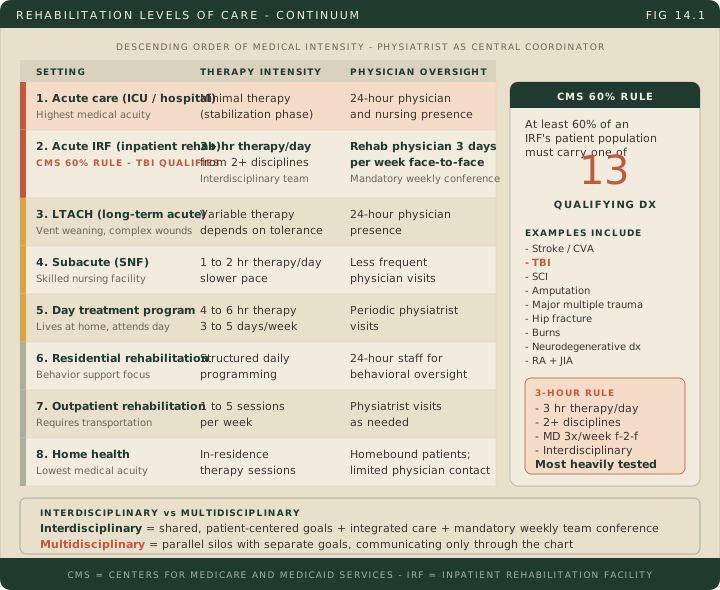
The interdisciplinary team is the cornerstone of TBI rehabilitation. Multidisciplinary teams have disciplines working in parallel with separate goals, communicating through the chart. Interdisciplinary teams collaborate with shared, patient-centered goals, joint treatment planning, and integrated care delivery, anchored by a mandatory weekly team conference. The physiatrist leads on medication management, spasticity, seizure management, complications, team coordination, family conferences, functional prognosis, and discharge planning. The roster includes physical therapy, occupational therapy, speech-language pathology (with videofluoroscopic swallow study [VFSS] and fiberoptic endoscopic evaluation of swallowing [FEES] capability), neuropsychology, rehabilitation nursing, social work, therapeutic recreation, rehabilitation psychology, and a certified rehabilitation counselor for vocational planning.
High Yield: IRF Criteria and Team Structure
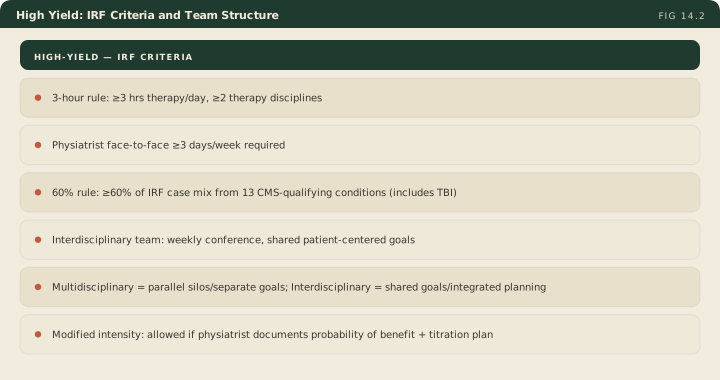
- 3-hour rule: at least 3 hours of therapy per day, 2 or more therapy disciplines.
- Physiatrist face-to-face 3 days per week required.
- Interdisciplinary team with weekly conference; shared patient-centered goals.
- 60% rule: at least 60% of IRF case mix from 13 CMS-qualifying conditions, including TBI.
- Modified intensity admission (at least 15 hours of therapy across 7 consecutive days) allowed if physiatrist documents likely benefit and a titration plan.
- Multidisciplinary = parallel silos with separate goals; interdisciplinary = shared goals with integrated planning.